SUBSCRIBE TO OUR FREE NEWSLETTER
Daily news & progressive opinion—funded by the people, not the corporations—delivered straight to your inbox.
5
#000000
#FFFFFF
To donate by check, phone, or other method, see our More Ways to Give page.
Daily news & progressive opinion—funded by the people, not the corporations—delivered straight to your inbox.
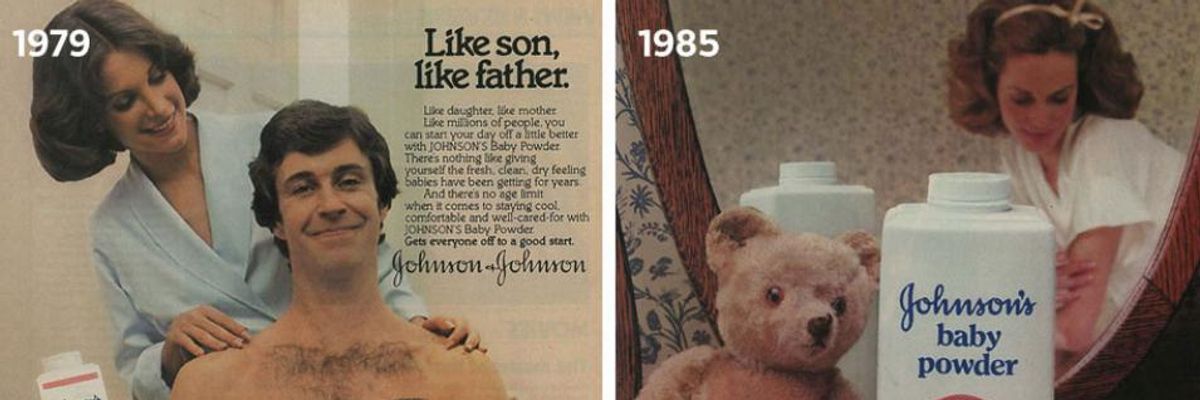
For decades, Reuters noted, "J&J has promoted its iconic Baby Powder as a safe, gentle product for babies and adults alike." (Photo: Reuters)
A Reuters investigation published Friday charges that Johnson & Johnson, a multi-billion dollar company known for its healthcare products, knew for decades that its iconic talcum baby powder "was sometimes tainted with carcinogenic asbestos," but concealed the information from regulators and the public.
Asbestos, "the name given to six minerals that occur naturally in the environment as bundles of fibers," has been used in North America's automotive, construction, and shipbuilding industries since the late 1800s, according to the National Cancer Institute. The World Health Organization (WHO) warns that "all types of asbestos cause lung cancer, mesothelioma, cancer of the larynx and ovary, and asbestosis (fibrosis of the lungs)."
Because asbestos sometimes occurs in the earth along with talc, contamination is possible. Reuters--along with attorneys for more than 11,000 plaintiffs currently suing Johnson & Johnson, claiming the company's products caused their cancer--examined memos, internal reports, and other confidential documents as well as deposition and trial testimony.
That mountain of evidence, according to Reuters, revealed
that from at least 1971 to the early 2000s, the company's raw talc and finished powders sometimes tested positive for small amounts of asbestos, and that company executives, mine managers, scientists, doctors, and lawyers fretted over the problem and how to address it while failing to disclose it to regulators or the public.
The documents also depict successful efforts to influence U.S. regulators' plans to limit asbestos in cosmetic talc products and scientific research on the health effects of talc.
While, over the past two decades, some legal challenges claiming that Johnson & Johnson products were tainted with asbestos and caused cancer have been unsuccessful, three recent developments seem to signal a shift. A pair of cases in New Jersey and California saw significant awards for mesothelioma patients, and a "watershed" verdict in St. Louis expanded the company's potential liability.
Outlining the St. Louis case, Reuters explained:
The 22 plaintiffs were the first to succeed with a claim that asbestos-tainted Baby Powder and Shower to Shower talc, a longtime brand the company sold in 2012, caused ovarian cancer, which is much more common than mesothelioma. The jury awarded them $4.69 billion in damages. Most of the talc cases have been brought by women with ovarian cancer who say they regularly used J&J talc products as a perineal antiperspirant and deodorant.
"When people really understand what's going on," said Mark Lanier, an attorney for one of the plaintiffs, "I think it increases J&J's exposure a thousand-fold."
Johnson & Johnson, as Reuters noted, "has dominated the talc powder market for more than 100 years, its sales outpacing those of all competitors combined... And while talc products contributed just $420 million to J&J's $76.5 billion in revenue last year, Baby Powder is considered an essential facet of the healthcare-products maker's carefully tended image as a caring company--a 'sacred cow,' as one 2003 internal email put it."
Another attorney who's not tied to the cases against Johnson & Johnson concluded on Twitter that the 1970s memos mentioned in Reuters' report are "on par with key docs uncovered in the tobacco litigation."
Journalist Eoin Higgins, also responding on Twitter, simply said: "What a story. What the fuck."
Johnson & Johnson, meanwhile, has vowed to appeal all verdicts against it and maintains that its products are safe. The company's vice president of global media relations, Ernie Knewitz, wrote in an email to Reuters:
Plaintiffs attorneys out for personal financial gain are distorting historical documents and intentionally creating confusion in the courtroom and in the media... This is all a calculated attempt to distract from the fact that thousands of independent tests prove our talc does not contain asbestos or cause cancer. Any suggestion that Johnson & Johnson knew or hid information about the safety of talc is false.
Following the report, the publicly traded company's shares plummeted by more than 11 percent.
Dear Common Dreams reader, It’s been nearly 30 years since I co-founded Common Dreams with my late wife, Lina Newhouser. We had the radical notion that journalism should serve the public good, not corporate profits. It was clear to us from the outset what it would take to build such a project. No paid advertisements. No corporate sponsors. No millionaire publisher telling us what to think or do. Many people said we wouldn't last a year, but we proved those doubters wrong. Together with a tremendous team of journalists and dedicated staff, we built an independent media outlet free from the constraints of profits and corporate control. Our mission has always been simple: To inform. To inspire. To ignite change for the common good. Building Common Dreams was not easy. Our survival was never guaranteed. When you take on the most powerful forces—Wall Street greed, fossil fuel industry destruction, Big Tech lobbyists, and uber-rich oligarchs who have spent billions upon billions rigging the economy and democracy in their favor—the only bulwark you have is supporters who believe in your work. But here’s the urgent message from me today. It's never been this bad out there. And it's never been this hard to keep us going. At the very moment Common Dreams is most needed, the threats we face are intensifying. We need your support now more than ever. We don't accept corporate advertising and never will. We don't have a paywall because we don't think people should be blocked from critical news based on their ability to pay. Everything we do is funded by the donations of readers like you. When everyone does the little they can afford, we are strong. But if that support retreats or dries up, so do we. Will you donate now to make sure Common Dreams not only survives but thrives? —Craig Brown, Co-founder |
A Reuters investigation published Friday charges that Johnson & Johnson, a multi-billion dollar company known for its healthcare products, knew for decades that its iconic talcum baby powder "was sometimes tainted with carcinogenic asbestos," but concealed the information from regulators and the public.
Asbestos, "the name given to six minerals that occur naturally in the environment as bundles of fibers," has been used in North America's automotive, construction, and shipbuilding industries since the late 1800s, according to the National Cancer Institute. The World Health Organization (WHO) warns that "all types of asbestos cause lung cancer, mesothelioma, cancer of the larynx and ovary, and asbestosis (fibrosis of the lungs)."
Because asbestos sometimes occurs in the earth along with talc, contamination is possible. Reuters--along with attorneys for more than 11,000 plaintiffs currently suing Johnson & Johnson, claiming the company's products caused their cancer--examined memos, internal reports, and other confidential documents as well as deposition and trial testimony.
That mountain of evidence, according to Reuters, revealed
that from at least 1971 to the early 2000s, the company's raw talc and finished powders sometimes tested positive for small amounts of asbestos, and that company executives, mine managers, scientists, doctors, and lawyers fretted over the problem and how to address it while failing to disclose it to regulators or the public.
The documents also depict successful efforts to influence U.S. regulators' plans to limit asbestos in cosmetic talc products and scientific research on the health effects of talc.
While, over the past two decades, some legal challenges claiming that Johnson & Johnson products were tainted with asbestos and caused cancer have been unsuccessful, three recent developments seem to signal a shift. A pair of cases in New Jersey and California saw significant awards for mesothelioma patients, and a "watershed" verdict in St. Louis expanded the company's potential liability.
Outlining the St. Louis case, Reuters explained:
The 22 plaintiffs were the first to succeed with a claim that asbestos-tainted Baby Powder and Shower to Shower talc, a longtime brand the company sold in 2012, caused ovarian cancer, which is much more common than mesothelioma. The jury awarded them $4.69 billion in damages. Most of the talc cases have been brought by women with ovarian cancer who say they regularly used J&J talc products as a perineal antiperspirant and deodorant.
"When people really understand what's going on," said Mark Lanier, an attorney for one of the plaintiffs, "I think it increases J&J's exposure a thousand-fold."
Johnson & Johnson, as Reuters noted, "has dominated the talc powder market for more than 100 years, its sales outpacing those of all competitors combined... And while talc products contributed just $420 million to J&J's $76.5 billion in revenue last year, Baby Powder is considered an essential facet of the healthcare-products maker's carefully tended image as a caring company--a 'sacred cow,' as one 2003 internal email put it."
Another attorney who's not tied to the cases against Johnson & Johnson concluded on Twitter that the 1970s memos mentioned in Reuters' report are "on par with key docs uncovered in the tobacco litigation."
Journalist Eoin Higgins, also responding on Twitter, simply said: "What a story. What the fuck."
Johnson & Johnson, meanwhile, has vowed to appeal all verdicts against it and maintains that its products are safe. The company's vice president of global media relations, Ernie Knewitz, wrote in an email to Reuters:
Plaintiffs attorneys out for personal financial gain are distorting historical documents and intentionally creating confusion in the courtroom and in the media... This is all a calculated attempt to distract from the fact that thousands of independent tests prove our talc does not contain asbestos or cause cancer. Any suggestion that Johnson & Johnson knew or hid information about the safety of talc is false.
Following the report, the publicly traded company's shares plummeted by more than 11 percent.
A Reuters investigation published Friday charges that Johnson & Johnson, a multi-billion dollar company known for its healthcare products, knew for decades that its iconic talcum baby powder "was sometimes tainted with carcinogenic asbestos," but concealed the information from regulators and the public.
Asbestos, "the name given to six minerals that occur naturally in the environment as bundles of fibers," has been used in North America's automotive, construction, and shipbuilding industries since the late 1800s, according to the National Cancer Institute. The World Health Organization (WHO) warns that "all types of asbestos cause lung cancer, mesothelioma, cancer of the larynx and ovary, and asbestosis (fibrosis of the lungs)."
Because asbestos sometimes occurs in the earth along with talc, contamination is possible. Reuters--along with attorneys for more than 11,000 plaintiffs currently suing Johnson & Johnson, claiming the company's products caused their cancer--examined memos, internal reports, and other confidential documents as well as deposition and trial testimony.
That mountain of evidence, according to Reuters, revealed
that from at least 1971 to the early 2000s, the company's raw talc and finished powders sometimes tested positive for small amounts of asbestos, and that company executives, mine managers, scientists, doctors, and lawyers fretted over the problem and how to address it while failing to disclose it to regulators or the public.
The documents also depict successful efforts to influence U.S. regulators' plans to limit asbestos in cosmetic talc products and scientific research on the health effects of talc.
While, over the past two decades, some legal challenges claiming that Johnson & Johnson products were tainted with asbestos and caused cancer have been unsuccessful, three recent developments seem to signal a shift. A pair of cases in New Jersey and California saw significant awards for mesothelioma patients, and a "watershed" verdict in St. Louis expanded the company's potential liability.
Outlining the St. Louis case, Reuters explained:
The 22 plaintiffs were the first to succeed with a claim that asbestos-tainted Baby Powder and Shower to Shower talc, a longtime brand the company sold in 2012, caused ovarian cancer, which is much more common than mesothelioma. The jury awarded them $4.69 billion in damages. Most of the talc cases have been brought by women with ovarian cancer who say they regularly used J&J talc products as a perineal antiperspirant and deodorant.
"When people really understand what's going on," said Mark Lanier, an attorney for one of the plaintiffs, "I think it increases J&J's exposure a thousand-fold."
Johnson & Johnson, as Reuters noted, "has dominated the talc powder market for more than 100 years, its sales outpacing those of all competitors combined... And while talc products contributed just $420 million to J&J's $76.5 billion in revenue last year, Baby Powder is considered an essential facet of the healthcare-products maker's carefully tended image as a caring company--a 'sacred cow,' as one 2003 internal email put it."
Another attorney who's not tied to the cases against Johnson & Johnson concluded on Twitter that the 1970s memos mentioned in Reuters' report are "on par with key docs uncovered in the tobacco litigation."
Journalist Eoin Higgins, also responding on Twitter, simply said: "What a story. What the fuck."
Johnson & Johnson, meanwhile, has vowed to appeal all verdicts against it and maintains that its products are safe. The company's vice president of global media relations, Ernie Knewitz, wrote in an email to Reuters:
Plaintiffs attorneys out for personal financial gain are distorting historical documents and intentionally creating confusion in the courtroom and in the media... This is all a calculated attempt to distract from the fact that thousands of independent tests prove our talc does not contain asbestos or cause cancer. Any suggestion that Johnson & Johnson knew or hid information about the safety of talc is false.
Following the report, the publicly traded company's shares plummeted by more than 11 percent.