SUBSCRIBE TO OUR FREE NEWSLETTER
Daily news & progressive opinion—funded by the people, not the corporations—delivered straight to your inbox.
5
#000000
#FFFFFF
To donate by check, phone, or other method, see our More Ways to Give page.
For the first time ever, researchers have tied "climate change triggered by volcanic greenhouse gases" to the largest extinction in Earth's history, often called the "Great Dying," 252 million years ago--and their findings, published Thursday by Science, are just the latest fuel added to the burning concern about the world's current extinction crisis.
"The ultimate, driving change that led to the mass extinction is the same driving change that humans are doing today, which is injecting greenhouse gases into the atmosphere."
--Justin Penn, lead author
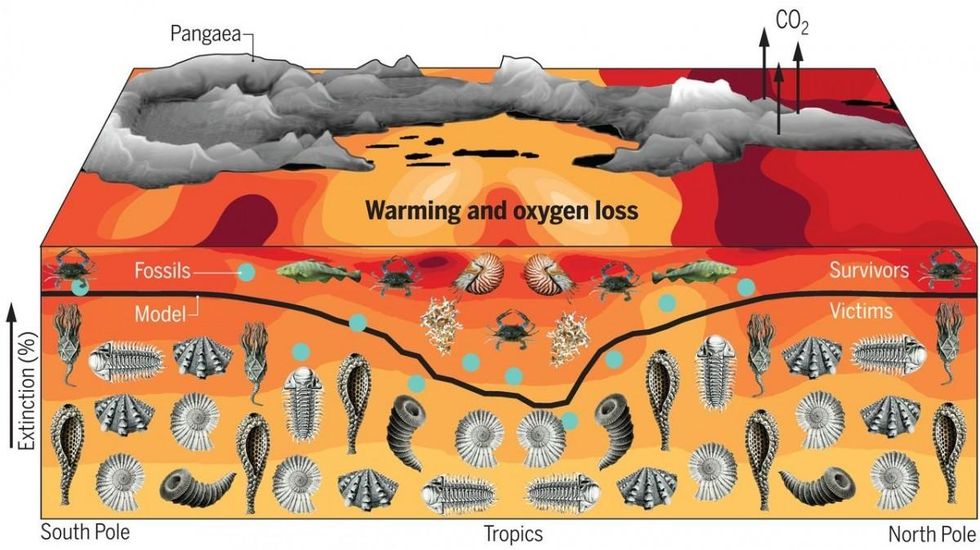
The study adds to a growing body of research on alarming declines in biodiversity, offering a glimpse of what could come of the planet's inhabitants if global warming is allowed to continue unabated. The Great Dying, at the end of the Permian Period, wiped out 96 percent of all marine species and 70 percent of terrestrial species.
"The ultimate, driving change that led to the mass extinction is the same driving change that humans are doing today, which is injecting greenhouse gases into the atmosphere," Justin Penn, a University of Washington doctoral student in oceanography and the study's lead author, told the Seattle Times.
"The study tells us what's at the end of the road if we let climate [change] keep going," warned Curtis Deutsch, Penn's co-author and PhD adviser, as the latest projections show emissions hitting record-breaking levels this year. "The further we go, the more species we're likely to lose... That's frightening. The loss of species is irreversible."
The research team, which also included scientists from Stanford, used a supercomputer to model the impact of greenhouse gases from volcanic eruptions near the end of the Permian Period on the species that existed at that time.
While scientists have long believed the volcanic activity was tied to the mass extinction, as United States Geological Survey geologist and volcanologist Seth Burgess put it, this new research "takes the next step in figuring out why things died at the end of the Permian... It couples what we think was happening in the climate with the fossil record, and it does it elegantly."
The study determined that as ocean waters warmed and oxygen levels fell, marine animals suffocated and died out. "For the first time, we've got a whole lot of confidence that this is what happened," Deutsch told the Guardian. "It's a very strong argument that rising temperatures and oxygen depletion were to blame."
Given the comparisons to current events--scientists are also tracking oxygen depletion in the world's oceans that is happening now, this time due to massive human and industrial carbon emissions--the study has elicited calls for urgent and global action to mitigate the intertwined extinction and climate crises, as world leaders are gathered at COP24 in Poland to discuss how to meet the goals of the Paris agreement.
"Voluminous emissions of carbon dioxide to the atmosphere, rapid global warming, and a decline in biodiversity--the storyline is modern, but the setting is ancient," Penn State geosciences professor Lee Kump, who was not part of the research team, wrote in a Science piece responding to the new findings.
"As our understanding of the drivers and consequences of end-Permian climate change and mass extinction improves," Kump added, "the lessons for the future become clear."
"It's entirely within our control to steer the planet on a different path away from the brink," concluded meteorologist and Grist columnist Eric Holthaus. "Reading about this may make you may feel powerless, but collectively, our choices are the most powerful geological force in our planet's history."
For the first time ever, researchers have tied "climate change triggered by volcanic greenhouse gases" to the largest extinction in Earth's history, often called the "Great Dying," 252 million years ago--and their findings, published Thursday by Science, are just the latest fuel added to the burning concern about the world's current extinction crisis.
"The ultimate, driving change that led to the mass extinction is the same driving change that humans are doing today, which is injecting greenhouse gases into the atmosphere."
--Justin Penn, lead author
The study adds to a growing body of research on alarming declines in biodiversity, offering a glimpse of what could come of the planet's inhabitants if global warming is allowed to continue unabated. The Great Dying, at the end of the Permian Period, wiped out 96 percent of all marine species and 70 percent of terrestrial species.
"The ultimate, driving change that led to the mass extinction is the same driving change that humans are doing today, which is injecting greenhouse gases into the atmosphere," Justin Penn, a University of Washington doctoral student in oceanography and the study's lead author, told the Seattle Times.
"The study tells us what's at the end of the road if we let climate [change] keep going," warned Curtis Deutsch, Penn's co-author and PhD adviser, as the latest projections show emissions hitting record-breaking levels this year. "The further we go, the more species we're likely to lose... That's frightening. The loss of species is irreversible."
The research team, which also included scientists from Stanford, used a supercomputer to model the impact of greenhouse gases from volcanic eruptions near the end of the Permian Period on the species that existed at that time.
While scientists have long believed the volcanic activity was tied to the mass extinction, as United States Geological Survey geologist and volcanologist Seth Burgess put it, this new research "takes the next step in figuring out why things died at the end of the Permian... It couples what we think was happening in the climate with the fossil record, and it does it elegantly."
The study determined that as ocean waters warmed and oxygen levels fell, marine animals suffocated and died out. "For the first time, we've got a whole lot of confidence that this is what happened," Deutsch told the Guardian. "It's a very strong argument that rising temperatures and oxygen depletion were to blame."
Given the comparisons to current events--scientists are also tracking oxygen depletion in the world's oceans that is happening now, this time due to massive human and industrial carbon emissions--the study has elicited calls for urgent and global action to mitigate the intertwined extinction and climate crises, as world leaders are gathered at COP24 in Poland to discuss how to meet the goals of the Paris agreement.
"Voluminous emissions of carbon dioxide to the atmosphere, rapid global warming, and a decline in biodiversity--the storyline is modern, but the setting is ancient," Penn State geosciences professor Lee Kump, who was not part of the research team, wrote in a Science piece responding to the new findings.
"As our understanding of the drivers and consequences of end-Permian climate change and mass extinction improves," Kump added, "the lessons for the future become clear."
"It's entirely within our control to steer the planet on a different path away from the brink," concluded meteorologist and Grist columnist Eric Holthaus. "Reading about this may make you may feel powerless, but collectively, our choices are the most powerful geological force in our planet's history."
For the first time ever, researchers have tied "climate change triggered by volcanic greenhouse gases" to the largest extinction in Earth's history, often called the "Great Dying," 252 million years ago--and their findings, published Thursday by Science, are just the latest fuel added to the burning concern about the world's current extinction crisis.
"The ultimate, driving change that led to the mass extinction is the same driving change that humans are doing today, which is injecting greenhouse gases into the atmosphere."
--Justin Penn, lead author
The study adds to a growing body of research on alarming declines in biodiversity, offering a glimpse of what could come of the planet's inhabitants if global warming is allowed to continue unabated. The Great Dying, at the end of the Permian Period, wiped out 96 percent of all marine species and 70 percent of terrestrial species.
"The ultimate, driving change that led to the mass extinction is the same driving change that humans are doing today, which is injecting greenhouse gases into the atmosphere," Justin Penn, a University of Washington doctoral student in oceanography and the study's lead author, told the Seattle Times.
"The study tells us what's at the end of the road if we let climate [change] keep going," warned Curtis Deutsch, Penn's co-author and PhD adviser, as the latest projections show emissions hitting record-breaking levels this year. "The further we go, the more species we're likely to lose... That's frightening. The loss of species is irreversible."
The research team, which also included scientists from Stanford, used a supercomputer to model the impact of greenhouse gases from volcanic eruptions near the end of the Permian Period on the species that existed at that time.
While scientists have long believed the volcanic activity was tied to the mass extinction, as United States Geological Survey geologist and volcanologist Seth Burgess put it, this new research "takes the next step in figuring out why things died at the end of the Permian... It couples what we think was happening in the climate with the fossil record, and it does it elegantly."
The study determined that as ocean waters warmed and oxygen levels fell, marine animals suffocated and died out. "For the first time, we've got a whole lot of confidence that this is what happened," Deutsch told the Guardian. "It's a very strong argument that rising temperatures and oxygen depletion were to blame."
Given the comparisons to current events--scientists are also tracking oxygen depletion in the world's oceans that is happening now, this time due to massive human and industrial carbon emissions--the study has elicited calls for urgent and global action to mitigate the intertwined extinction and climate crises, as world leaders are gathered at COP24 in Poland to discuss how to meet the goals of the Paris agreement.
"Voluminous emissions of carbon dioxide to the atmosphere, rapid global warming, and a decline in biodiversity--the storyline is modern, but the setting is ancient," Penn State geosciences professor Lee Kump, who was not part of the research team, wrote in a Science piece responding to the new findings.
"As our understanding of the drivers and consequences of end-Permian climate change and mass extinction improves," Kump added, "the lessons for the future become clear."
"It's entirely within our control to steer the planet on a different path away from the brink," concluded meteorologist and Grist columnist Eric Holthaus. "Reading about this may make you may feel powerless, but collectively, our choices are the most powerful geological force in our planet's history."