SUBSCRIBE TO OUR FREE NEWSLETTER
Daily news & progressive opinion—funded by the people, not the corporations—delivered straight to your inbox.
5
#000000
#FFFFFF
To donate by check, phone, or other method, see our More Ways to Give page.
Daily news & progressive opinion—funded by the people, not the corporations—delivered straight to your inbox.
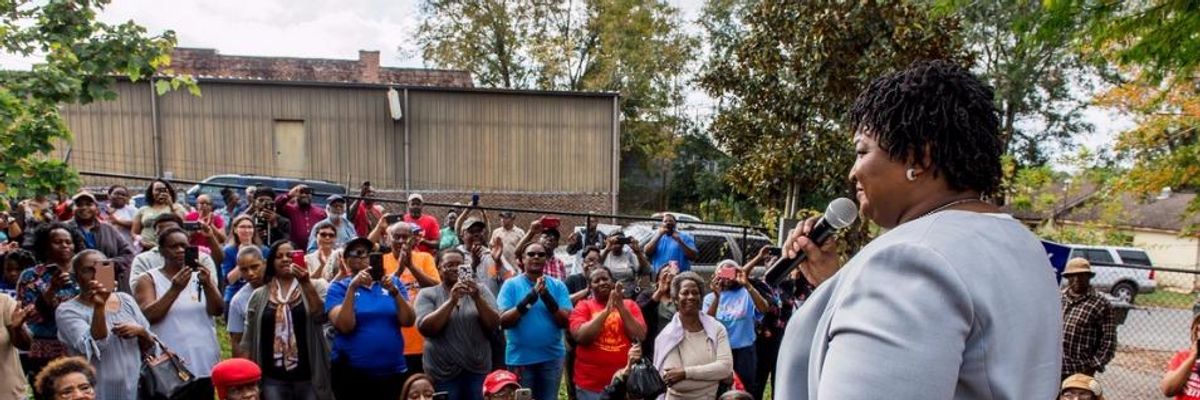
Democrat Stacey Abrams has refused to concede her gubernatorial race to Republican Brian Kemp, citing rampant voter suppression efforts by Kemp's campaign which left provisional ballots uncounted across the state. (Photo: Stacey Abrams/Twitter)
In her fight to ensure every Georgia voter's voice is heard after a campaign marred by rampant voter suppression, Democratic gubernatorial candidate Stacey Abrams is preparing an unprecedented legal challenge in which a court may hear directly from voters about their experiences trying to cast ballots on Election Day.
The Abrams campaign has not said whether it will definitely pursue the challenge, but evidence is being gathered so the team can do so within five days of election certification, as required by Georgia law.
Invoking a statute that has never before been used in a major election in the state, Abrams' team is collecting evidence from across the state that her Republican opponent, Brian Kemp, was behind "misconduct, fraud, or irregularities...sufficient to change or place in doubt the results."
Kemp, who until last Thursday was Georgia's secretary of state and in charge of overseeing its elections, declared himself the winner on November 6, but Abrams has yet to concede the race. She and political observers across the country have argued for months that there is more than enough evidence that Kemp committed gross misconduct.
Operating "as though the secretary of state's taxpayer-funded office [was] an arm of the campaign," as Abrams' campaign manager, Lauren Groh-Wargo, told NPR last week, Kemp kicked more than 100,000 Georgians off the voter rolls and changed 53,000 people's voter status to "pending" due to clerical errors on their registration forms. The vast majority of those who were disenfranchised were African-American.
A federal court ruled this week that all provisional ballots must be counted and blocked election officials from certifying Kemp as the winner until Friday evening. Kemp currently has 50.2 percent of the vote and 18,000 more votes than he needs to avoid a run-off. Abrams is assembling a team of three dozen attorneys who may file a petition asserting that there are very likely far more than 18,000 Georgians who were not permitted to vote or whose ballots were improperly rejected.
After urging supporters to call the state's voter protection hotline to make sure their vote was counted, Abrams' team is gathering affidavits from voters who "describe long lines that discouraged people from voting, poll workers failing to offer provisional ballots to people who didn't show up on the rolls or were at the wrong polling place, and election equipment that froze and had to be rebooted," according to the Associated Press.
Dear Common Dreams reader, It’s been nearly 30 years since I co-founded Common Dreams with my late wife, Lina Newhouser. We had the radical notion that journalism should serve the public good, not corporate profits. It was clear to us from the outset what it would take to build such a project. No paid advertisements. No corporate sponsors. No millionaire publisher telling us what to think or do. Many people said we wouldn't last a year, but we proved those doubters wrong. Together with a tremendous team of journalists and dedicated staff, we built an independent media outlet free from the constraints of profits and corporate control. Our mission has always been simple: To inform. To inspire. To ignite change for the common good. Building Common Dreams was not easy. Our survival was never guaranteed. When you take on the most powerful forces—Wall Street greed, fossil fuel industry destruction, Big Tech lobbyists, and uber-rich oligarchs who have spent billions upon billions rigging the economy and democracy in their favor—the only bulwark you have is supporters who believe in your work. But here’s the urgent message from me today. It's never been this bad out there. And it's never been this hard to keep us going. At the very moment Common Dreams is most needed, the threats we face are intensifying. We need your support now more than ever. We don't accept corporate advertising and never will. We don't have a paywall because we don't think people should be blocked from critical news based on their ability to pay. Everything we do is funded by the donations of readers like you. When everyone does the little they can afford, we are strong. But if that support retreats or dries up, so do we. Will you donate now to make sure Common Dreams not only survives but thrives? —Craig Brown, Co-founder |
In her fight to ensure every Georgia voter's voice is heard after a campaign marred by rampant voter suppression, Democratic gubernatorial candidate Stacey Abrams is preparing an unprecedented legal challenge in which a court may hear directly from voters about their experiences trying to cast ballots on Election Day.
The Abrams campaign has not said whether it will definitely pursue the challenge, but evidence is being gathered so the team can do so within five days of election certification, as required by Georgia law.
Invoking a statute that has never before been used in a major election in the state, Abrams' team is collecting evidence from across the state that her Republican opponent, Brian Kemp, was behind "misconduct, fraud, or irregularities...sufficient to change or place in doubt the results."
Kemp, who until last Thursday was Georgia's secretary of state and in charge of overseeing its elections, declared himself the winner on November 6, but Abrams has yet to concede the race. She and political observers across the country have argued for months that there is more than enough evidence that Kemp committed gross misconduct.
Operating "as though the secretary of state's taxpayer-funded office [was] an arm of the campaign," as Abrams' campaign manager, Lauren Groh-Wargo, told NPR last week, Kemp kicked more than 100,000 Georgians off the voter rolls and changed 53,000 people's voter status to "pending" due to clerical errors on their registration forms. The vast majority of those who were disenfranchised were African-American.
A federal court ruled this week that all provisional ballots must be counted and blocked election officials from certifying Kemp as the winner until Friday evening. Kemp currently has 50.2 percent of the vote and 18,000 more votes than he needs to avoid a run-off. Abrams is assembling a team of three dozen attorneys who may file a petition asserting that there are very likely far more than 18,000 Georgians who were not permitted to vote or whose ballots were improperly rejected.
After urging supporters to call the state's voter protection hotline to make sure their vote was counted, Abrams' team is gathering affidavits from voters who "describe long lines that discouraged people from voting, poll workers failing to offer provisional ballots to people who didn't show up on the rolls or were at the wrong polling place, and election equipment that froze and had to be rebooted," according to the Associated Press.
In her fight to ensure every Georgia voter's voice is heard after a campaign marred by rampant voter suppression, Democratic gubernatorial candidate Stacey Abrams is preparing an unprecedented legal challenge in which a court may hear directly from voters about their experiences trying to cast ballots on Election Day.
The Abrams campaign has not said whether it will definitely pursue the challenge, but evidence is being gathered so the team can do so within five days of election certification, as required by Georgia law.
Invoking a statute that has never before been used in a major election in the state, Abrams' team is collecting evidence from across the state that her Republican opponent, Brian Kemp, was behind "misconduct, fraud, or irregularities...sufficient to change or place in doubt the results."
Kemp, who until last Thursday was Georgia's secretary of state and in charge of overseeing its elections, declared himself the winner on November 6, but Abrams has yet to concede the race. She and political observers across the country have argued for months that there is more than enough evidence that Kemp committed gross misconduct.
Operating "as though the secretary of state's taxpayer-funded office [was] an arm of the campaign," as Abrams' campaign manager, Lauren Groh-Wargo, told NPR last week, Kemp kicked more than 100,000 Georgians off the voter rolls and changed 53,000 people's voter status to "pending" due to clerical errors on their registration forms. The vast majority of those who were disenfranchised were African-American.
A federal court ruled this week that all provisional ballots must be counted and blocked election officials from certifying Kemp as the winner until Friday evening. Kemp currently has 50.2 percent of the vote and 18,000 more votes than he needs to avoid a run-off. Abrams is assembling a team of three dozen attorneys who may file a petition asserting that there are very likely far more than 18,000 Georgians who were not permitted to vote or whose ballots were improperly rejected.
After urging supporters to call the state's voter protection hotline to make sure their vote was counted, Abrams' team is gathering affidavits from voters who "describe long lines that discouraged people from voting, poll workers failing to offer provisional ballots to people who didn't show up on the rolls or were at the wrong polling place, and election equipment that froze and had to be rebooted," according to the Associated Press.