
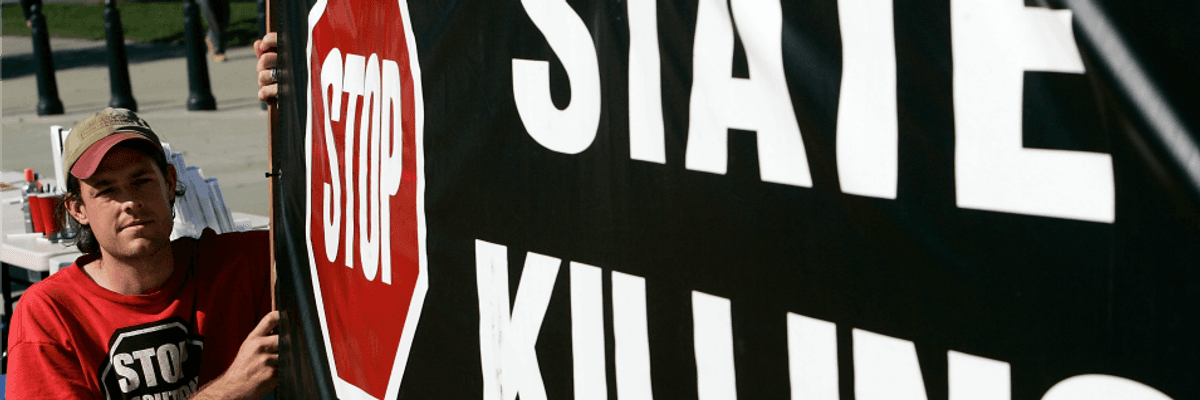
Scott Langley of Boston, Massachusetts, holds a banner during a vigil against the death penalty in front of the U.S. Supreme Court July 1, 2008 in Washington, DC. The Abolitionist Action Committee and the National Coalition to Abolish the Death Penalty held the vigil to abolish the death penalty to mark the 1972 and 1976 Supreme Court rulings suspending the death penalty and later allowing executions to resume. (Photo: Alex Wong/Getty Images)
Citing Arbitrary Use and Racial Bias, Washington Supreme Court Abolishes State's Death Penalty
"This is a hugely important moment in our pursuit for equal and fair application of justice."
Citing racial bias and arbitrary application, the Supreme Court of Washington on Thursday ruled that the use of capital punishment violates the state's Constitution, a decision that will ban the use of the death penalty going forward and immediately commuted the sentences of death-row inmates to life terms.
"Washington's Supreme Court showed courage in refusing to allow racism to infect life and death decisions. Let's hope that courage is contagious." --Jeff Robinson, ACLU"Today's decision by the state Supreme Court thankfully ends the death penalty in Washington," declared Washington's Democratic Governor Jay Inslee in response to the ruling.
"The court makes it perfectly clear that capital punishment in our state has been imposed in an 'arbitrary and racially biased manner,' is 'unequally applied' and serves no criminal justice goal," Inslee added. "This is a hugely important moment in our pursuit for equal and fair application of justice."
The ACLU noted the ruling makes Washington the 20th state in the U.S. to ban the death penalty, but the group said it "won't stop fighting until it's struck down everywhere in America."
As Slate reports:
the court held Thursday that capital punishment is imposed in "an arbitrary and racially biased manner" and "fails to serve any legitimate penological goals." The problems go beyond race: Most prosecutors in the state have stopped seeking the death penalty, so all current capital sentences arise from just six of Washington's 39 counties. The location of your crime may therefore determine whether you live or die. This "random" and "capricious" application of the ultimate punishment, the court ruled, fatally undermines any state interest "retribution and deterrence of capital crimes by prospective offenders."
There are currently eight inmates on Washington's death row. The court converted their sentences to life imprisonment and forbade the state from conducting any further executions. Because its ruling is based entirely in the state constitution, the U.S. Supreme Court cannot overturn it. And the court left no room for future reconsideration of its unanimous decision. Capital punishment is over in Washington State.
Jeff Robinson, deputy legal director and director of the ACLU's Trone Center for Justice at the American Civil Liberties Union, said the court recognized clearly that racial bias remains at the heart of "who should and who should die" in the America's skewed justice system.
"There is nothing unique about the role racism played in Washington's death penalty," said Robinson. "What is rare is the Supreme Court's willingness to call out the truth that has always been there."
Noting that both conscious and unconscious racial bias "plays a role in the death penalty decisions across America, influencing who faces this ultimate punishment, who sits on the jury, what kind of victim impact and mitigation evidence is used, and who is given life or death," Robinson said that this kind of "disparity can be described by many words -- but justice is not one of them."
Human rights groups and other death penalty opponents said they hope that others states, and ultimately the U.S. federal government, will now follow the other twenty states and ban the death penalty nationwide:
"Washington's Supreme Court showed courage in refusing to allow racism to infect life and death decisions," said the ACLU's Robinson. "Let's hope that courage is contagious."
An Urgent Message From Our Co-Founder
Dear Common Dreams reader, It’s been nearly 30 years since I co-founded Common Dreams with my late wife, Lina Newhouser. We had the radical notion that journalism should serve the public good, not corporate profits. It was clear to us from the outset what it would take to build such a project. No paid advertisements. No corporate sponsors. No millionaire publisher telling us what to think or do. Many people said we wouldn't last a year, but we proved those doubters wrong. Together with a tremendous team of journalists and dedicated staff, we built an independent media outlet free from the constraints of profits and corporate control. Our mission has always been simple: To inform. To inspire. To ignite change for the common good. Building Common Dreams was not easy. Our survival was never guaranteed. When you take on the most powerful forces—Wall Street greed, fossil fuel industry destruction, Big Tech lobbyists, and uber-rich oligarchs who have spent billions upon billions rigging the economy and democracy in their favor—the only bulwark you have is supporters who believe in your work. But here’s the urgent message from me today. It's never been this bad out there. And it's never been this hard to keep us going. At the very moment Common Dreams is most needed, the threats we face are intensifying. We need your support now more than ever. We don't accept corporate advertising and never will. We don't have a paywall because we don't think people should be blocked from critical news based on their ability to pay. Everything we do is funded by the donations of readers like you. When everyone does the little they can afford, we are strong. But if that support retreats or dries up, so do we. Will you donate now to make sure Common Dreams not only survives but thrives? —Craig Brown, Co-founder |
Citing racial bias and arbitrary application, the Supreme Court of Washington on Thursday ruled that the use of capital punishment violates the state's Constitution, a decision that will ban the use of the death penalty going forward and immediately commuted the sentences of death-row inmates to life terms.
"Washington's Supreme Court showed courage in refusing to allow racism to infect life and death decisions. Let's hope that courage is contagious." --Jeff Robinson, ACLU"Today's decision by the state Supreme Court thankfully ends the death penalty in Washington," declared Washington's Democratic Governor Jay Inslee in response to the ruling.
"The court makes it perfectly clear that capital punishment in our state has been imposed in an 'arbitrary and racially biased manner,' is 'unequally applied' and serves no criminal justice goal," Inslee added. "This is a hugely important moment in our pursuit for equal and fair application of justice."
The ACLU noted the ruling makes Washington the 20th state in the U.S. to ban the death penalty, but the group said it "won't stop fighting until it's struck down everywhere in America."
As Slate reports:
the court held Thursday that capital punishment is imposed in "an arbitrary and racially biased manner" and "fails to serve any legitimate penological goals." The problems go beyond race: Most prosecutors in the state have stopped seeking the death penalty, so all current capital sentences arise from just six of Washington's 39 counties. The location of your crime may therefore determine whether you live or die. This "random" and "capricious" application of the ultimate punishment, the court ruled, fatally undermines any state interest "retribution and deterrence of capital crimes by prospective offenders."
There are currently eight inmates on Washington's death row. The court converted their sentences to life imprisonment and forbade the state from conducting any further executions. Because its ruling is based entirely in the state constitution, the U.S. Supreme Court cannot overturn it. And the court left no room for future reconsideration of its unanimous decision. Capital punishment is over in Washington State.
Jeff Robinson, deputy legal director and director of the ACLU's Trone Center for Justice at the American Civil Liberties Union, said the court recognized clearly that racial bias remains at the heart of "who should and who should die" in the America's skewed justice system.
"There is nothing unique about the role racism played in Washington's death penalty," said Robinson. "What is rare is the Supreme Court's willingness to call out the truth that has always been there."
Noting that both conscious and unconscious racial bias "plays a role in the death penalty decisions across America, influencing who faces this ultimate punishment, who sits on the jury, what kind of victim impact and mitigation evidence is used, and who is given life or death," Robinson said that this kind of "disparity can be described by many words -- but justice is not one of them."
Human rights groups and other death penalty opponents said they hope that others states, and ultimately the U.S. federal government, will now follow the other twenty states and ban the death penalty nationwide:
"Washington's Supreme Court showed courage in refusing to allow racism to infect life and death decisions," said the ACLU's Robinson. "Let's hope that courage is contagious."
Citing racial bias and arbitrary application, the Supreme Court of Washington on Thursday ruled that the use of capital punishment violates the state's Constitution, a decision that will ban the use of the death penalty going forward and immediately commuted the sentences of death-row inmates to life terms.
"Washington's Supreme Court showed courage in refusing to allow racism to infect life and death decisions. Let's hope that courage is contagious." --Jeff Robinson, ACLU"Today's decision by the state Supreme Court thankfully ends the death penalty in Washington," declared Washington's Democratic Governor Jay Inslee in response to the ruling.
"The court makes it perfectly clear that capital punishment in our state has been imposed in an 'arbitrary and racially biased manner,' is 'unequally applied' and serves no criminal justice goal," Inslee added. "This is a hugely important moment in our pursuit for equal and fair application of justice."
The ACLU noted the ruling makes Washington the 20th state in the U.S. to ban the death penalty, but the group said it "won't stop fighting until it's struck down everywhere in America."
As Slate reports:
the court held Thursday that capital punishment is imposed in "an arbitrary and racially biased manner" and "fails to serve any legitimate penological goals." The problems go beyond race: Most prosecutors in the state have stopped seeking the death penalty, so all current capital sentences arise from just six of Washington's 39 counties. The location of your crime may therefore determine whether you live or die. This "random" and "capricious" application of the ultimate punishment, the court ruled, fatally undermines any state interest "retribution and deterrence of capital crimes by prospective offenders."
There are currently eight inmates on Washington's death row. The court converted their sentences to life imprisonment and forbade the state from conducting any further executions. Because its ruling is based entirely in the state constitution, the U.S. Supreme Court cannot overturn it. And the court left no room for future reconsideration of its unanimous decision. Capital punishment is over in Washington State.
Jeff Robinson, deputy legal director and director of the ACLU's Trone Center for Justice at the American Civil Liberties Union, said the court recognized clearly that racial bias remains at the heart of "who should and who should die" in the America's skewed justice system.
"There is nothing unique about the role racism played in Washington's death penalty," said Robinson. "What is rare is the Supreme Court's willingness to call out the truth that has always been there."
Noting that both conscious and unconscious racial bias "plays a role in the death penalty decisions across America, influencing who faces this ultimate punishment, who sits on the jury, what kind of victim impact and mitigation evidence is used, and who is given life or death," Robinson said that this kind of "disparity can be described by many words -- but justice is not one of them."
Human rights groups and other death penalty opponents said they hope that others states, and ultimately the U.S. federal government, will now follow the other twenty states and ban the death penalty nationwide:
"Washington's Supreme Court showed courage in refusing to allow racism to infect life and death decisions," said the ACLU's Robinson. "Let's hope that courage is contagious."