

SUBSCRIBE TO OUR FREE NEWSLETTER
Daily news & progressive opinion—funded by the people, not the corporations—delivered straight to your inbox.
5
#000000
#FFFFFF
To donate by check, phone, or other method, see our More Ways to Give page.
Daily news & progressive opinion—funded by the people, not the corporations—delivered straight to your inbox.
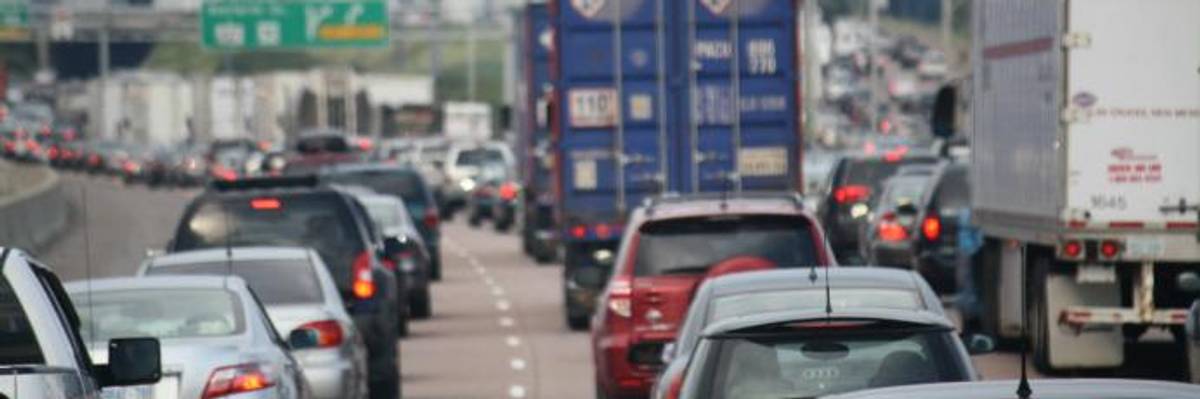
An environmental impact statement published by the Trump administration last month predicts the while its plan to roll back federal rules for cars and light trucks would increase greenhouse gas emissions, as the Washington Post summarized, "that policy would add just a very small drop to a very big, hot bucket." (Photo: Danielle Scott/Flickr/cc)
Despite the Trump administration's own prediction that by the end of this century, the world could warm "a disastrous" 7degF, or about 4degC, above pre-industrial levels, the president has decided not to curb greenhouse gas emissions, but instead to use the devastating findings to justify and intensify his pro-fossil fuel agenda.
"The amazing thing they're saying is human activities are going to lead to this rise of carbon dioxide that is disastrous for the environment and society. And then they're saying they're not going to do anything about it."
--Michael MacCracken, former federal scientist
Buried in a 500-page draft environmental impact statement (pdf) published by the Department of Transportation last month, and highlighted by a Washington Post report on Friday, is the "startling assumption" about just how high the planet's temperature will soar by 2100.
The document was produced by the National Highway Traffic Safety Administration (NHTSA) as a defense of the administration's proposal to roll back greenhouse gas emissions standards for cars and light trucks.
"While the proposal would increase greenhouse gas emissions, the impact statement says, that policy would add just a very small drop to a very big, hot bucket," the Post explained. "The analysis assumes the planet's fate is already sealed."
The document's conclusions, and the Trump administration's subsequent moves to push policies that appease polluting industries at the expense of people and the environment, baffled and alarmed experts.
"The amazing thing they're saying is human activities are going to lead to this rise of carbon dioxide that is disastrous for the environment and society. And then they're saying they're not going to do anything about it," responded Michael MacCracken, who served as a senior scientist at the U.S. Global Change Research Program from 1993 to 2002.
Pennsylvania State University scientist Michael E. Mann noted on Twitter Friday that experts previously have warned that "business-as-usual" emissions would cause the global temperature to rise 4-5degC or 7-9degF by the end of the century, which, as the Post pointed out, would produce "catastrophic" consequences for the planet and its inhabitants.
"With this administration, it's almost as if this science is happening in another galaxy," Rachel Cleetus of the Union of Concerned Scientists told the newspaper. Although federal researchers have clearly asserted in recent research that human activity is producing dangerous planet-warming emissions, as Cleetus put it, "that feedback isn't informing the policy."
Their concerns about the Trump administration come as researchers for the United Nations warn that on a global scale, governments around the world are failing in their efforts to meet the goals of the Paris climate agreement--from which President Donald Trump has vowed to withdraw, even as every other nation on the planet has pledged their support for the accord--which aims to limit global warming to 1.5degC above pre-industrial levels by 2100.
"It's extraordinarily challenging to get to the 1.5degC target and we are nowhere near on track to doing that."
--Drew Shindell, climate scientist
"It's extraordinarily challenging to get to the 1.5degC target and we are nowhere near on track to doing that," Drew Shindell, a Duke University climate scientist and a co-author of the Intergovernmental Panel on Climate Change (IPCC) report that will be unveiled in South Korea early next month, told the Guardian.
"While it's technically possible, it's extremely improbable, absent a real sea change in the way we evaluate risk," he said. "We are nowhere near that."
Although Shindell did not disclose precise details about the forthcoming IPCC report ahead of the U.N. meeting that convenes Oct. 1, he emphasized that policymakers the world over must implement policies to reduce emissions from cars, trucks, and airplanes as well as from fossil fuels--especially coal--by transitioning to clean sources of energy such as solar and wind.
Dear Common Dreams reader, It’s been nearly 30 years since I co-founded Common Dreams with my late wife, Lina Newhouser. We had the radical notion that journalism should serve the public good, not corporate profits. It was clear to us from the outset what it would take to build such a project. No paid advertisements. No corporate sponsors. No millionaire publisher telling us what to think or do. Many people said we wouldn't last a year, but we proved those doubters wrong. Together with a tremendous team of journalists and dedicated staff, we built an independent media outlet free from the constraints of profits and corporate control. Our mission has always been simple: To inform. To inspire. To ignite change for the common good. Building Common Dreams was not easy. Our survival was never guaranteed. When you take on the most powerful forces—Wall Street greed, fossil fuel industry destruction, Big Tech lobbyists, and uber-rich oligarchs who have spent billions upon billions rigging the economy and democracy in their favor—the only bulwark you have is supporters who believe in your work. But here’s the urgent message from me today. It's never been this bad out there. And it's never been this hard to keep us going. At the very moment Common Dreams is most needed, the threats we face are intensifying. We need your support now more than ever. We don't accept corporate advertising and never will. We don't have a paywall because we don't think people should be blocked from critical news based on their ability to pay. Everything we do is funded by the donations of readers like you. When everyone does the little they can afford, we are strong. But if that support retreats or dries up, so do we. Will you donate now to make sure Common Dreams not only survives but thrives? —Craig Brown, Co-founder |
Despite the Trump administration's own prediction that by the end of this century, the world could warm "a disastrous" 7degF, or about 4degC, above pre-industrial levels, the president has decided not to curb greenhouse gas emissions, but instead to use the devastating findings to justify and intensify his pro-fossil fuel agenda.
"The amazing thing they're saying is human activities are going to lead to this rise of carbon dioxide that is disastrous for the environment and society. And then they're saying they're not going to do anything about it."
--Michael MacCracken, former federal scientist
Buried in a 500-page draft environmental impact statement (pdf) published by the Department of Transportation last month, and highlighted by a Washington Post report on Friday, is the "startling assumption" about just how high the planet's temperature will soar by 2100.
The document was produced by the National Highway Traffic Safety Administration (NHTSA) as a defense of the administration's proposal to roll back greenhouse gas emissions standards for cars and light trucks.
"While the proposal would increase greenhouse gas emissions, the impact statement says, that policy would add just a very small drop to a very big, hot bucket," the Post explained. "The analysis assumes the planet's fate is already sealed."
The document's conclusions, and the Trump administration's subsequent moves to push policies that appease polluting industries at the expense of people and the environment, baffled and alarmed experts.
"The amazing thing they're saying is human activities are going to lead to this rise of carbon dioxide that is disastrous for the environment and society. And then they're saying they're not going to do anything about it," responded Michael MacCracken, who served as a senior scientist at the U.S. Global Change Research Program from 1993 to 2002.
Pennsylvania State University scientist Michael E. Mann noted on Twitter Friday that experts previously have warned that "business-as-usual" emissions would cause the global temperature to rise 4-5degC or 7-9degF by the end of the century, which, as the Post pointed out, would produce "catastrophic" consequences for the planet and its inhabitants.
"With this administration, it's almost as if this science is happening in another galaxy," Rachel Cleetus of the Union of Concerned Scientists told the newspaper. Although federal researchers have clearly asserted in recent research that human activity is producing dangerous planet-warming emissions, as Cleetus put it, "that feedback isn't informing the policy."
Their concerns about the Trump administration come as researchers for the United Nations warn that on a global scale, governments around the world are failing in their efforts to meet the goals of the Paris climate agreement--from which President Donald Trump has vowed to withdraw, even as every other nation on the planet has pledged their support for the accord--which aims to limit global warming to 1.5degC above pre-industrial levels by 2100.
"It's extraordinarily challenging to get to the 1.5degC target and we are nowhere near on track to doing that."
--Drew Shindell, climate scientist
"It's extraordinarily challenging to get to the 1.5degC target and we are nowhere near on track to doing that," Drew Shindell, a Duke University climate scientist and a co-author of the Intergovernmental Panel on Climate Change (IPCC) report that will be unveiled in South Korea early next month, told the Guardian.
"While it's technically possible, it's extremely improbable, absent a real sea change in the way we evaluate risk," he said. "We are nowhere near that."
Although Shindell did not disclose precise details about the forthcoming IPCC report ahead of the U.N. meeting that convenes Oct. 1, he emphasized that policymakers the world over must implement policies to reduce emissions from cars, trucks, and airplanes as well as from fossil fuels--especially coal--by transitioning to clean sources of energy such as solar and wind.
Despite the Trump administration's own prediction that by the end of this century, the world could warm "a disastrous" 7degF, or about 4degC, above pre-industrial levels, the president has decided not to curb greenhouse gas emissions, but instead to use the devastating findings to justify and intensify his pro-fossil fuel agenda.
"The amazing thing they're saying is human activities are going to lead to this rise of carbon dioxide that is disastrous for the environment and society. And then they're saying they're not going to do anything about it."
--Michael MacCracken, former federal scientist
Buried in a 500-page draft environmental impact statement (pdf) published by the Department of Transportation last month, and highlighted by a Washington Post report on Friday, is the "startling assumption" about just how high the planet's temperature will soar by 2100.
The document was produced by the National Highway Traffic Safety Administration (NHTSA) as a defense of the administration's proposal to roll back greenhouse gas emissions standards for cars and light trucks.
"While the proposal would increase greenhouse gas emissions, the impact statement says, that policy would add just a very small drop to a very big, hot bucket," the Post explained. "The analysis assumes the planet's fate is already sealed."
The document's conclusions, and the Trump administration's subsequent moves to push policies that appease polluting industries at the expense of people and the environment, baffled and alarmed experts.
"The amazing thing they're saying is human activities are going to lead to this rise of carbon dioxide that is disastrous for the environment and society. And then they're saying they're not going to do anything about it," responded Michael MacCracken, who served as a senior scientist at the U.S. Global Change Research Program from 1993 to 2002.
Pennsylvania State University scientist Michael E. Mann noted on Twitter Friday that experts previously have warned that "business-as-usual" emissions would cause the global temperature to rise 4-5degC or 7-9degF by the end of the century, which, as the Post pointed out, would produce "catastrophic" consequences for the planet and its inhabitants.
"With this administration, it's almost as if this science is happening in another galaxy," Rachel Cleetus of the Union of Concerned Scientists told the newspaper. Although federal researchers have clearly asserted in recent research that human activity is producing dangerous planet-warming emissions, as Cleetus put it, "that feedback isn't informing the policy."
Their concerns about the Trump administration come as researchers for the United Nations warn that on a global scale, governments around the world are failing in their efforts to meet the goals of the Paris climate agreement--from which President Donald Trump has vowed to withdraw, even as every other nation on the planet has pledged their support for the accord--which aims to limit global warming to 1.5degC above pre-industrial levels by 2100.
"It's extraordinarily challenging to get to the 1.5degC target and we are nowhere near on track to doing that."
--Drew Shindell, climate scientist
"It's extraordinarily challenging to get to the 1.5degC target and we are nowhere near on track to doing that," Drew Shindell, a Duke University climate scientist and a co-author of the Intergovernmental Panel on Climate Change (IPCC) report that will be unveiled in South Korea early next month, told the Guardian.
"While it's technically possible, it's extremely improbable, absent a real sea change in the way we evaluate risk," he said. "We are nowhere near that."
Although Shindell did not disclose precise details about the forthcoming IPCC report ahead of the U.N. meeting that convenes Oct. 1, he emphasized that policymakers the world over must implement policies to reduce emissions from cars, trucks, and airplanes as well as from fossil fuels--especially coal--by transitioning to clean sources of energy such as solar and wind.

