SUBSCRIBE TO OUR FREE NEWSLETTER
Daily news & progressive opinion—funded by the people, not the corporations—delivered straight to your inbox.
5
#000000
#FFFFFF
To donate by check, phone, or other method, see our More Ways to Give page.
Daily news & progressive opinion—funded by the people, not the corporations—delivered straight to your inbox.
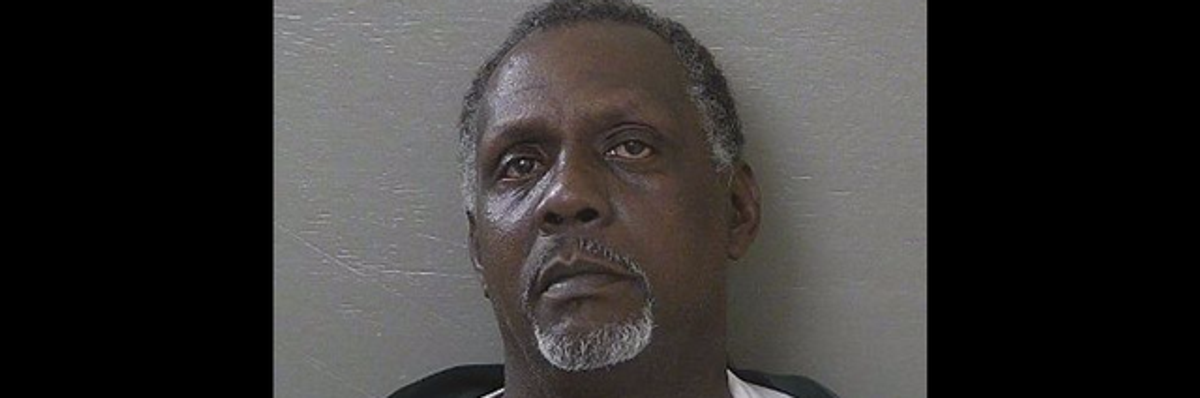
Robert Spellman was sentence last week to 20 years in prison for stealing ten cartons of cigarettes from a local convenience store. (Photo: Escambia County Jail)
Ten years after the behavior of over-leveraged and fraudulent banks created a global financial disaster that resulted in hundreds of billions of dollars in losses; a multi-trillion bailout using public money; and millions of people losing their homes to foreclosure, but saw not one high-level financial executive go to jail, a man in Florida has been sentenced to a 20-year prison term for stealing $600 worth of cigarettes from a local convenience store.
According to the Associated Press, "Robert Spellman, 48, received the lengthy sentence after a jury in Pensacola convicted him of burglary and grand theft last month." As the Pensacola News Journal reports:
He went into the Circle K in the 200 block of West Cervantes Street and took 10 cartons of cigarettes from a locked manager's office in the stock room.
He was found nearby, matched a description of the suspect, was wearing the same clothing and had the cigarettes, according to the State Attorney's Office.
Spellman had 14 felony and 31 misdemeanor convictions prior to this charge, so his 20-year sentence qualifies him as a habitual felony offender.
While the average carton contains 200 cigarettes, that means Spellman will now serve approximately 3.65 days in prison for each of the 2,000 cigarettes he allegedly stole.
Asked in 2016 about why no high-level bankers went to jail after the 2008 crash, former Attorney General Eric Holder lamented that reality by claiming the DOJ just coudn't make the cases stick, though said he wished it had been possible:
Writing about the tenth anniversary of the 2008 crash last month in Rolling Stone, journalist Matt Taibbi noted that while "everyone in the upper echelon of the finance community got Paid In Full in the bailout, even the exact people who screwed up the worst," those whose suffered most of the "miserable story turned out to be poor, nonwhite, and elderly."
Though it's likely that most poor, nonwhite, and elderly Americans didn't need to be told that.
Dear Common Dreams reader, It’s been nearly 30 years since I co-founded Common Dreams with my late wife, Lina Newhouser. We had the radical notion that journalism should serve the public good, not corporate profits. It was clear to us from the outset what it would take to build such a project. No paid advertisements. No corporate sponsors. No millionaire publisher telling us what to think or do. Many people said we wouldn't last a year, but we proved those doubters wrong. Together with a tremendous team of journalists and dedicated staff, we built an independent media outlet free from the constraints of profits and corporate control. Our mission has always been simple: To inform. To inspire. To ignite change for the common good. Building Common Dreams was not easy. Our survival was never guaranteed. When you take on the most powerful forces—Wall Street greed, fossil fuel industry destruction, Big Tech lobbyists, and uber-rich oligarchs who have spent billions upon billions rigging the economy and democracy in their favor—the only bulwark you have is supporters who believe in your work. But here’s the urgent message from me today. It's never been this bad out there. And it's never been this hard to keep us going. At the very moment Common Dreams is most needed, the threats we face are intensifying. We need your support now more than ever. We don't accept corporate advertising and never will. We don't have a paywall because we don't think people should be blocked from critical news based on their ability to pay. Everything we do is funded by the donations of readers like you. When everyone does the little they can afford, we are strong. But if that support retreats or dries up, so do we. Will you donate now to make sure Common Dreams not only survives but thrives? —Craig Brown, Co-founder |
Ten years after the behavior of over-leveraged and fraudulent banks created a global financial disaster that resulted in hundreds of billions of dollars in losses; a multi-trillion bailout using public money; and millions of people losing their homes to foreclosure, but saw not one high-level financial executive go to jail, a man in Florida has been sentenced to a 20-year prison term for stealing $600 worth of cigarettes from a local convenience store.
According to the Associated Press, "Robert Spellman, 48, received the lengthy sentence after a jury in Pensacola convicted him of burglary and grand theft last month." As the Pensacola News Journal reports:
He went into the Circle K in the 200 block of West Cervantes Street and took 10 cartons of cigarettes from a locked manager's office in the stock room.
He was found nearby, matched a description of the suspect, was wearing the same clothing and had the cigarettes, according to the State Attorney's Office.
Spellman had 14 felony and 31 misdemeanor convictions prior to this charge, so his 20-year sentence qualifies him as a habitual felony offender.
While the average carton contains 200 cigarettes, that means Spellman will now serve approximately 3.65 days in prison for each of the 2,000 cigarettes he allegedly stole.
Asked in 2016 about why no high-level bankers went to jail after the 2008 crash, former Attorney General Eric Holder lamented that reality by claiming the DOJ just coudn't make the cases stick, though said he wished it had been possible:
Writing about the tenth anniversary of the 2008 crash last month in Rolling Stone, journalist Matt Taibbi noted that while "everyone in the upper echelon of the finance community got Paid In Full in the bailout, even the exact people who screwed up the worst," those whose suffered most of the "miserable story turned out to be poor, nonwhite, and elderly."
Though it's likely that most poor, nonwhite, and elderly Americans didn't need to be told that.
Ten years after the behavior of over-leveraged and fraudulent banks created a global financial disaster that resulted in hundreds of billions of dollars in losses; a multi-trillion bailout using public money; and millions of people losing their homes to foreclosure, but saw not one high-level financial executive go to jail, a man in Florida has been sentenced to a 20-year prison term for stealing $600 worth of cigarettes from a local convenience store.
According to the Associated Press, "Robert Spellman, 48, received the lengthy sentence after a jury in Pensacola convicted him of burglary and grand theft last month." As the Pensacola News Journal reports:
He went into the Circle K in the 200 block of West Cervantes Street and took 10 cartons of cigarettes from a locked manager's office in the stock room.
He was found nearby, matched a description of the suspect, was wearing the same clothing and had the cigarettes, according to the State Attorney's Office.
Spellman had 14 felony and 31 misdemeanor convictions prior to this charge, so his 20-year sentence qualifies him as a habitual felony offender.
While the average carton contains 200 cigarettes, that means Spellman will now serve approximately 3.65 days in prison for each of the 2,000 cigarettes he allegedly stole.
Asked in 2016 about why no high-level bankers went to jail after the 2008 crash, former Attorney General Eric Holder lamented that reality by claiming the DOJ just coudn't make the cases stick, though said he wished it had been possible:
Writing about the tenth anniversary of the 2008 crash last month in Rolling Stone, journalist Matt Taibbi noted that while "everyone in the upper echelon of the finance community got Paid In Full in the bailout, even the exact people who screwed up the worst," those whose suffered most of the "miserable story turned out to be poor, nonwhite, and elderly."
Though it's likely that most poor, nonwhite, and elderly Americans didn't need to be told that.