SUBSCRIBE TO OUR FREE NEWSLETTER
Daily news & progressive opinion—funded by the people, not the corporations—delivered straight to your inbox.
5
#000000
#FFFFFF
To donate by check, phone, or other method, see our More Ways to Give page.
Daily news & progressive opinion—funded by the people, not the corporations—delivered straight to your inbox.
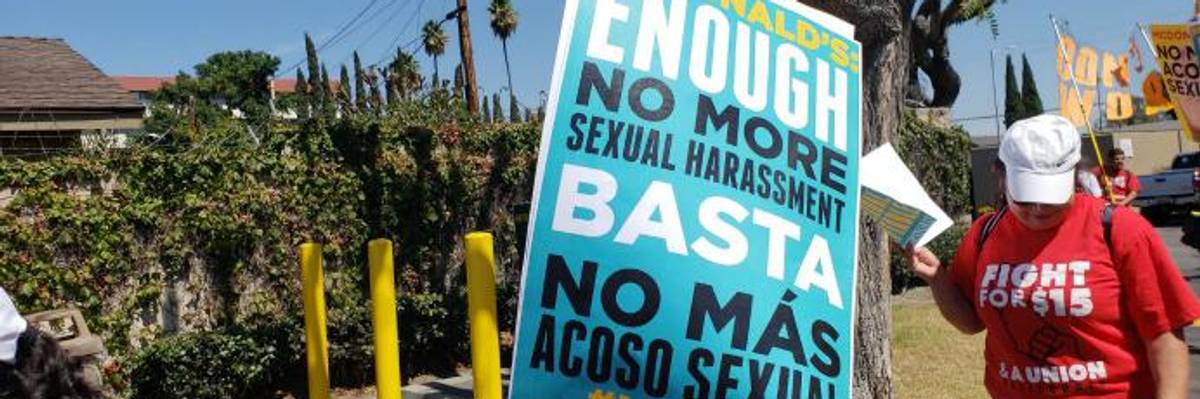
McDonald's workers in Los Angeles marched along with employees across several states to demand the company strengthen its policies to prevent and respond to sexual harassment. (Photo: @FightFor15LA/Twitter)
In the first-ever nationwide strike of its kind for the fast food industry, hundreds of McDonald's workers channeled the power of the #MeToo movement on Tuesday by walking out to protest the company's failure to address the "sexual assault epidemic" at its restaurants.
Protests across 10 major American cities--Chicago, Durham, Kansas City, Los Angeles, Miami, Milwaukee, New Orleans, Orlando, San Francisco, and St Louis--aimed to pressure the company to "strengthen and enforce its zero-tolerance policy against sexual harassment" by holding mandatory trainings, creating an effective system to manage complaints, and forming a committee that includes workers to improve policies.
"Today's action is not just bold, but historic," the Cut reports. "This is the first-ever nationwide strike against sexual harassment, and it's led by working-class women of color in a moment of reckoning that tends to be dominated by accounts of the wealthy and privileged."
Protesters outside McDonald's Chicago headquarters held a five-minute moment of silence "to highlight how we've been silenced too long about sexual harassment." The group also taped their demands to the building doors.
"We're breaking our silence, we're making history," Teresa Cervantes declared at a Chicago rally, "so youth will have a better future." Cervantes has worked for multiple McDonald's restaurants in the Chicago area, and her daughter also works for the company.
McDonald's claims there are "policies, procedures, and training in place that are specifically designed to prevent sexual harassment," but workers say complaints often have been met with indifference or even retaliation.
"All the men feel like they have all the power, so they'll cut your hours. Or if they can't, they'll just make your day a living hell. They make you feel like you are nothing, just because you tried to stand up against them," Adriana Alvarez, who has worked at a Chicago McDonald's for nine years and helped organize the strike, told The New Republic.
Participants in the lunch-time strike shared their stories of experiencing harassment or assault at the hands of customers, fellow employees, and supervisors.
In May, just days before McDonald's annual shareholder meeting, 10 women who worked at the company's restaurants throughout the country--backed by Fight for $15 and the TIMES UP Legal Defense Fund--filed complaints with the U.S. Equal Employment Opportunity Commission (EEOC).
Tanya Harrell, who worked at a McDonald's in Gretna, Louisiana, is one of those 10 women. She told the Guardianshe had multiple coworkers make unwelcome sexual advances: one grabbed her breasts at the restaurant; another pinned her to a bathroom wall and tried to have sex with her. "I felt totally exposed," Harrell said.
"Managers feel it's not their problem," she added. "They don't take it seriously."
As the workers walked off the job in hopes of making McDonald's take complaints more seriously, both Sens. Bernie Sanders (I-Vt.) and Elizabeth Warren (D-Mass.) offered their support for the strike.
Dear Common Dreams reader, It’s been nearly 30 years since I co-founded Common Dreams with my late wife, Lina Newhouser. We had the radical notion that journalism should serve the public good, not corporate profits. It was clear to us from the outset what it would take to build such a project. No paid advertisements. No corporate sponsors. No millionaire publisher telling us what to think or do. Many people said we wouldn't last a year, but we proved those doubters wrong. Together with a tremendous team of journalists and dedicated staff, we built an independent media outlet free from the constraints of profits and corporate control. Our mission has always been simple: To inform. To inspire. To ignite change for the common good. Building Common Dreams was not easy. Our survival was never guaranteed. When you take on the most powerful forces—Wall Street greed, fossil fuel industry destruction, Big Tech lobbyists, and uber-rich oligarchs who have spent billions upon billions rigging the economy and democracy in their favor—the only bulwark you have is supporters who believe in your work. But here’s the urgent message from me today. It's never been this bad out there. And it's never been this hard to keep us going. At the very moment Common Dreams is most needed, the threats we face are intensifying. We need your support now more than ever. We don't accept corporate advertising and never will. We don't have a paywall because we don't think people should be blocked from critical news based on their ability to pay. Everything we do is funded by the donations of readers like you. When everyone does the little they can afford, we are strong. But if that support retreats or dries up, so do we. Will you donate now to make sure Common Dreams not only survives but thrives? —Craig Brown, Co-founder |
In the first-ever nationwide strike of its kind for the fast food industry, hundreds of McDonald's workers channeled the power of the #MeToo movement on Tuesday by walking out to protest the company's failure to address the "sexual assault epidemic" at its restaurants.
Protests across 10 major American cities--Chicago, Durham, Kansas City, Los Angeles, Miami, Milwaukee, New Orleans, Orlando, San Francisco, and St Louis--aimed to pressure the company to "strengthen and enforce its zero-tolerance policy against sexual harassment" by holding mandatory trainings, creating an effective system to manage complaints, and forming a committee that includes workers to improve policies.
"Today's action is not just bold, but historic," the Cut reports. "This is the first-ever nationwide strike against sexual harassment, and it's led by working-class women of color in a moment of reckoning that tends to be dominated by accounts of the wealthy and privileged."
Protesters outside McDonald's Chicago headquarters held a five-minute moment of silence "to highlight how we've been silenced too long about sexual harassment." The group also taped their demands to the building doors.
"We're breaking our silence, we're making history," Teresa Cervantes declared at a Chicago rally, "so youth will have a better future." Cervantes has worked for multiple McDonald's restaurants in the Chicago area, and her daughter also works for the company.
McDonald's claims there are "policies, procedures, and training in place that are specifically designed to prevent sexual harassment," but workers say complaints often have been met with indifference or even retaliation.
"All the men feel like they have all the power, so they'll cut your hours. Or if they can't, they'll just make your day a living hell. They make you feel like you are nothing, just because you tried to stand up against them," Adriana Alvarez, who has worked at a Chicago McDonald's for nine years and helped organize the strike, told The New Republic.
Participants in the lunch-time strike shared their stories of experiencing harassment or assault at the hands of customers, fellow employees, and supervisors.
In May, just days before McDonald's annual shareholder meeting, 10 women who worked at the company's restaurants throughout the country--backed by Fight for $15 and the TIMES UP Legal Defense Fund--filed complaints with the U.S. Equal Employment Opportunity Commission (EEOC).
Tanya Harrell, who worked at a McDonald's in Gretna, Louisiana, is one of those 10 women. She told the Guardianshe had multiple coworkers make unwelcome sexual advances: one grabbed her breasts at the restaurant; another pinned her to a bathroom wall and tried to have sex with her. "I felt totally exposed," Harrell said.
"Managers feel it's not their problem," she added. "They don't take it seriously."
As the workers walked off the job in hopes of making McDonald's take complaints more seriously, both Sens. Bernie Sanders (I-Vt.) and Elizabeth Warren (D-Mass.) offered their support for the strike.
In the first-ever nationwide strike of its kind for the fast food industry, hundreds of McDonald's workers channeled the power of the #MeToo movement on Tuesday by walking out to protest the company's failure to address the "sexual assault epidemic" at its restaurants.
Protests across 10 major American cities--Chicago, Durham, Kansas City, Los Angeles, Miami, Milwaukee, New Orleans, Orlando, San Francisco, and St Louis--aimed to pressure the company to "strengthen and enforce its zero-tolerance policy against sexual harassment" by holding mandatory trainings, creating an effective system to manage complaints, and forming a committee that includes workers to improve policies.
"Today's action is not just bold, but historic," the Cut reports. "This is the first-ever nationwide strike against sexual harassment, and it's led by working-class women of color in a moment of reckoning that tends to be dominated by accounts of the wealthy and privileged."
Protesters outside McDonald's Chicago headquarters held a five-minute moment of silence "to highlight how we've been silenced too long about sexual harassment." The group also taped their demands to the building doors.
"We're breaking our silence, we're making history," Teresa Cervantes declared at a Chicago rally, "so youth will have a better future." Cervantes has worked for multiple McDonald's restaurants in the Chicago area, and her daughter also works for the company.
McDonald's claims there are "policies, procedures, and training in place that are specifically designed to prevent sexual harassment," but workers say complaints often have been met with indifference or even retaliation.
"All the men feel like they have all the power, so they'll cut your hours. Or if they can't, they'll just make your day a living hell. They make you feel like you are nothing, just because you tried to stand up against them," Adriana Alvarez, who has worked at a Chicago McDonald's for nine years and helped organize the strike, told The New Republic.
Participants in the lunch-time strike shared their stories of experiencing harassment or assault at the hands of customers, fellow employees, and supervisors.
In May, just days before McDonald's annual shareholder meeting, 10 women who worked at the company's restaurants throughout the country--backed by Fight for $15 and the TIMES UP Legal Defense Fund--filed complaints with the U.S. Equal Employment Opportunity Commission (EEOC).
Tanya Harrell, who worked at a McDonald's in Gretna, Louisiana, is one of those 10 women. She told the Guardianshe had multiple coworkers make unwelcome sexual advances: one grabbed her breasts at the restaurant; another pinned her to a bathroom wall and tried to have sex with her. "I felt totally exposed," Harrell said.
"Managers feel it's not their problem," she added. "They don't take it seriously."
As the workers walked off the job in hopes of making McDonald's take complaints more seriously, both Sens. Bernie Sanders (I-Vt.) and Elizabeth Warren (D-Mass.) offered their support for the strike.