SUBSCRIBE TO OUR FREE NEWSLETTER
Daily news & progressive opinion—funded by the people, not the corporations—delivered straight to your inbox.
5
#000000
#FFFFFF
To donate by check, phone, or other method, see our More Ways to Give page.
Daily news & progressive opinion—funded by the people, not the corporations—delivered straight to your inbox.
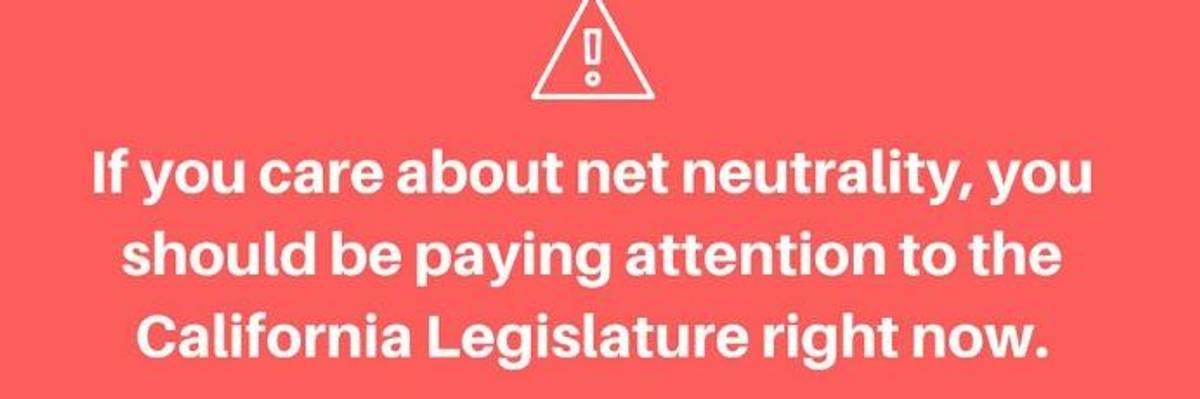
"Yesterday the California Assembly passed the strongest net neutrality bill in the country. But the Senate still has to approve it by midnight tonight," noted the advocacy group Fight for the Future. (Photo: Fight for the Future)
With just hours to go before the end of California's 2018 legislative session, open internet advocates ramped up pressure on the state's senators to ignore the aggressive lobbying of the telecom industry and pass SB 822, which has been described as the strongest net neutrality bill in the country.
If the California Senate fails to approve SB 822 on Friday before the midnight deadline, a final vote on the bill will be delayed until next year, which would prolong the state's fight over net neutrality and possibly leave the measure vulnerable to manipulation by big internet service providers (ISPs) and pro-industry lawmakers.
After celebrating the California Assembly's overwhelming passage of SB 822 Thursday night, the advocacy group Fight for the Future (FFTF) noted that "the Senate must approve it, and ISPs are still lobbying fiercely to defeat it." The Senate is the final hurdle SB 822 must clear before it reaches Gov. Jerry Brown's desk.
With a vote on the net neutrality measure potentially just hours away, the California Cable and Telecommunications Association (CCTA)--the industry's largest state cable and telecommunications association and fervent opponent of SB 822--pleaded with Brown on Twitter to veto the legislation if it makes it out of the Senate.
In response, FFTF expressed confidence that Brown will "listen to the people of California and sign SB 822 into law."
If passed and signed into law, SB 822 would restore the net neutrality protections repealed by the Republican-controlled Federal Communications Commission (FCC) last December and establish strong protections against telecom throttling, price hikes, and content discrimination.
Passage of the measure is also expected to kick off a legal fight with the FCC, which is attempting to bar states from implementing their own net neutrality protections.
Democratic state Sen. Scott Wiener, the primary author of SB 822, declared on Thursday, "We have one final vote left to go to get the strongest net neutrality protections in the nation passed out of the legislature and onto the governor's desk."
Watch a live stream of the vote here:
Dear Common Dreams reader, It’s been nearly 30 years since I co-founded Common Dreams with my late wife, Lina Newhouser. We had the radical notion that journalism should serve the public good, not corporate profits. It was clear to us from the outset what it would take to build such a project. No paid advertisements. No corporate sponsors. No millionaire publisher telling us what to think or do. Many people said we wouldn't last a year, but we proved those doubters wrong. Together with a tremendous team of journalists and dedicated staff, we built an independent media outlet free from the constraints of profits and corporate control. Our mission has always been simple: To inform. To inspire. To ignite change for the common good. Building Common Dreams was not easy. Our survival was never guaranteed. When you take on the most powerful forces—Wall Street greed, fossil fuel industry destruction, Big Tech lobbyists, and uber-rich oligarchs who have spent billions upon billions rigging the economy and democracy in their favor—the only bulwark you have is supporters who believe in your work. But here’s the urgent message from me today. It's never been this bad out there. And it's never been this hard to keep us going. At the very moment Common Dreams is most needed, the threats we face are intensifying. We need your support now more than ever. We don't accept corporate advertising and never will. We don't have a paywall because we don't think people should be blocked from critical news based on their ability to pay. Everything we do is funded by the donations of readers like you. When everyone does the little they can afford, we are strong. But if that support retreats or dries up, so do we. Will you donate now to make sure Common Dreams not only survives but thrives? —Craig Brown, Co-founder |
With just hours to go before the end of California's 2018 legislative session, open internet advocates ramped up pressure on the state's senators to ignore the aggressive lobbying of the telecom industry and pass SB 822, which has been described as the strongest net neutrality bill in the country.
If the California Senate fails to approve SB 822 on Friday before the midnight deadline, a final vote on the bill will be delayed until next year, which would prolong the state's fight over net neutrality and possibly leave the measure vulnerable to manipulation by big internet service providers (ISPs) and pro-industry lawmakers.
After celebrating the California Assembly's overwhelming passage of SB 822 Thursday night, the advocacy group Fight for the Future (FFTF) noted that "the Senate must approve it, and ISPs are still lobbying fiercely to defeat it." The Senate is the final hurdle SB 822 must clear before it reaches Gov. Jerry Brown's desk.
With a vote on the net neutrality measure potentially just hours away, the California Cable and Telecommunications Association (CCTA)--the industry's largest state cable and telecommunications association and fervent opponent of SB 822--pleaded with Brown on Twitter to veto the legislation if it makes it out of the Senate.
In response, FFTF expressed confidence that Brown will "listen to the people of California and sign SB 822 into law."
If passed and signed into law, SB 822 would restore the net neutrality protections repealed by the Republican-controlled Federal Communications Commission (FCC) last December and establish strong protections against telecom throttling, price hikes, and content discrimination.
Passage of the measure is also expected to kick off a legal fight with the FCC, which is attempting to bar states from implementing their own net neutrality protections.
Democratic state Sen. Scott Wiener, the primary author of SB 822, declared on Thursday, "We have one final vote left to go to get the strongest net neutrality protections in the nation passed out of the legislature and onto the governor's desk."
Watch a live stream of the vote here:
With just hours to go before the end of California's 2018 legislative session, open internet advocates ramped up pressure on the state's senators to ignore the aggressive lobbying of the telecom industry and pass SB 822, which has been described as the strongest net neutrality bill in the country.
If the California Senate fails to approve SB 822 on Friday before the midnight deadline, a final vote on the bill will be delayed until next year, which would prolong the state's fight over net neutrality and possibly leave the measure vulnerable to manipulation by big internet service providers (ISPs) and pro-industry lawmakers.
After celebrating the California Assembly's overwhelming passage of SB 822 Thursday night, the advocacy group Fight for the Future (FFTF) noted that "the Senate must approve it, and ISPs are still lobbying fiercely to defeat it." The Senate is the final hurdle SB 822 must clear before it reaches Gov. Jerry Brown's desk.
With a vote on the net neutrality measure potentially just hours away, the California Cable and Telecommunications Association (CCTA)--the industry's largest state cable and telecommunications association and fervent opponent of SB 822--pleaded with Brown on Twitter to veto the legislation if it makes it out of the Senate.
In response, FFTF expressed confidence that Brown will "listen to the people of California and sign SB 822 into law."
If passed and signed into law, SB 822 would restore the net neutrality protections repealed by the Republican-controlled Federal Communications Commission (FCC) last December and establish strong protections against telecom throttling, price hikes, and content discrimination.
Passage of the measure is also expected to kick off a legal fight with the FCC, which is attempting to bar states from implementing their own net neutrality protections.
Democratic state Sen. Scott Wiener, the primary author of SB 822, declared on Thursday, "We have one final vote left to go to get the strongest net neutrality protections in the nation passed out of the legislature and onto the governor's desk."
Watch a live stream of the vote here: