

SUBSCRIBE TO OUR FREE NEWSLETTER
Daily news & progressive opinion—funded by the people, not the corporations—delivered straight to your inbox.
5
#000000
#FFFFFF
To donate by check, phone, or other method, see our More Ways to Give page.
Daily news & progressive opinion—funded by the people, not the corporations—delivered straight to your inbox.
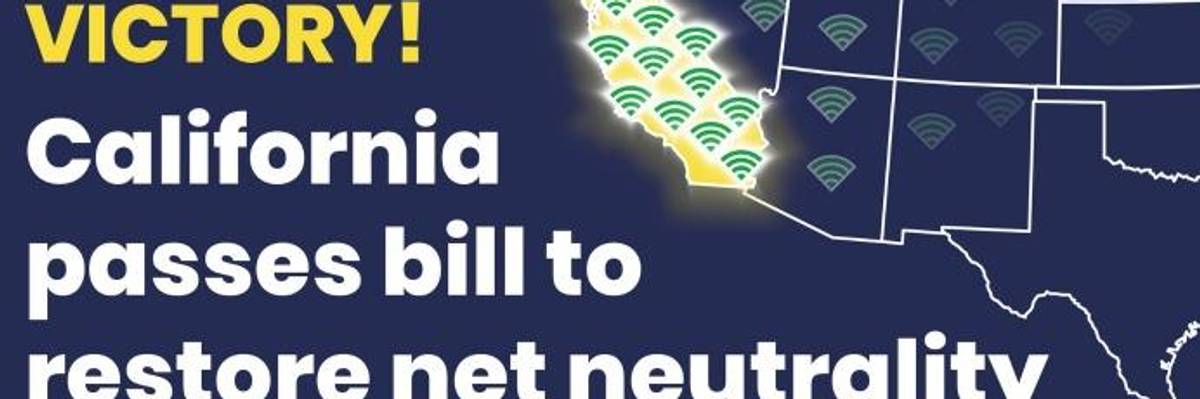
"We did it. We passed the strongest net neutrality standards in the nation," Democratic state Senator Scott Wiener, the primary author of SB 822, said in a statement. (Photo: Fight for the Future)
In a major victory for the open internet that could have ripple effects throughout the United States, the California Senate on Friday thwarted aggressive lobbying by the telecom industry and passed the strongest, most comprehensive net neutrality bill in the nation.
"Internet users are still royally pissed off about the FCC's repeal. And they're not going to let their elected officials get away with it if they sell out their constituents by siding with big telecom companies."
--Evan Greer, Fight for the Future
"The passage of SB 822 in California has huge implications for our fight to restore neutrality nationwide," declared the advocacy group Fight for the Future (FFTF) following Friday's vote. "We also need to harness the momentum from this huge victory to put pressure on our elected officials in Congress."
"Finally," FFTF added, "y'all should be really proud of yourselves. Giant telcos like AT&T and Comcast spent enormous amounts of money lobbying to kill SB 822. They almost succeeded more than once, but we fought back. We drove phone calls, tweets, crowdfunded billboards, attended meetings."
Having cleared both houses of California's legislature, SB 822 will now head to Democratic Gov. Jerry Brown's desk for a signature.
Brown, who has 30 days to sign the measure, is already facing pressure from the telecom industry to veto the bill, so open internet advocates are warning Californians to remain vigilant and keep up the pressure.
If SB 822 is ultimately signed into law, it would restore the net neutrality protections repealed by the Republican-controlled FCC last December and implement even stronger rules by establishing "an outright ban on zero-rating--the practice of offering free data, potentially to the advantage of some companies over others--of specific apps."
"We did it," Democratic state Senator Scott Wiener, the primary author of SB 822, said in a statement. "We passed the strongest net neutrality standards in the nation. The internet is at the heart of 21st century life--our economy, our public safety and health systems, and our democracy. So when Donald Trump's FCC decided to take a wrecking ball to net neutrality protections, we knew that California had to step in to ensure our residents have access to a free and open internet."
As the fight for strong net neutrality protections gains steam at the state level, open internet advocates are hoping the resulting energy and momentum will translate into action in Congress, where the House is working to assemble enough votes to pass a Congressional Review Act resolution to undo the FCC's deeply unpopular repeal.
Evan Greer, deputy director of Fight for the Future, argued that lawmakers who don't support net neutrality will feel the wrath of voters in the upcoming midterm elections and beyond.
"Internet users are still royally pissed off about the FCC's repeal," Greer said in a statement following Friday's vote. "They're still paying attention. And they're not going to let their elected officials get away with it if they sell out their constituents by siding with big telecom companies."
Dear Common Dreams reader, It’s been nearly 30 years since I co-founded Common Dreams with my late wife, Lina Newhouser. We had the radical notion that journalism should serve the public good, not corporate profits. It was clear to us from the outset what it would take to build such a project. No paid advertisements. No corporate sponsors. No millionaire publisher telling us what to think or do. Many people said we wouldn't last a year, but we proved those doubters wrong. Together with a tremendous team of journalists and dedicated staff, we built an independent media outlet free from the constraints of profits and corporate control. Our mission has always been simple: To inform. To inspire. To ignite change for the common good. Building Common Dreams was not easy. Our survival was never guaranteed. When you take on the most powerful forces—Wall Street greed, fossil fuel industry destruction, Big Tech lobbyists, and uber-rich oligarchs who have spent billions upon billions rigging the economy and democracy in their favor—the only bulwark you have is supporters who believe in your work. But here’s the urgent message from me today. It's never been this bad out there. And it's never been this hard to keep us going. At the very moment Common Dreams is most needed, the threats we face are intensifying. We need your support now more than ever. We don't accept corporate advertising and never will. We don't have a paywall because we don't think people should be blocked from critical news based on their ability to pay. Everything we do is funded by the donations of readers like you. When everyone does the little they can afford, we are strong. But if that support retreats or dries up, so do we. Will you donate now to make sure Common Dreams not only survives but thrives? —Craig Brown, Co-founder |
In a major victory for the open internet that could have ripple effects throughout the United States, the California Senate on Friday thwarted aggressive lobbying by the telecom industry and passed the strongest, most comprehensive net neutrality bill in the nation.
"Internet users are still royally pissed off about the FCC's repeal. And they're not going to let their elected officials get away with it if they sell out their constituents by siding with big telecom companies."
--Evan Greer, Fight for the Future
"The passage of SB 822 in California has huge implications for our fight to restore neutrality nationwide," declared the advocacy group Fight for the Future (FFTF) following Friday's vote. "We also need to harness the momentum from this huge victory to put pressure on our elected officials in Congress."
"Finally," FFTF added, "y'all should be really proud of yourselves. Giant telcos like AT&T and Comcast spent enormous amounts of money lobbying to kill SB 822. They almost succeeded more than once, but we fought back. We drove phone calls, tweets, crowdfunded billboards, attended meetings."
Having cleared both houses of California's legislature, SB 822 will now head to Democratic Gov. Jerry Brown's desk for a signature.
Brown, who has 30 days to sign the measure, is already facing pressure from the telecom industry to veto the bill, so open internet advocates are warning Californians to remain vigilant and keep up the pressure.
If SB 822 is ultimately signed into law, it would restore the net neutrality protections repealed by the Republican-controlled FCC last December and implement even stronger rules by establishing "an outright ban on zero-rating--the practice of offering free data, potentially to the advantage of some companies over others--of specific apps."
"We did it," Democratic state Senator Scott Wiener, the primary author of SB 822, said in a statement. "We passed the strongest net neutrality standards in the nation. The internet is at the heart of 21st century life--our economy, our public safety and health systems, and our democracy. So when Donald Trump's FCC decided to take a wrecking ball to net neutrality protections, we knew that California had to step in to ensure our residents have access to a free and open internet."
As the fight for strong net neutrality protections gains steam at the state level, open internet advocates are hoping the resulting energy and momentum will translate into action in Congress, where the House is working to assemble enough votes to pass a Congressional Review Act resolution to undo the FCC's deeply unpopular repeal.
Evan Greer, deputy director of Fight for the Future, argued that lawmakers who don't support net neutrality will feel the wrath of voters in the upcoming midterm elections and beyond.
"Internet users are still royally pissed off about the FCC's repeal," Greer said in a statement following Friday's vote. "They're still paying attention. And they're not going to let their elected officials get away with it if they sell out their constituents by siding with big telecom companies."
In a major victory for the open internet that could have ripple effects throughout the United States, the California Senate on Friday thwarted aggressive lobbying by the telecom industry and passed the strongest, most comprehensive net neutrality bill in the nation.
"Internet users are still royally pissed off about the FCC's repeal. And they're not going to let their elected officials get away with it if they sell out their constituents by siding with big telecom companies."
--Evan Greer, Fight for the Future
"The passage of SB 822 in California has huge implications for our fight to restore neutrality nationwide," declared the advocacy group Fight for the Future (FFTF) following Friday's vote. "We also need to harness the momentum from this huge victory to put pressure on our elected officials in Congress."
"Finally," FFTF added, "y'all should be really proud of yourselves. Giant telcos like AT&T and Comcast spent enormous amounts of money lobbying to kill SB 822. They almost succeeded more than once, but we fought back. We drove phone calls, tweets, crowdfunded billboards, attended meetings."
Having cleared both houses of California's legislature, SB 822 will now head to Democratic Gov. Jerry Brown's desk for a signature.
Brown, who has 30 days to sign the measure, is already facing pressure from the telecom industry to veto the bill, so open internet advocates are warning Californians to remain vigilant and keep up the pressure.
If SB 822 is ultimately signed into law, it would restore the net neutrality protections repealed by the Republican-controlled FCC last December and implement even stronger rules by establishing "an outright ban on zero-rating--the practice of offering free data, potentially to the advantage of some companies over others--of specific apps."
"We did it," Democratic state Senator Scott Wiener, the primary author of SB 822, said in a statement. "We passed the strongest net neutrality standards in the nation. The internet is at the heart of 21st century life--our economy, our public safety and health systems, and our democracy. So when Donald Trump's FCC decided to take a wrecking ball to net neutrality protections, we knew that California had to step in to ensure our residents have access to a free and open internet."
As the fight for strong net neutrality protections gains steam at the state level, open internet advocates are hoping the resulting energy and momentum will translate into action in Congress, where the House is working to assemble enough votes to pass a Congressional Review Act resolution to undo the FCC's deeply unpopular repeal.
Evan Greer, deputy director of Fight for the Future, argued that lawmakers who don't support net neutrality will feel the wrath of voters in the upcoming midterm elections and beyond.
"Internet users are still royally pissed off about the FCC's repeal," Greer said in a statement following Friday's vote. "They're still paying attention. And they're not going to let their elected officials get away with it if they sell out their constituents by siding with big telecom companies."

