


Closing in on a major defeat for the powerful corporate interests trying to wrest control of how the internet functions, the California Assembly on Thursday night overwhelmingly passed SB 822, a bill that proponents have call "the strongest and most comprehensive state level net neutrality bill in the country."
" Net neutrality is not dead. It's coming back with a vengeance." --Evan Greer, Fight for the Future
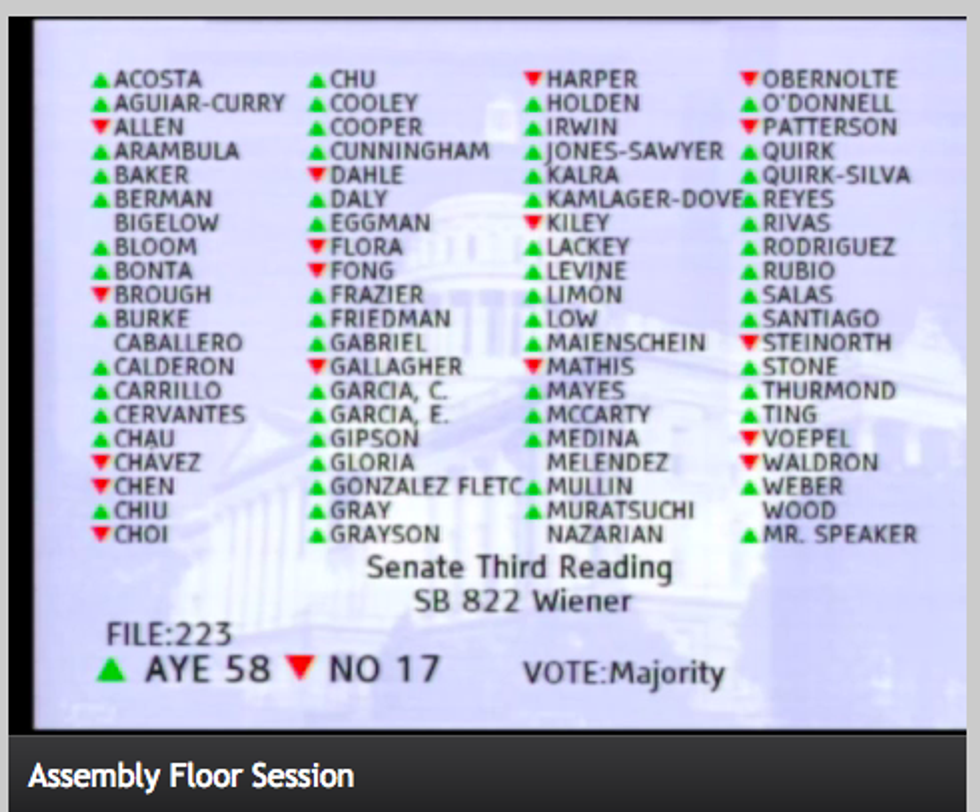
Made necessary by the GOP-controlled FCC's decision to roll back the federal rules that protect large internet service providers (ISPs) from throttling online content or creating preferential pathways on the internet, the bill passed with bipartisan support in the Democratic-controlled chamber by a vote of 58 to 17.
Sen. Scott Wiener (D-San Francisco), who introduced the legislation, said the lopsided vote was proof that the bill--which explicitly prohibits ISPs from blocking or throttling apps, websites, and other online services and also bans paid prioritization of data or content--is resoundingly popularity.
"People want this," Wiener said. "It is not controversial. The vote today reflected that."
What the final roll call looked like:
"This victory belongs to the Internet," declared Fight for the Future, one of the leading members of a large coalition that has fought relentlessly to push back against the FCC's decision, both at the state level and federally. "Net Neutrality is coming back. It's only a matter of time," the group said.
"No one wants their cable or phone company to control what they see and do on the Internet," said Evan Greer, FFTF's deputy director. "California just took a huge step toward restoring protections that prevent companies like AT&T and Comcast from screwing us all over more than they already do. Big ISPs spent millions on campaign contributions, lobbyists, and dark ads on social networks, but in the end it was no match for the passion and dedication of net neutrality supporters using the Internet to sound the alarm and mobilize."
"We're in the home stretch here. California could pass a gold standard net neutrality bill, providing a template for states going forward. California can prove that ISP money can't defeat real peoples voices." --Electronic Frontier FoundationAfter its passage but detailing the effort of the major telecom companies to kill the bill, the Electronic Frontier Foundation in a statement celebrated the organized grassroots effort--both online and off--that deserves credit for what California lawmakers are nowon the verge of achieving.
"ISPs have tried hard to gut and kill this bill, pouring money and robocalls into California," the group declared. "There was a moment where that campaign looked like it might have been successful, but you spoke out and got strong net neutrality protections restored. But that hiccup means that, although a version of the bill already passed in the California Senate, it's now different enough from that initial version to have to be re-voted on."
And concluded, "We're in the home stretch here. California could pass a gold standard net neutrality bill, providing a template for states going forward. California can prove that ISP money can't defeat real peoples voices."
The bill nows head immediately to the state Senate, but it must be passed before a midnight deadline in order to reach the governor's desk for signature before the current legislative session ends.
"The California Senate must immediately approve this measure and we hope and expect that Governor Brown will sign it," said FFTF's Greer.
In addition, Greer added, "other states should then follow California's lead, and Congress should pass the Congressional Review Act (CRA) resolution to restore common sense protections that never should have been repealed in the first place.
"Net neutrality is not dead," she concluded. "It's coming back with a vengeance."
Closing in on a major defeat for the powerful corporate interests trying to wrest control of how the internet functions, the California Assembly on Thursday night overwhelmingly passed SB 822, a bill that proponents have call "the strongest and most comprehensive state level net neutrality bill in the country."
" Net neutrality is not dead. It's coming back with a vengeance." --Evan Greer, Fight for the Future
Made necessary by the GOP-controlled FCC's decision to roll back the federal rules that protect large internet service providers (ISPs) from throttling online content or creating preferential pathways on the internet, the bill passed with bipartisan support in the Democratic-controlled chamber by a vote of 58 to 17.
Sen. Scott Wiener (D-San Francisco), who introduced the legislation, said the lopsided vote was proof that the bill--which explicitly prohibits ISPs from blocking or throttling apps, websites, and other online services and also bans paid prioritization of data or content--is resoundingly popularity.
"People want this," Wiener said. "It is not controversial. The vote today reflected that."
What the final roll call looked like:
"This victory belongs to the Internet," declared Fight for the Future, one of the leading members of a large coalition that has fought relentlessly to push back against the FCC's decision, both at the state level and federally. "Net Neutrality is coming back. It's only a matter of time," the group said.
"No one wants their cable or phone company to control what they see and do on the Internet," said Evan Greer, FFTF's deputy director. "California just took a huge step toward restoring protections that prevent companies like AT&T and Comcast from screwing us all over more than they already do. Big ISPs spent millions on campaign contributions, lobbyists, and dark ads on social networks, but in the end it was no match for the passion and dedication of net neutrality supporters using the Internet to sound the alarm and mobilize."
"We're in the home stretch here. California could pass a gold standard net neutrality bill, providing a template for states going forward. California can prove that ISP money can't defeat real peoples voices." --Electronic Frontier FoundationAfter its passage but detailing the effort of the major telecom companies to kill the bill, the Electronic Frontier Foundation in a statement celebrated the organized grassroots effort--both online and off--that deserves credit for what California lawmakers are nowon the verge of achieving.
"ISPs have tried hard to gut and kill this bill, pouring money and robocalls into California," the group declared. "There was a moment where that campaign looked like it might have been successful, but you spoke out and got strong net neutrality protections restored. But that hiccup means that, although a version of the bill already passed in the California Senate, it's now different enough from that initial version to have to be re-voted on."
And concluded, "We're in the home stretch here. California could pass a gold standard net neutrality bill, providing a template for states going forward. California can prove that ISP money can't defeat real peoples voices."
The bill nows head immediately to the state Senate, but it must be passed before a midnight deadline in order to reach the governor's desk for signature before the current legislative session ends.
"The California Senate must immediately approve this measure and we hope and expect that Governor Brown will sign it," said FFTF's Greer.
In addition, Greer added, "other states should then follow California's lead, and Congress should pass the Congressional Review Act (CRA) resolution to restore common sense protections that never should have been repealed in the first place.
"Net neutrality is not dead," she concluded. "It's coming back with a vengeance."
Closing in on a major defeat for the powerful corporate interests trying to wrest control of how the internet functions, the California Assembly on Thursday night overwhelmingly passed SB 822, a bill that proponents have call "the strongest and most comprehensive state level net neutrality bill in the country."
" Net neutrality is not dead. It's coming back with a vengeance." --Evan Greer, Fight for the Future
Made necessary by the GOP-controlled FCC's decision to roll back the federal rules that protect large internet service providers (ISPs) from throttling online content or creating preferential pathways on the internet, the bill passed with bipartisan support in the Democratic-controlled chamber by a vote of 58 to 17.
Sen. Scott Wiener (D-San Francisco), who introduced the legislation, said the lopsided vote was proof that the bill--which explicitly prohibits ISPs from blocking or throttling apps, websites, and other online services and also bans paid prioritization of data or content--is resoundingly popularity.
"People want this," Wiener said. "It is not controversial. The vote today reflected that."
What the final roll call looked like:
"This victory belongs to the Internet," declared Fight for the Future, one of the leading members of a large coalition that has fought relentlessly to push back against the FCC's decision, both at the state level and federally. "Net Neutrality is coming back. It's only a matter of time," the group said.
"No one wants their cable or phone company to control what they see and do on the Internet," said Evan Greer, FFTF's deputy director. "California just took a huge step toward restoring protections that prevent companies like AT&T and Comcast from screwing us all over more than they already do. Big ISPs spent millions on campaign contributions, lobbyists, and dark ads on social networks, but in the end it was no match for the passion and dedication of net neutrality supporters using the Internet to sound the alarm and mobilize."
"We're in the home stretch here. California could pass a gold standard net neutrality bill, providing a template for states going forward. California can prove that ISP money can't defeat real peoples voices." --Electronic Frontier FoundationAfter its passage but detailing the effort of the major telecom companies to kill the bill, the Electronic Frontier Foundation in a statement celebrated the organized grassroots effort--both online and off--that deserves credit for what California lawmakers are nowon the verge of achieving.
"ISPs have tried hard to gut and kill this bill, pouring money and robocalls into California," the group declared. "There was a moment where that campaign looked like it might have been successful, but you spoke out and got strong net neutrality protections restored. But that hiccup means that, although a version of the bill already passed in the California Senate, it's now different enough from that initial version to have to be re-voted on."
And concluded, "We're in the home stretch here. California could pass a gold standard net neutrality bill, providing a template for states going forward. California can prove that ISP money can't defeat real peoples voices."
The bill nows head immediately to the state Senate, but it must be passed before a midnight deadline in order to reach the governor's desk for signature before the current legislative session ends.
"The California Senate must immediately approve this measure and we hope and expect that Governor Brown will sign it," said FFTF's Greer.
In addition, Greer added, "other states should then follow California's lead, and Congress should pass the Congressional Review Act (CRA) resolution to restore common sense protections that never should have been repealed in the first place.
"Net neutrality is not dead," she concluded. "It's coming back with a vengeance."