SUBSCRIBE TO OUR FREE NEWSLETTER
Daily news & progressive opinion—funded by the people, not the corporations—delivered straight to your inbox.
5
#000000
#FFFFFF
To donate by check, phone, or other method, see our More Ways to Give page.
Daily news & progressive opinion—funded by the people, not the corporations—delivered straight to your inbox.
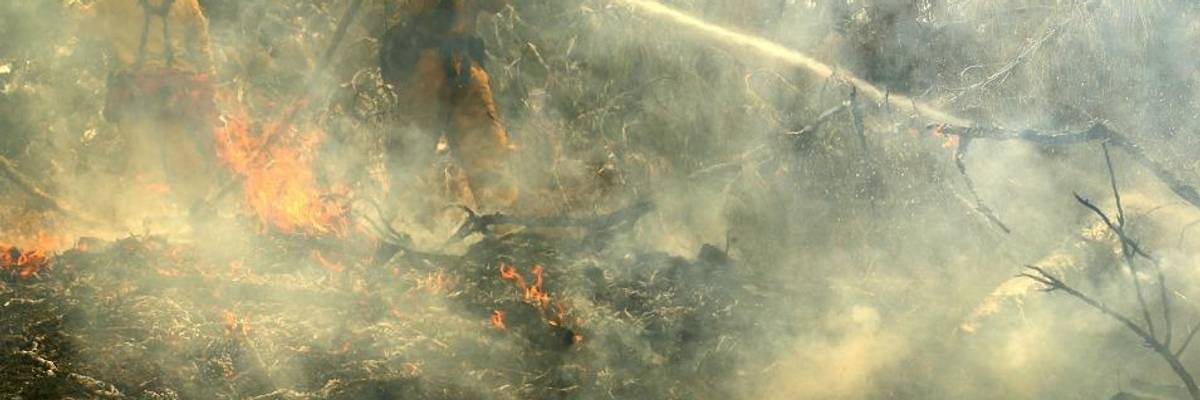
President Donald Trump partially blamed low availability of water for the wildfires that have spread across California in a tweet on Sunday. (Photo: Justin Sullivan/Getty Images)
In his first public statement on the wildfires that have ravaged over 150,000 acres in California, President Donald Trump confounded and frustrated many on social media with a tweet blaming California's "bad environmental laws" for the blazes.
While climate scientists in recent weeks have stated that above-average temperatures in the state throughout the summer, driven by the climate crisis, have created conditions in which wildfires have spread rapidly and have been difficult to control, the president spouted out right-wing talking points in response to the disasters.
"Even if we eliminated all habitat for riparian species and fish, and allowed saltwater intrusion into the delta and set up a sprinkler system over the state, that wouldn't compensate for greater moisture loss from climate change," Professor LeRoy Westerling, who researches wildfire and climatology at University of California-Merced, told the San Francisco Chronicle in response to Trump's theory.
Alex Hall, a climate scientist at UCLA, told the New York Times that while the causes of wildfires can be complex, sustained high temperatures contribute to their rapid spread.
"What has been really unusual in the Western U.S. this summer has been the sustained heat," Hall told the Times last week. "It really pulls water out of vegetation, and that sets up conditions for big fires."
While many on Twitter saw Trump's latest tweet as a topic for ridicule, Christian Science Monitor journalist Dan Murphy called the president's statement "vile, repugnant, and dangerous" in its inaccuracy--especially considering Trump's attempts to undermine climate action that would help to stem the climate crisis.
As Murphy mentions, the president appeared to reference an argument made by Republicans about building more dams as a means to reduce the damage of California's droughts. Fourteen Republican lawmakers appealed to the California Water Commission last year to secure funding for a $3 billion dam proposal on the San Joaquin River.
But as science columnist Michael Hiltzik wrote in the Los Angeles Times in May, dam-building has fallen out of favor in the U.S. in recent decades, due to "recognition that dams are expensive, environmentally disastrous, and offer benefits that are frequently oversold and fade away over time."
Additionally, firefighters who have battled the Carr and the Mendocino Complex fires in northern California have not reported a lack of water to fight the blazes.
According to Climate Central reporter John Upton, Trump's call to "tree clear" was a likely reference to the logging industry--which the president has sought to help before in his attacks on national monuments.
But Trump's worst offense, critics said, was ignoring the reality of the climate crisis days after taking steps to make it harder for California to regulate auto emissions--likely helping to make out-of-control, deadly wildfires a fact of life for Californians in years to come.
Dear Common Dreams reader, It’s been nearly 30 years since I co-founded Common Dreams with my late wife, Lina Newhouser. We had the radical notion that journalism should serve the public good, not corporate profits. It was clear to us from the outset what it would take to build such a project. No paid advertisements. No corporate sponsors. No millionaire publisher telling us what to think or do. Many people said we wouldn't last a year, but we proved those doubters wrong. Together with a tremendous team of journalists and dedicated staff, we built an independent media outlet free from the constraints of profits and corporate control. Our mission has always been simple: To inform. To inspire. To ignite change for the common good. Building Common Dreams was not easy. Our survival was never guaranteed. When you take on the most powerful forces—Wall Street greed, fossil fuel industry destruction, Big Tech lobbyists, and uber-rich oligarchs who have spent billions upon billions rigging the economy and democracy in their favor—the only bulwark you have is supporters who believe in your work. But here’s the urgent message from me today. It's never been this bad out there. And it's never been this hard to keep us going. At the very moment Common Dreams is most needed, the threats we face are intensifying. We need your support now more than ever. We don't accept corporate advertising and never will. We don't have a paywall because we don't think people should be blocked from critical news based on their ability to pay. Everything we do is funded by the donations of readers like you. When everyone does the little they can afford, we are strong. But if that support retreats or dries up, so do we. Will you donate now to make sure Common Dreams not only survives but thrives? —Craig Brown, Co-founder |
In his first public statement on the wildfires that have ravaged over 150,000 acres in California, President Donald Trump confounded and frustrated many on social media with a tweet blaming California's "bad environmental laws" for the blazes.
While climate scientists in recent weeks have stated that above-average temperatures in the state throughout the summer, driven by the climate crisis, have created conditions in which wildfires have spread rapidly and have been difficult to control, the president spouted out right-wing talking points in response to the disasters.
"Even if we eliminated all habitat for riparian species and fish, and allowed saltwater intrusion into the delta and set up a sprinkler system over the state, that wouldn't compensate for greater moisture loss from climate change," Professor LeRoy Westerling, who researches wildfire and climatology at University of California-Merced, told the San Francisco Chronicle in response to Trump's theory.
Alex Hall, a climate scientist at UCLA, told the New York Times that while the causes of wildfires can be complex, sustained high temperatures contribute to their rapid spread.
"What has been really unusual in the Western U.S. this summer has been the sustained heat," Hall told the Times last week. "It really pulls water out of vegetation, and that sets up conditions for big fires."
While many on Twitter saw Trump's latest tweet as a topic for ridicule, Christian Science Monitor journalist Dan Murphy called the president's statement "vile, repugnant, and dangerous" in its inaccuracy--especially considering Trump's attempts to undermine climate action that would help to stem the climate crisis.
As Murphy mentions, the president appeared to reference an argument made by Republicans about building more dams as a means to reduce the damage of California's droughts. Fourteen Republican lawmakers appealed to the California Water Commission last year to secure funding for a $3 billion dam proposal on the San Joaquin River.
But as science columnist Michael Hiltzik wrote in the Los Angeles Times in May, dam-building has fallen out of favor in the U.S. in recent decades, due to "recognition that dams are expensive, environmentally disastrous, and offer benefits that are frequently oversold and fade away over time."
Additionally, firefighters who have battled the Carr and the Mendocino Complex fires in northern California have not reported a lack of water to fight the blazes.
According to Climate Central reporter John Upton, Trump's call to "tree clear" was a likely reference to the logging industry--which the president has sought to help before in his attacks on national monuments.
But Trump's worst offense, critics said, was ignoring the reality of the climate crisis days after taking steps to make it harder for California to regulate auto emissions--likely helping to make out-of-control, deadly wildfires a fact of life for Californians in years to come.
In his first public statement on the wildfires that have ravaged over 150,000 acres in California, President Donald Trump confounded and frustrated many on social media with a tweet blaming California's "bad environmental laws" for the blazes.
While climate scientists in recent weeks have stated that above-average temperatures in the state throughout the summer, driven by the climate crisis, have created conditions in which wildfires have spread rapidly and have been difficult to control, the president spouted out right-wing talking points in response to the disasters.
"Even if we eliminated all habitat for riparian species and fish, and allowed saltwater intrusion into the delta and set up a sprinkler system over the state, that wouldn't compensate for greater moisture loss from climate change," Professor LeRoy Westerling, who researches wildfire and climatology at University of California-Merced, told the San Francisco Chronicle in response to Trump's theory.
Alex Hall, a climate scientist at UCLA, told the New York Times that while the causes of wildfires can be complex, sustained high temperatures contribute to their rapid spread.
"What has been really unusual in the Western U.S. this summer has been the sustained heat," Hall told the Times last week. "It really pulls water out of vegetation, and that sets up conditions for big fires."
While many on Twitter saw Trump's latest tweet as a topic for ridicule, Christian Science Monitor journalist Dan Murphy called the president's statement "vile, repugnant, and dangerous" in its inaccuracy--especially considering Trump's attempts to undermine climate action that would help to stem the climate crisis.
As Murphy mentions, the president appeared to reference an argument made by Republicans about building more dams as a means to reduce the damage of California's droughts. Fourteen Republican lawmakers appealed to the California Water Commission last year to secure funding for a $3 billion dam proposal on the San Joaquin River.
But as science columnist Michael Hiltzik wrote in the Los Angeles Times in May, dam-building has fallen out of favor in the U.S. in recent decades, due to "recognition that dams are expensive, environmentally disastrous, and offer benefits that are frequently oversold and fade away over time."
Additionally, firefighters who have battled the Carr and the Mendocino Complex fires in northern California have not reported a lack of water to fight the blazes.
According to Climate Central reporter John Upton, Trump's call to "tree clear" was a likely reference to the logging industry--which the president has sought to help before in his attacks on national monuments.
But Trump's worst offense, critics said, was ignoring the reality of the climate crisis days after taking steps to make it harder for California to regulate auto emissions--likely helping to make out-of-control, deadly wildfires a fact of life for Californians in years to come.