SUBSCRIBE TO OUR FREE NEWSLETTER
Daily news & progressive opinion—funded by the people, not the corporations—delivered straight to your inbox.
5
#000000
#FFFFFF
To donate by check, phone, or other method, see our More Ways to Give page.
Daily news & progressive opinion—funded by the people, not the corporations—delivered straight to your inbox.
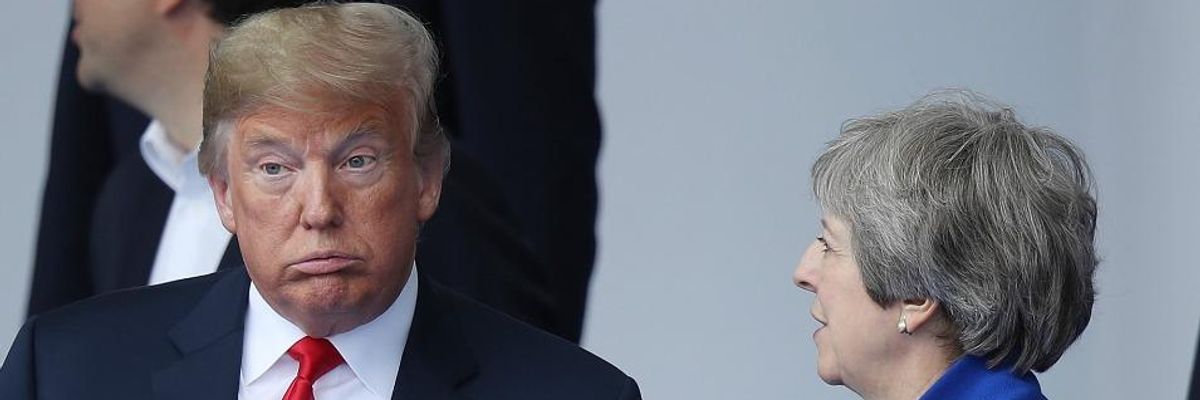
U.S. President Donald Trump (L) and British Prime Minister Theresa May attend the opening ceremony at the 2018 NATO Summit at NATO headquarters on July 11, 2018 in Brussels, Belgium. Leaders from NATO member and partner states are meeting for a two-day summit, which is being overshadowed by strong demands by U.S. President Trump for most NATO member countries to spend more on defense. (Photo: Sean Gallup/Getty Images)
One of the chief reasons that most European nations enjoy a higher standard of living and their residents annually express larger levels of collective happiness than people living in the United States is because of their commitment to spending on social wellness that exceeds their relative spending on military misadventure, weapons, and global empire.
But at the two-day NATO summit that kicked off in Brussels on Wednesday, President Donald Trump called on European leaders to follow the U.S. down its failed path of backwards priorities as he called on them to double their annual military spending, relative to Gross National Product, on the transatlantic alliance.
"Instead of worrying what other countries are spending on their militaries, the president should worry about the ways his own military wastes funds that could be used to solve problems at home." --Lindsay Koshgarian, National Priorities Project"President Trump, who spoke, raised the question not just to reach 2%, today, but set a new target - 4%. He just left after he announced that," Bulgarian president Rumen Radev told reporters, according to BNR public radio.
According to the Associated Press, White House press secretary Sarah Huckabee Sanders later confirmed Trump raised the idea of European members doubling their spending during a closed-door meeting with fellow NATO leaders.
In response, Lindsay Koshgarian, program director for the National Priorities Project which tracks Pentagon spending and its social implications, said that European leaders--and the people they represent--should be very wary about Trump's demand to increase military expenditures.
"Military spending for any country," Koshagarian said, "should be determined by two things: real national security needs, and curbing waste and profit motives that drive military spending up without making us safer."
The size of a nation's particular GDP is irrelevant, she argued, and warned Europe that following the wasteful habits that Trump has embraced in the U.S. could be a recipe for disaster. "The United States has wasted $5.6 trillion on wars in Iraq and Afghanistan with nothing to show for it," she said. "And, wasteful military spending is rampant, like the $125 billion in unnecessary bureaucracy at the Pentagon. Instead of worrying what other countries are spending on their militaries, the president should worry about the ways his own military wastes funds that could be used to solve problems at home."
Meanwhile, Rep. Ted Lieu (D-Calif.) was among those questioning whether or not Trump actually understands the basis of the NATO alliance or how it works:
While Trump has been making a habit--and a spectacle--of calling out NATO members for not living up to their commitment to the alliance in terms of military spending, it's not at all clear the serial liar and "not a smart man" has his facts straight.
As NBC News' Peter Alexander points out, "Even the US doesn't spend 4%. According to the most recent estimates from NATO, the US spent 3.57% of its GDP last year."
Dear Common Dreams reader, It’s been nearly 30 years since I co-founded Common Dreams with my late wife, Lina Newhouser. We had the radical notion that journalism should serve the public good, not corporate profits. It was clear to us from the outset what it would take to build such a project. No paid advertisements. No corporate sponsors. No millionaire publisher telling us what to think or do. Many people said we wouldn't last a year, but we proved those doubters wrong. Together with a tremendous team of journalists and dedicated staff, we built an independent media outlet free from the constraints of profits and corporate control. Our mission has always been simple: To inform. To inspire. To ignite change for the common good. Building Common Dreams was not easy. Our survival was never guaranteed. When you take on the most powerful forces—Wall Street greed, fossil fuel industry destruction, Big Tech lobbyists, and uber-rich oligarchs who have spent billions upon billions rigging the economy and democracy in their favor—the only bulwark you have is supporters who believe in your work. But here’s the urgent message from me today. It's never been this bad out there. And it's never been this hard to keep us going. At the very moment Common Dreams is most needed, the threats we face are intensifying. We need your support now more than ever. We don't accept corporate advertising and never will. We don't have a paywall because we don't think people should be blocked from critical news based on their ability to pay. Everything we do is funded by the donations of readers like you. When everyone does the little they can afford, we are strong. But if that support retreats or dries up, so do we. Will you donate now to make sure Common Dreams not only survives but thrives? —Craig Brown, Co-founder |
One of the chief reasons that most European nations enjoy a higher standard of living and their residents annually express larger levels of collective happiness than people living in the United States is because of their commitment to spending on social wellness that exceeds their relative spending on military misadventure, weapons, and global empire.
But at the two-day NATO summit that kicked off in Brussels on Wednesday, President Donald Trump called on European leaders to follow the U.S. down its failed path of backwards priorities as he called on them to double their annual military spending, relative to Gross National Product, on the transatlantic alliance.
"Instead of worrying what other countries are spending on their militaries, the president should worry about the ways his own military wastes funds that could be used to solve problems at home." --Lindsay Koshgarian, National Priorities Project"President Trump, who spoke, raised the question not just to reach 2%, today, but set a new target - 4%. He just left after he announced that," Bulgarian president Rumen Radev told reporters, according to BNR public radio.
According to the Associated Press, White House press secretary Sarah Huckabee Sanders later confirmed Trump raised the idea of European members doubling their spending during a closed-door meeting with fellow NATO leaders.
In response, Lindsay Koshgarian, program director for the National Priorities Project which tracks Pentagon spending and its social implications, said that European leaders--and the people they represent--should be very wary about Trump's demand to increase military expenditures.
"Military spending for any country," Koshagarian said, "should be determined by two things: real national security needs, and curbing waste and profit motives that drive military spending up without making us safer."
The size of a nation's particular GDP is irrelevant, she argued, and warned Europe that following the wasteful habits that Trump has embraced in the U.S. could be a recipe for disaster. "The United States has wasted $5.6 trillion on wars in Iraq and Afghanistan with nothing to show for it," she said. "And, wasteful military spending is rampant, like the $125 billion in unnecessary bureaucracy at the Pentagon. Instead of worrying what other countries are spending on their militaries, the president should worry about the ways his own military wastes funds that could be used to solve problems at home."
Meanwhile, Rep. Ted Lieu (D-Calif.) was among those questioning whether or not Trump actually understands the basis of the NATO alliance or how it works:
While Trump has been making a habit--and a spectacle--of calling out NATO members for not living up to their commitment to the alliance in terms of military spending, it's not at all clear the serial liar and "not a smart man" has his facts straight.
As NBC News' Peter Alexander points out, "Even the US doesn't spend 4%. According to the most recent estimates from NATO, the US spent 3.57% of its GDP last year."
One of the chief reasons that most European nations enjoy a higher standard of living and their residents annually express larger levels of collective happiness than people living in the United States is because of their commitment to spending on social wellness that exceeds their relative spending on military misadventure, weapons, and global empire.
But at the two-day NATO summit that kicked off in Brussels on Wednesday, President Donald Trump called on European leaders to follow the U.S. down its failed path of backwards priorities as he called on them to double their annual military spending, relative to Gross National Product, on the transatlantic alliance.
"Instead of worrying what other countries are spending on their militaries, the president should worry about the ways his own military wastes funds that could be used to solve problems at home." --Lindsay Koshgarian, National Priorities Project"President Trump, who spoke, raised the question not just to reach 2%, today, but set a new target - 4%. He just left after he announced that," Bulgarian president Rumen Radev told reporters, according to BNR public radio.
According to the Associated Press, White House press secretary Sarah Huckabee Sanders later confirmed Trump raised the idea of European members doubling their spending during a closed-door meeting with fellow NATO leaders.
In response, Lindsay Koshgarian, program director for the National Priorities Project which tracks Pentagon spending and its social implications, said that European leaders--and the people they represent--should be very wary about Trump's demand to increase military expenditures.
"Military spending for any country," Koshagarian said, "should be determined by two things: real national security needs, and curbing waste and profit motives that drive military spending up without making us safer."
The size of a nation's particular GDP is irrelevant, she argued, and warned Europe that following the wasteful habits that Trump has embraced in the U.S. could be a recipe for disaster. "The United States has wasted $5.6 trillion on wars in Iraq and Afghanistan with nothing to show for it," she said. "And, wasteful military spending is rampant, like the $125 billion in unnecessary bureaucracy at the Pentagon. Instead of worrying what other countries are spending on their militaries, the president should worry about the ways his own military wastes funds that could be used to solve problems at home."
Meanwhile, Rep. Ted Lieu (D-Calif.) was among those questioning whether or not Trump actually understands the basis of the NATO alliance or how it works:
While Trump has been making a habit--and a spectacle--of calling out NATO members for not living up to their commitment to the alliance in terms of military spending, it's not at all clear the serial liar and "not a smart man" has his facts straight.
As NBC News' Peter Alexander points out, "Even the US doesn't spend 4%. According to the most recent estimates from NATO, the US spent 3.57% of its GDP last year."