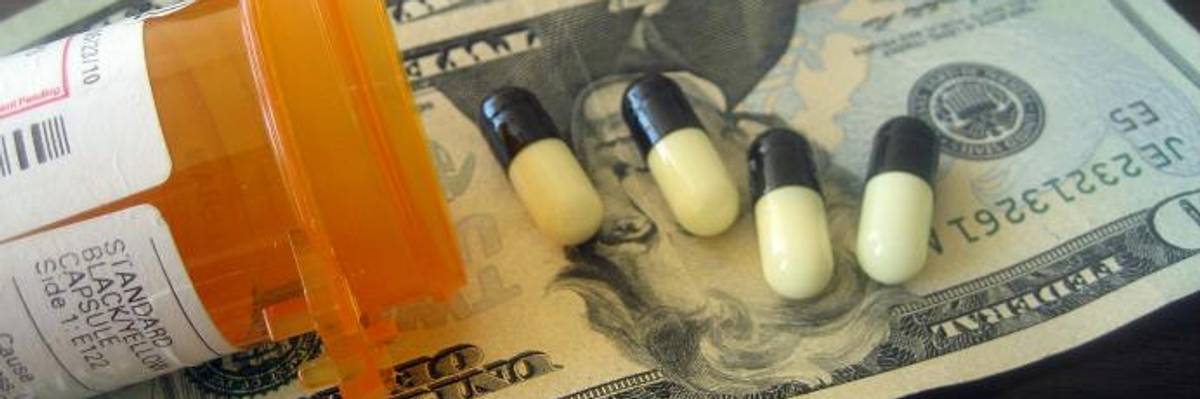
Sen. Bernie Sanders (I-Vt.) on Monday demanded that President Donald Trump keep his campaign promise to force pharmaceutical companies to lower the costs of medications. (Photo: TaxRebate.org.uk/Flickr/cc)
Sanders on Trump's Whining About Big Pharma: "Stop Just Talking About High Drug Prices... Do Something"
The senator called on the president to support legislation that would enable Medicare to negotiate prices and allow for the importation of medication from other countries
Sen. Bernie Sanders (I-Vt.) on Monday called on President Donald Trump to "stop just talking about high drug prices" and actually "do something" after the president whined on Twitter about Big Pharma raising prescription drug prices while continuing to flout his campaign promise lower costs for consumers.
Sanders tweeted:
The senator was responding to an afternoon tweet in which Trump referenced reports from last week that Pfizer had raised the price of several drugs for the second time this year:
Although Trump had vowed to take on the pharmaceutical industry during his race to the Oval Office, as Bloomberg noted Monday, "so far his most-noticed efforts have been using Twitter and stump speeches to call out pharmaceutical companies, rather than enacting major new policies."
In mid-May, the president unveiled a drug plan that critics immediately denounced as "pharma-friendly." As Common Dreams reported, "rather than allowing the government to negotiate lower drug prices--a proposal backed by 92 percent of Americans--Trump's plan vaguely promises to 'encourage innovation' in the private sector while pursuing 'reforms' to Medicare to promote 'greater flexibility.'"
As Bloomberg put it, "Five weeks ago, Trump said that drugmakers would announce 'voluntary, massive' cuts in drug prices in two weeks. So far, no such announcement from the industry has happened."
In fact, as Politico pointed out last week:
A Wells Fargo report found 104 price increases in June and the first two days of July, with an average jump of 31.5 percent and a median increase of 9.4 percent. That followed 48 increases in May. The list price hikes don't factor in discounts that companies may provide to some insurance companies and patients.
The across-the-board increases cast doubt on whether Trump and Health and Human Services Secretary Alex Azar can pressure manufacturers to voluntarily drop prices without the threat of specific consequences.
Azar responded to Trump's tweet on Monday with a declaration that "change is coming to drug pricing, whether painful or not for pharmaceutical companies," while offering no new plans to force such changes.
Meanwhile, Sanders--who has slammed Trump's drug plan as "lukewarm"--and several top congressional Democrats in October introduced actual legislation, officially titled the Medicare Drug Price Negotiation Act of 2017 (pdf), that would enable the Department of Health and Human Services to negotiate lower prescription drug prices under Medicare Part D.
An Urgent Message From Our Co-Founder
Dear Common Dreams reader, It’s been nearly 30 years since I co-founded Common Dreams with my late wife, Lina Newhouser. We had the radical notion that journalism should serve the public good, not corporate profits. It was clear to us from the outset what it would take to build such a project. No paid advertisements. No corporate sponsors. No millionaire publisher telling us what to think or do. Many people said we wouldn't last a year, but we proved those doubters wrong. Together with a tremendous team of journalists and dedicated staff, we built an independent media outlet free from the constraints of profits and corporate control. Our mission has always been simple: To inform. To inspire. To ignite change for the common good. Building Common Dreams was not easy. Our survival was never guaranteed. When you take on the most powerful forces—Wall Street greed, fossil fuel industry destruction, Big Tech lobbyists, and uber-rich oligarchs who have spent billions upon billions rigging the economy and democracy in their favor—the only bulwark you have is supporters who believe in your work. But here’s the urgent message from me today. It's never been this bad out there. And it's never been this hard to keep us going. At the very moment Common Dreams is most needed, the threats we face are intensifying. We need your support now more than ever. We don't accept corporate advertising and never will. We don't have a paywall because we don't think people should be blocked from critical news based on their ability to pay. Everything we do is funded by the donations of readers like you. When everyone does the little they can afford, we are strong. But if that support retreats or dries up, so do we. Will you donate now to make sure Common Dreams not only survives but thrives? —Craig Brown, Co-founder |
Sen. Bernie Sanders (I-Vt.) on Monday called on President Donald Trump to "stop just talking about high drug prices" and actually "do something" after the president whined on Twitter about Big Pharma raising prescription drug prices while continuing to flout his campaign promise lower costs for consumers.
Sanders tweeted:
The senator was responding to an afternoon tweet in which Trump referenced reports from last week that Pfizer had raised the price of several drugs for the second time this year:
Although Trump had vowed to take on the pharmaceutical industry during his race to the Oval Office, as Bloomberg noted Monday, "so far his most-noticed efforts have been using Twitter and stump speeches to call out pharmaceutical companies, rather than enacting major new policies."
In mid-May, the president unveiled a drug plan that critics immediately denounced as "pharma-friendly." As Common Dreams reported, "rather than allowing the government to negotiate lower drug prices--a proposal backed by 92 percent of Americans--Trump's plan vaguely promises to 'encourage innovation' in the private sector while pursuing 'reforms' to Medicare to promote 'greater flexibility.'"
As Bloomberg put it, "Five weeks ago, Trump said that drugmakers would announce 'voluntary, massive' cuts in drug prices in two weeks. So far, no such announcement from the industry has happened."
In fact, as Politico pointed out last week:
A Wells Fargo report found 104 price increases in June and the first two days of July, with an average jump of 31.5 percent and a median increase of 9.4 percent. That followed 48 increases in May. The list price hikes don't factor in discounts that companies may provide to some insurance companies and patients.
The across-the-board increases cast doubt on whether Trump and Health and Human Services Secretary Alex Azar can pressure manufacturers to voluntarily drop prices without the threat of specific consequences.
Azar responded to Trump's tweet on Monday with a declaration that "change is coming to drug pricing, whether painful or not for pharmaceutical companies," while offering no new plans to force such changes.
Meanwhile, Sanders--who has slammed Trump's drug plan as "lukewarm"--and several top congressional Democrats in October introduced actual legislation, officially titled the Medicare Drug Price Negotiation Act of 2017 (pdf), that would enable the Department of Health and Human Services to negotiate lower prescription drug prices under Medicare Part D.
Sen. Bernie Sanders (I-Vt.) on Monday called on President Donald Trump to "stop just talking about high drug prices" and actually "do something" after the president whined on Twitter about Big Pharma raising prescription drug prices while continuing to flout his campaign promise lower costs for consumers.
Sanders tweeted:
The senator was responding to an afternoon tweet in which Trump referenced reports from last week that Pfizer had raised the price of several drugs for the second time this year:
Although Trump had vowed to take on the pharmaceutical industry during his race to the Oval Office, as Bloomberg noted Monday, "so far his most-noticed efforts have been using Twitter and stump speeches to call out pharmaceutical companies, rather than enacting major new policies."
In mid-May, the president unveiled a drug plan that critics immediately denounced as "pharma-friendly." As Common Dreams reported, "rather than allowing the government to negotiate lower drug prices--a proposal backed by 92 percent of Americans--Trump's plan vaguely promises to 'encourage innovation' in the private sector while pursuing 'reforms' to Medicare to promote 'greater flexibility.'"
As Bloomberg put it, "Five weeks ago, Trump said that drugmakers would announce 'voluntary, massive' cuts in drug prices in two weeks. So far, no such announcement from the industry has happened."
In fact, as Politico pointed out last week:
A Wells Fargo report found 104 price increases in June and the first two days of July, with an average jump of 31.5 percent and a median increase of 9.4 percent. That followed 48 increases in May. The list price hikes don't factor in discounts that companies may provide to some insurance companies and patients.
The across-the-board increases cast doubt on whether Trump and Health and Human Services Secretary Alex Azar can pressure manufacturers to voluntarily drop prices without the threat of specific consequences.
Azar responded to Trump's tweet on Monday with a declaration that "change is coming to drug pricing, whether painful or not for pharmaceutical companies," while offering no new plans to force such changes.
Meanwhile, Sanders--who has slammed Trump's drug plan as "lukewarm"--and several top congressional Democrats in October introduced actual legislation, officially titled the Medicare Drug Price Negotiation Act of 2017 (pdf), that would enable the Department of Health and Human Services to negotiate lower prescription drug prices under Medicare Part D.