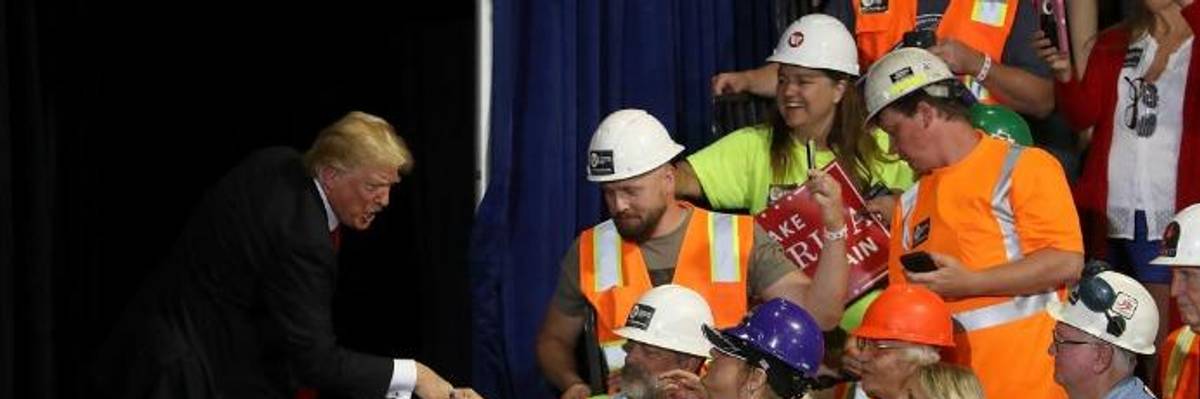
President Donald Trump greets supporters during a campaign rally at Four Seasons Arena on July 5, 2018 in Great Falls, Montana. (Photo: Justin Sullivan/Getty Images)
'Hard to Fathom the Recklessness': American Workers, Farmers at Risk as Trump Escalates Trade War With China
China immediately hit back with equivalent tariffs and slammed the Trump White House for "behaving like a gang of hoodlums."
Brushing aside repeated warnings that a rapid escalation of trade tensions between the world's two largest economies could place millions of American jobs at risk, President Donald Trump on Friday officially dragged the U.S. into what is already being characterized as "the largest trade war in history" by imposing 25 percent tariffs on $34 billion worth of Chinese goods.
"With Trump's tariffs on China, it's hard to fathom the recklessness of the president and the utter failure of U.S. politics to allow one psychopath to have so much power."
-- Jeffrey Sachs, Columbia UniversitySlamming the Trump administration for "behaving like a gang of hoodlums with its shakedown of other countries," China immediately hit back at the U.S. with equivalent tariffs, taking aim at American soybeans, corn, and other goods.
"With Trump's tariffs on China, it's hard to fathom the recklessness of the president and the utter failure of U.S. politics to allow one psychopath to have so much power," wrote Columbia University professor Jeffrey Sachs, who described Trump's decision last month to hit the European Union, Mexico, and Canada with steel and aluminum tariffs as a "psychopath's trade war."
In an analysis of Trump's tariff moves on Friday, The Week's Jeff Spross echoed Sachs' conclusion that the president is recklessly rushing into a trade war without any clear objectives or endgame--aside from "putting on a show."
"It's worth remembering that the president was a reality TV star. And in that profession, the point is ratings," Spross writes. "And it's hard to escape the conclusion that this trade war is just another show Trump's putting on. In which case, will he ever let it end?"
"It's worth remembering that the president was a reality TV star. And in that profession, the point is ratings. And it's hard to escape the conclusion that this trade war is just another show Trump's putting on."
--Jeff Spross, The Week
While some commentators argued that this first round of tariffs is likely to have massive economic effects, Trump--whose sprawling business empire continues to profit from partnerships with Chinese state-backed companies--suggested to reporters aboard Air Force One on Thursday that he is planning to continue escalating the trade war with China, with the ultimate aim of imposing tariffs on more than $500 billion in goods.
After the first $34 billion in penalties, Trump said, "you have another $16 [billion] in two weeks, and then, as you know, we have $200 billion in abeyance and then after the $200 billion, we have $300 billion in abeyance. Ok? So we have 50 plus 200 plus almost 300."
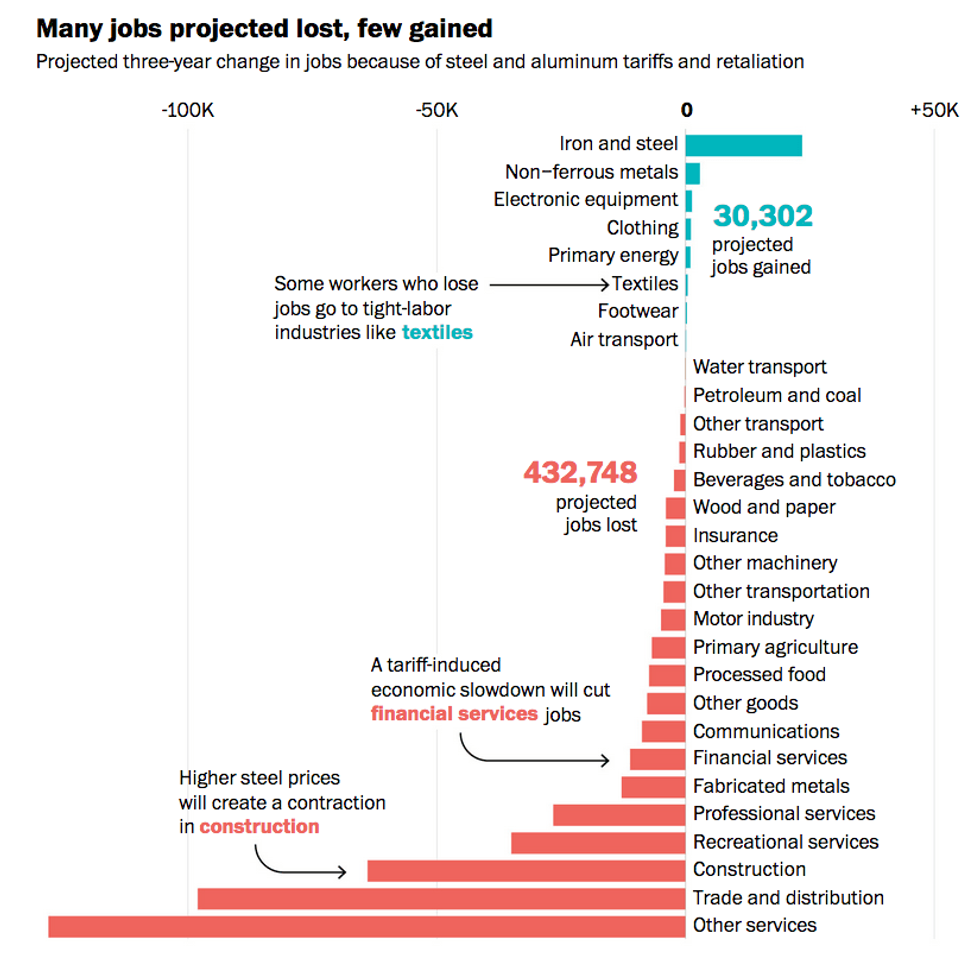
Providing an indication of the impact Trump's tariffs and China's retaliations could have on American jobs, the Washington Post published a chart showing that while some industries will likely see small job gains over the next several years, they will be far outweighed by massive job losses in other industries.
"One factor for the projected loss is that there are 5.1 million jobs in manufacturing industries that stand to be hurt by higher steel and aluminum prices," the Post reports. "That compares to 313,000 jobs in the industries that make the metals and will benefit from higher prices."

American farmers--many of whom voted for Trump in the 2016 election and still support him despite the tariffs--are already bracing for impact as China launches its own calculated retaliation against Trump's trade penalties.
"If the trade war continues into the spring of 2019, the owners of thousands of smaller farms, many handed down from generation to generation, could face tough decisions, pitting their pocketbooks against the president's policies," NBC News reported on Friday.

An Urgent Message From Our Co-Founder
Dear Common Dreams reader, It’s been nearly 30 years since I co-founded Common Dreams with my late wife, Lina Newhouser. We had the radical notion that journalism should serve the public good, not corporate profits. It was clear to us from the outset what it would take to build such a project. No paid advertisements. No corporate sponsors. No millionaire publisher telling us what to think or do. Many people said we wouldn't last a year, but we proved those doubters wrong. Together with a tremendous team of journalists and dedicated staff, we built an independent media outlet free from the constraints of profits and corporate control. Our mission has always been simple: To inform. To inspire. To ignite change for the common good. Building Common Dreams was not easy. Our survival was never guaranteed. When you take on the most powerful forces—Wall Street greed, fossil fuel industry destruction, Big Tech lobbyists, and uber-rich oligarchs who have spent billions upon billions rigging the economy and democracy in their favor—the only bulwark you have is supporters who believe in your work. But here’s the urgent message from me today. It's never been this bad out there. And it's never been this hard to keep us going. At the very moment Common Dreams is most needed, the threats we face are intensifying. We need your support now more than ever. We don't accept corporate advertising and never will. We don't have a paywall because we don't think people should be blocked from critical news based on their ability to pay. Everything we do is funded by the donations of readers like you. When everyone does the little they can afford, we are strong. But if that support retreats or dries up, so do we. Will you donate now to make sure Common Dreams not only survives but thrives? —Craig Brown, Co-founder |
Brushing aside repeated warnings that a rapid escalation of trade tensions between the world's two largest economies could place millions of American jobs at risk, President Donald Trump on Friday officially dragged the U.S. into what is already being characterized as "the largest trade war in history" by imposing 25 percent tariffs on $34 billion worth of Chinese goods.
"With Trump's tariffs on China, it's hard to fathom the recklessness of the president and the utter failure of U.S. politics to allow one psychopath to have so much power."
-- Jeffrey Sachs, Columbia UniversitySlamming the Trump administration for "behaving like a gang of hoodlums with its shakedown of other countries," China immediately hit back at the U.S. with equivalent tariffs, taking aim at American soybeans, corn, and other goods.
"With Trump's tariffs on China, it's hard to fathom the recklessness of the president and the utter failure of U.S. politics to allow one psychopath to have so much power," wrote Columbia University professor Jeffrey Sachs, who described Trump's decision last month to hit the European Union, Mexico, and Canada with steel and aluminum tariffs as a "psychopath's trade war."
In an analysis of Trump's tariff moves on Friday, The Week's Jeff Spross echoed Sachs' conclusion that the president is recklessly rushing into a trade war without any clear objectives or endgame--aside from "putting on a show."
"It's worth remembering that the president was a reality TV star. And in that profession, the point is ratings," Spross writes. "And it's hard to escape the conclusion that this trade war is just another show Trump's putting on. In which case, will he ever let it end?"
"It's worth remembering that the president was a reality TV star. And in that profession, the point is ratings. And it's hard to escape the conclusion that this trade war is just another show Trump's putting on."
--Jeff Spross, The Week
While some commentators argued that this first round of tariffs is likely to have massive economic effects, Trump--whose sprawling business empire continues to profit from partnerships with Chinese state-backed companies--suggested to reporters aboard Air Force One on Thursday that he is planning to continue escalating the trade war with China, with the ultimate aim of imposing tariffs on more than $500 billion in goods.
After the first $34 billion in penalties, Trump said, "you have another $16 [billion] in two weeks, and then, as you know, we have $200 billion in abeyance and then after the $200 billion, we have $300 billion in abeyance. Ok? So we have 50 plus 200 plus almost 300."
Providing an indication of the impact Trump's tariffs and China's retaliations could have on American jobs, the Washington Post published a chart showing that while some industries will likely see small job gains over the next several years, they will be far outweighed by massive job losses in other industries.
"One factor for the projected loss is that there are 5.1 million jobs in manufacturing industries that stand to be hurt by higher steel and aluminum prices," the Post reports. "That compares to 313,000 jobs in the industries that make the metals and will benefit from higher prices."

American farmers--many of whom voted for Trump in the 2016 election and still support him despite the tariffs--are already bracing for impact as China launches its own calculated retaliation against Trump's trade penalties.
"If the trade war continues into the spring of 2019, the owners of thousands of smaller farms, many handed down from generation to generation, could face tough decisions, pitting their pocketbooks against the president's policies," NBC News reported on Friday.
Brushing aside repeated warnings that a rapid escalation of trade tensions between the world's two largest economies could place millions of American jobs at risk, President Donald Trump on Friday officially dragged the U.S. into what is already being characterized as "the largest trade war in history" by imposing 25 percent tariffs on $34 billion worth of Chinese goods.
"With Trump's tariffs on China, it's hard to fathom the recklessness of the president and the utter failure of U.S. politics to allow one psychopath to have so much power."
-- Jeffrey Sachs, Columbia UniversitySlamming the Trump administration for "behaving like a gang of hoodlums with its shakedown of other countries," China immediately hit back at the U.S. with equivalent tariffs, taking aim at American soybeans, corn, and other goods.
"With Trump's tariffs on China, it's hard to fathom the recklessness of the president and the utter failure of U.S. politics to allow one psychopath to have so much power," wrote Columbia University professor Jeffrey Sachs, who described Trump's decision last month to hit the European Union, Mexico, and Canada with steel and aluminum tariffs as a "psychopath's trade war."
In an analysis of Trump's tariff moves on Friday, The Week's Jeff Spross echoed Sachs' conclusion that the president is recklessly rushing into a trade war without any clear objectives or endgame--aside from "putting on a show."
"It's worth remembering that the president was a reality TV star. And in that profession, the point is ratings," Spross writes. "And it's hard to escape the conclusion that this trade war is just another show Trump's putting on. In which case, will he ever let it end?"
"It's worth remembering that the president was a reality TV star. And in that profession, the point is ratings. And it's hard to escape the conclusion that this trade war is just another show Trump's putting on."
--Jeff Spross, The Week
While some commentators argued that this first round of tariffs is likely to have massive economic effects, Trump--whose sprawling business empire continues to profit from partnerships with Chinese state-backed companies--suggested to reporters aboard Air Force One on Thursday that he is planning to continue escalating the trade war with China, with the ultimate aim of imposing tariffs on more than $500 billion in goods.
After the first $34 billion in penalties, Trump said, "you have another $16 [billion] in two weeks, and then, as you know, we have $200 billion in abeyance and then after the $200 billion, we have $300 billion in abeyance. Ok? So we have 50 plus 200 plus almost 300."
Providing an indication of the impact Trump's tariffs and China's retaliations could have on American jobs, the Washington Post published a chart showing that while some industries will likely see small job gains over the next several years, they will be far outweighed by massive job losses in other industries.
"One factor for the projected loss is that there are 5.1 million jobs in manufacturing industries that stand to be hurt by higher steel and aluminum prices," the Post reports. "That compares to 313,000 jobs in the industries that make the metals and will benefit from higher prices."

American farmers--many of whom voted for Trump in the 2016 election and still support him despite the tariffs--are already bracing for impact as China launches its own calculated retaliation against Trump's trade penalties.
"If the trade war continues into the spring of 2019, the owners of thousands of smaller farms, many handed down from generation to generation, could face tough decisions, pitting their pocketbooks against the president's policies," NBC News reported on Friday.