SUBSCRIBE TO OUR FREE NEWSLETTER
Daily news & progressive opinion—funded by the people, not the corporations—delivered straight to your inbox.
5
#000000
#FFFFFF
To donate by check, phone, or other method, see our More Ways to Give page.
Daily news & progressive opinion—funded by the people, not the corporations—delivered straight to your inbox.
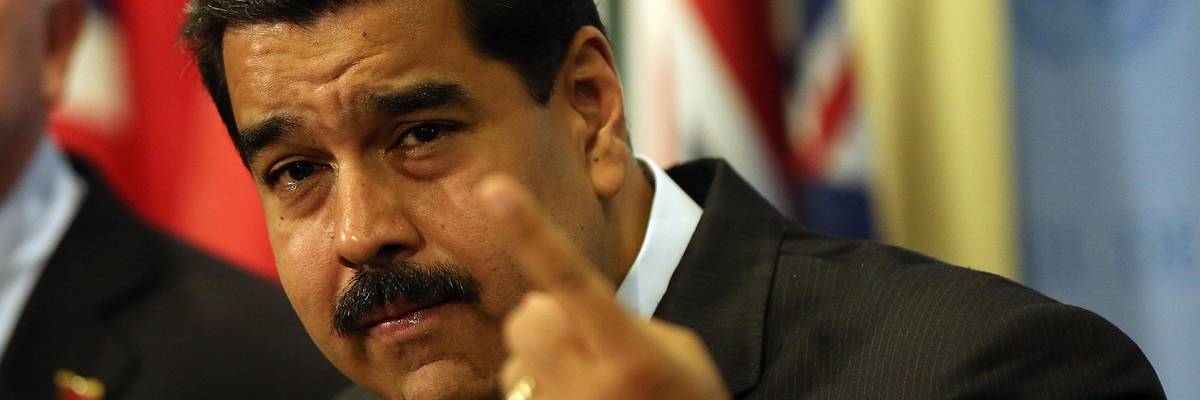
Venezuelan President Nicolas Maduro speaks to the media following a meeting with UN chief Ban Ki-moon at the United Nations (UN) headquarters in New York on July 28, 2015 in New York City. Maduro is in New York to speak with the UN about his country's escalating border dispute with Guyana. (Photo: Spencer Platt/Getty Images)
Surrounded by his top military aides in a White House meeting less than a year ago, the Associated Press on Wednesday reports that President Donald Trump wanted to know why the U.S. military couldn't "just simply invade" the country of Venezuela.
Based on the account of "a senior administration official familiar with what was said," AP reports that the president's comments "stunned" those at the meeting, including U.S. Secretary of State Rex Tillerson and national security adviser H.R. McMaster, both of whom have now left the administration.
From AP:
In an exchange that lasted around five minutes, McMaster and others took turns explaining to Trump how military action could backfire and risk losing hard-won support among Latin American governments to punish President Nicolas Maduro for taking Venezuela down the path of dictatorship, according to the official. The official spoke on the condition of anonymity because of the sensitive nature of the discussions.
But Trump pushed back. Although he gave no indication he was about to order up military plans, he pointed to what he considered past cases of successful gunboat diplomacy in the region, according to the official, like the invasions of Panama and Grenada in the 1980s.
While some of those around him continued attempts to ignore or dissuade the president, reportedly Trump could not let the idea go and AP cites "two high-ranking Colombian officials" who confirmed that he brought the idea of a military overthrow up with Colombian President Juan Manuel Santos during a closed-door meeting in August of 2017.
A month later, during a dinner with other Latin American leaders on the sidelines of the U.N. General Assembly meeting in New York, the reporting says that Trump--despite warnings not to do so--once more brought up the subject.
"The U.S. official said Trump was specifically briefed not to raise the issue and told it wouldn't play well," AP reports, "but the first thing the president said at the dinner was, 'My staff told me not to say this.' Trump then went around asking each leader if they were sure they didn't want a military solution, according to the official, who added that each leader told Trump in clear terms they were sure. Eventually, McMaster would pull aside the president and walk him through the dangers of an invasion, the official said."
Dear Common Dreams reader, It’s been nearly 30 years since I co-founded Common Dreams with my late wife, Lina Newhouser. We had the radical notion that journalism should serve the public good, not corporate profits. It was clear to us from the outset what it would take to build such a project. No paid advertisements. No corporate sponsors. No millionaire publisher telling us what to think or do. Many people said we wouldn't last a year, but we proved those doubters wrong. Together with a tremendous team of journalists and dedicated staff, we built an independent media outlet free from the constraints of profits and corporate control. Our mission has always been simple: To inform. To inspire. To ignite change for the common good. Building Common Dreams was not easy. Our survival was never guaranteed. When you take on the most powerful forces—Wall Street greed, fossil fuel industry destruction, Big Tech lobbyists, and uber-rich oligarchs who have spent billions upon billions rigging the economy and democracy in their favor—the only bulwark you have is supporters who believe in your work. But here’s the urgent message from me today. It's never been this bad out there. And it's never been this hard to keep us going. At the very moment Common Dreams is most needed, the threats we face are intensifying. We need your support now more than ever. We don't accept corporate advertising and never will. We don't have a paywall because we don't think people should be blocked from critical news based on their ability to pay. Everything we do is funded by the donations of readers like you. When everyone does the little they can afford, we are strong. But if that support retreats or dries up, so do we. Will you donate now to make sure Common Dreams not only survives but thrives? —Craig Brown, Co-founder |
Surrounded by his top military aides in a White House meeting less than a year ago, the Associated Press on Wednesday reports that President Donald Trump wanted to know why the U.S. military couldn't "just simply invade" the country of Venezuela.
Based on the account of "a senior administration official familiar with what was said," AP reports that the president's comments "stunned" those at the meeting, including U.S. Secretary of State Rex Tillerson and national security adviser H.R. McMaster, both of whom have now left the administration.
From AP:
In an exchange that lasted around five minutes, McMaster and others took turns explaining to Trump how military action could backfire and risk losing hard-won support among Latin American governments to punish President Nicolas Maduro for taking Venezuela down the path of dictatorship, according to the official. The official spoke on the condition of anonymity because of the sensitive nature of the discussions.
But Trump pushed back. Although he gave no indication he was about to order up military plans, he pointed to what he considered past cases of successful gunboat diplomacy in the region, according to the official, like the invasions of Panama and Grenada in the 1980s.
While some of those around him continued attempts to ignore or dissuade the president, reportedly Trump could not let the idea go and AP cites "two high-ranking Colombian officials" who confirmed that he brought the idea of a military overthrow up with Colombian President Juan Manuel Santos during a closed-door meeting in August of 2017.
A month later, during a dinner with other Latin American leaders on the sidelines of the U.N. General Assembly meeting in New York, the reporting says that Trump--despite warnings not to do so--once more brought up the subject.
"The U.S. official said Trump was specifically briefed not to raise the issue and told it wouldn't play well," AP reports, "but the first thing the president said at the dinner was, 'My staff told me not to say this.' Trump then went around asking each leader if they were sure they didn't want a military solution, according to the official, who added that each leader told Trump in clear terms they were sure. Eventually, McMaster would pull aside the president and walk him through the dangers of an invasion, the official said."
Surrounded by his top military aides in a White House meeting less than a year ago, the Associated Press on Wednesday reports that President Donald Trump wanted to know why the U.S. military couldn't "just simply invade" the country of Venezuela.
Based on the account of "a senior administration official familiar with what was said," AP reports that the president's comments "stunned" those at the meeting, including U.S. Secretary of State Rex Tillerson and national security adviser H.R. McMaster, both of whom have now left the administration.
From AP:
In an exchange that lasted around five minutes, McMaster and others took turns explaining to Trump how military action could backfire and risk losing hard-won support among Latin American governments to punish President Nicolas Maduro for taking Venezuela down the path of dictatorship, according to the official. The official spoke on the condition of anonymity because of the sensitive nature of the discussions.
But Trump pushed back. Although he gave no indication he was about to order up military plans, he pointed to what he considered past cases of successful gunboat diplomacy in the region, according to the official, like the invasions of Panama and Grenada in the 1980s.
While some of those around him continued attempts to ignore or dissuade the president, reportedly Trump could not let the idea go and AP cites "two high-ranking Colombian officials" who confirmed that he brought the idea of a military overthrow up with Colombian President Juan Manuel Santos during a closed-door meeting in August of 2017.
A month later, during a dinner with other Latin American leaders on the sidelines of the U.N. General Assembly meeting in New York, the reporting says that Trump--despite warnings not to do so--once more brought up the subject.
"The U.S. official said Trump was specifically briefed not to raise the issue and told it wouldn't play well," AP reports, "but the first thing the president said at the dinner was, 'My staff told me not to say this.' Trump then went around asking each leader if they were sure they didn't want a military solution, according to the official, who added that each leader told Trump in clear terms they were sure. Eventually, McMaster would pull aside the president and walk him through the dangers of an invasion, the official said."