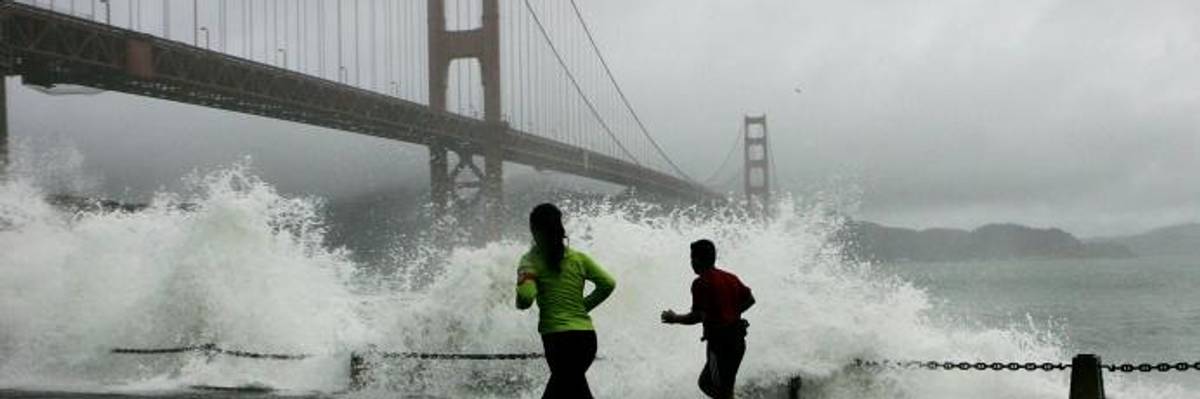
Two runners watch as a waves crash against the rocks at Fort Point near the Golden Gate Bridge. (Photo: Justin Sullivan/Getty Images)
California Cities Wanted Big Oil to Pay Up for Climate Damage But Federal Judge Just Said 'No'
"By kicking the case to a do-nothing Congress and a climate denying White House, the court essentially ruled that taxpayers alone should pay the massive costs of adapting to climate change."
While delivering a partial victory for science by affirming the undeniable role that fossil fuels have played in the global climate crisis, a federal judge on Monday tossed out a pair of lawsuits filed by the cities of Oakland and San Francisco, California that sought to make five oil and gas companies pay for their contributions to global warming-induced sea level rise, which has left oceanfront communities fighting increased flooding, coastal erosion, and property damage.
U.S. District Court Judge William Alsup--who was lauded earlier this year for hosting a historic "climate tutorial" in court for this case--wrote in his 16-page decision:
This order fully accepts the vast scientific consensus that the combustion of fossil fuels has materially increased atmospheric carbon dioxide levels, which in turn has increased the median temperature of the planet and accelerated sea level rise. But questions of how to appropriately balance these worldwide negatives against the worldwide positives of the energy itself, and of how to allocate the pluses and minueses among the nations of the world, demand the expertise of our environmental agencies, our diplomats, our Executive, and at least the Senate. Nuisance suits in various United States judicial districts regarding conduct worldwide are far less likely to solve the problem and, indeed, could interfere with reaching a worldwide consensus.
Because the cities accused these five major fossil fuel companies--BP, Chevron, ConocoPhillips, ExxonMobil, and Royal Dutch Shell--of creating a "public nuisance" that warranted compensation, this particular case wasn't about solving the global climate crisis, explained Richard Wiles of the Center for Climate Integrity, "but simply whether oil and gas producers should help San Francisco and Oakland pay for the costs of adapting to it."
"By kicking the case to a do-nothing Congress and a climate denying White House, the court essentially ruled that taxpayers alone should pay the massive costs of adapting to climate change," Wiles said.
"There are always adverse decisions along the road to victory. That was true in tobacco, lead, and asbestos, where the courts ultimately crafted a solution to a major crisis. This fight is just getting started and we expect to win."
--Richard Wiles, Center for Climate Integrity
"This is obviously not the ruling we wanted, but this doesn't mean the case is over," John Cote, a spokesman for the San Francisco city attorney, said. "We're reviewing the order and will decide on our next steps shortly."
Oakland City Attorney Barbara Parker told E&E News the lawyers are "considering all options, including an appeal."
Although Alsup sided with the fossil fuel companies, Cote added: "We're pleased that the court recognized that the science of global warming is no longer in dispute. Our litigation forced a public court proceeding on climate science, and now these companies can no longer deny it is real and valid. Our belief remains that these companies are liable for the harm they've caused."
While dismissing the suits, Alsup wrote: "The issue is not over science. All parties agree that fossil fuels have led to global warming and ocean rise and will continue to do so, and that eventually the navigable waters of the United States will intrude upon Oakland and California. The issue is a legal one." Though the five companies named in the suit are among the world's largest producers, the judge pointed out that "anyone who supplied fossil fuels with knowledge of the problem would be liable."
"It is never good when a judge says the other side wins," Niskanen Center attorney David Bookbinder--a co-counsel for a similar case brought by communities in Colorado--told Axios. However, "this is round one of many, many rounds of decisions in these cases," he said. "By no means is it the end of the process."
"There are always adverse decisions along the road to victory. That was true in tobacco, lead, and asbestos, where the courts ultimately crafted a solution to a major crisis," concluded Wiles. "This fight is just getting started and we expect to win."
We are at a crossroads
This country and this world are at a monumental crossroads. In a few short weeks, US voters will have an opportunity to beat back the forces of fascism and confront the billionaires who are rigging the economy, our media system, and our democracy, making it increasingly impossible for ordinary people to get by. We’re not just talking about the election. We’re talking about what must be done once these fascist elements are vanquished from power. We need a bolder set of solutions than what either major party has so far been willing to offer and a working-class movement ready to fight like hell for it. Trump didn't emerge from nowhere. The conditions that fueled MAGA authoritarianism were created by decades of radical neoliberal economic policies and a corrupt political system dominated by corporate interests. They slashed taxes on the super-rich, promising that the benefits would trickle down. They said giveaways to the corporate titans would make life more affordable for the rest of us. It was all bullshit. And when a bitter, betrayed populace searches for someone to blame, right-wing demagogues have little trouble finding scapegoats. People know when they're being lied to, but you won't hear any of this from the corporate media. Only independent journalism—powered and funded by people who believe in building a better world—can deliver truly trustworthy daily news. Our Fall Campaign is underway, and we need your help. To power our newsroom through the rest of the year, we need to raise $125,000 by midnight on October 31. So if you share our vision, please contribute whatever you can to sustain our work. |
While delivering a partial victory for science by affirming the undeniable role that fossil fuels have played in the global climate crisis, a federal judge on Monday tossed out a pair of lawsuits filed by the cities of Oakland and San Francisco, California that sought to make five oil and gas companies pay for their contributions to global warming-induced sea level rise, which has left oceanfront communities fighting increased flooding, coastal erosion, and property damage.
U.S. District Court Judge William Alsup--who was lauded earlier this year for hosting a historic "climate tutorial" in court for this case--wrote in his 16-page decision:
This order fully accepts the vast scientific consensus that the combustion of fossil fuels has materially increased atmospheric carbon dioxide levels, which in turn has increased the median temperature of the planet and accelerated sea level rise. But questions of how to appropriately balance these worldwide negatives against the worldwide positives of the energy itself, and of how to allocate the pluses and minueses among the nations of the world, demand the expertise of our environmental agencies, our diplomats, our Executive, and at least the Senate. Nuisance suits in various United States judicial districts regarding conduct worldwide are far less likely to solve the problem and, indeed, could interfere with reaching a worldwide consensus.
Because the cities accused these five major fossil fuel companies--BP, Chevron, ConocoPhillips, ExxonMobil, and Royal Dutch Shell--of creating a "public nuisance" that warranted compensation, this particular case wasn't about solving the global climate crisis, explained Richard Wiles of the Center for Climate Integrity, "but simply whether oil and gas producers should help San Francisco and Oakland pay for the costs of adapting to it."
"By kicking the case to a do-nothing Congress and a climate denying White House, the court essentially ruled that taxpayers alone should pay the massive costs of adapting to climate change," Wiles said.
"There are always adverse decisions along the road to victory. That was true in tobacco, lead, and asbestos, where the courts ultimately crafted a solution to a major crisis. This fight is just getting started and we expect to win."
--Richard Wiles, Center for Climate Integrity
"This is obviously not the ruling we wanted, but this doesn't mean the case is over," John Cote, a spokesman for the San Francisco city attorney, said. "We're reviewing the order and will decide on our next steps shortly."
Oakland City Attorney Barbara Parker told E&E News the lawyers are "considering all options, including an appeal."
Although Alsup sided with the fossil fuel companies, Cote added: "We're pleased that the court recognized that the science of global warming is no longer in dispute. Our litigation forced a public court proceeding on climate science, and now these companies can no longer deny it is real and valid. Our belief remains that these companies are liable for the harm they've caused."
While dismissing the suits, Alsup wrote: "The issue is not over science. All parties agree that fossil fuels have led to global warming and ocean rise and will continue to do so, and that eventually the navigable waters of the United States will intrude upon Oakland and California. The issue is a legal one." Though the five companies named in the suit are among the world's largest producers, the judge pointed out that "anyone who supplied fossil fuels with knowledge of the problem would be liable."
"It is never good when a judge says the other side wins," Niskanen Center attorney David Bookbinder--a co-counsel for a similar case brought by communities in Colorado--told Axios. However, "this is round one of many, many rounds of decisions in these cases," he said. "By no means is it the end of the process."
"There are always adverse decisions along the road to victory. That was true in tobacco, lead, and asbestos, where the courts ultimately crafted a solution to a major crisis," concluded Wiles. "This fight is just getting started and we expect to win."
While delivering a partial victory for science by affirming the undeniable role that fossil fuels have played in the global climate crisis, a federal judge on Monday tossed out a pair of lawsuits filed by the cities of Oakland and San Francisco, California that sought to make five oil and gas companies pay for their contributions to global warming-induced sea level rise, which has left oceanfront communities fighting increased flooding, coastal erosion, and property damage.
U.S. District Court Judge William Alsup--who was lauded earlier this year for hosting a historic "climate tutorial" in court for this case--wrote in his 16-page decision:
This order fully accepts the vast scientific consensus that the combustion of fossil fuels has materially increased atmospheric carbon dioxide levels, which in turn has increased the median temperature of the planet and accelerated sea level rise. But questions of how to appropriately balance these worldwide negatives against the worldwide positives of the energy itself, and of how to allocate the pluses and minueses among the nations of the world, demand the expertise of our environmental agencies, our diplomats, our Executive, and at least the Senate. Nuisance suits in various United States judicial districts regarding conduct worldwide are far less likely to solve the problem and, indeed, could interfere with reaching a worldwide consensus.
Because the cities accused these five major fossil fuel companies--BP, Chevron, ConocoPhillips, ExxonMobil, and Royal Dutch Shell--of creating a "public nuisance" that warranted compensation, this particular case wasn't about solving the global climate crisis, explained Richard Wiles of the Center for Climate Integrity, "but simply whether oil and gas producers should help San Francisco and Oakland pay for the costs of adapting to it."
"By kicking the case to a do-nothing Congress and a climate denying White House, the court essentially ruled that taxpayers alone should pay the massive costs of adapting to climate change," Wiles said.
"There are always adverse decisions along the road to victory. That was true in tobacco, lead, and asbestos, where the courts ultimately crafted a solution to a major crisis. This fight is just getting started and we expect to win."
--Richard Wiles, Center for Climate Integrity
"This is obviously not the ruling we wanted, but this doesn't mean the case is over," John Cote, a spokesman for the San Francisco city attorney, said. "We're reviewing the order and will decide on our next steps shortly."
Oakland City Attorney Barbara Parker told E&E News the lawyers are "considering all options, including an appeal."
Although Alsup sided with the fossil fuel companies, Cote added: "We're pleased that the court recognized that the science of global warming is no longer in dispute. Our litigation forced a public court proceeding on climate science, and now these companies can no longer deny it is real and valid. Our belief remains that these companies are liable for the harm they've caused."
While dismissing the suits, Alsup wrote: "The issue is not over science. All parties agree that fossil fuels have led to global warming and ocean rise and will continue to do so, and that eventually the navigable waters of the United States will intrude upon Oakland and California. The issue is a legal one." Though the five companies named in the suit are among the world's largest producers, the judge pointed out that "anyone who supplied fossil fuels with knowledge of the problem would be liable."
"It is never good when a judge says the other side wins," Niskanen Center attorney David Bookbinder--a co-counsel for a similar case brought by communities in Colorado--told Axios. However, "this is round one of many, many rounds of decisions in these cases," he said. "By no means is it the end of the process."
"There are always adverse decisions along the road to victory. That was true in tobacco, lead, and asbestos, where the courts ultimately crafted a solution to a major crisis," concluded Wiles. "This fight is just getting started and we expect to win."