SUBSCRIBE TO OUR FREE NEWSLETTER
Daily news & progressive opinion—funded by the people, not the corporations—delivered straight to your inbox.
5
#000000
#FFFFFF
To donate by check, phone, or other method, see our More Ways to Give page.
Daily news & progressive opinion—funded by the people, not the corporations—delivered straight to your inbox.
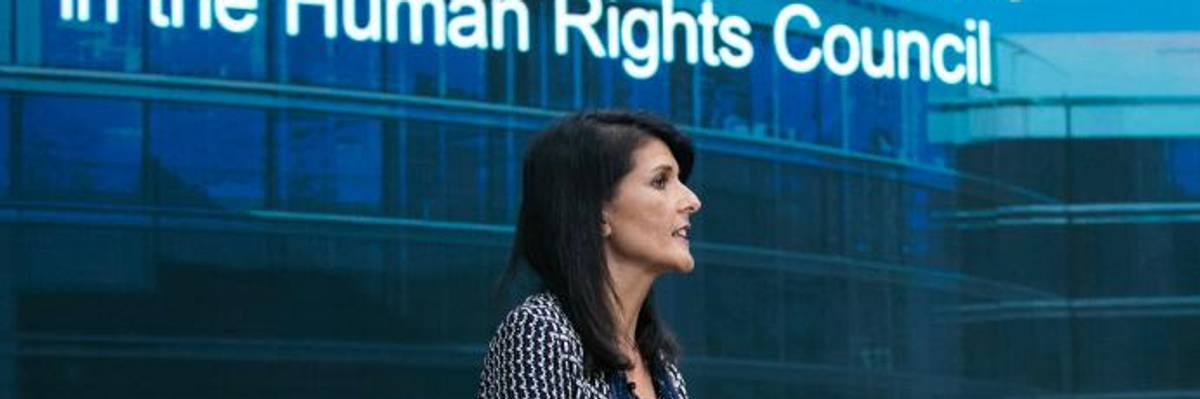
In June of 2017, U.S. Ambassador to the U.N. Nikki Haley said: "America does not seek to leave the Human Rights Council. We seek to reestablish the council's legitimacy." (Photo: United States Mission Geneva/Flickr/cc)
While the global community celebrates the 70th anniversary of the Universal Declaration of Human Rights, activist and diplomatic sources tell Reuters that the Trump administration is planning to pull the United States out of the Human Rights Council, the U.N.'s main body for such issues.
Sources who spoke on the condition of anonymity said the withdrawal appears to be "imminent," and due to the 47-member council's refusal to comply with the administration's demands for change, but added that U.S. diplomats are still preparing for the upcoming three-week session, which starts Monday.
In response, Swiss Ambassador Valentin Zellweger said: "The decision by the Americans will have a profound impact on the council. If they withdraw, we can expect significant consequences."
Reaction by progressives on social media was unkind toward the prospect of the U.S. further destroying its already troubled record on human rights:
Nikki Haley, the Trump-appointed U.S. Ambassador to the U.N., has yet to comment on the report, but last year she threatened to pull out because of what the administration perceived as "chronic anti-Israel bias." In an op-ed for the Washington Post ahead of the 2017 summer session, Haley expressed frustrations over resolutions focused on Israel while outlining the human rights records of Iran, Russia, Cuba, and Venezuela.
As Reuters noted, the council "has a permanent standing agenda item on suspected violations committed by Israel in the occupied Palestinian territories, which Washington wants removed." Since the last regular session ended in March with the U.S. opposing five resolutions that targeted Israel, Israeli forces have killed more than 100 unarmed Palestinian demonstrators in Gaza. In response to the violence, last month the council convened a special session, accused Israel of using excessive force, and voted to open an investigation.
The latest report of imminent U.S. withdrawal follows U.N. Secretary-General Antonio Guterres' message this week marking the 100-day countdown to the International Day of Peace, for which the theme of commemorations is "The Right to Peace--The Universal Declaration of Human Rights at 70." Envisioning a future in which "we will witness an end to violence," Guterres emphasized: "There is more to achieving peace than laying down weapons. True peace requires standing up for the human rights of all the world's people."
Dear Common Dreams reader, It’s been nearly 30 years since I co-founded Common Dreams with my late wife, Lina Newhouser. We had the radical notion that journalism should serve the public good, not corporate profits. It was clear to us from the outset what it would take to build such a project. No paid advertisements. No corporate sponsors. No millionaire publisher telling us what to think or do. Many people said we wouldn't last a year, but we proved those doubters wrong. Together with a tremendous team of journalists and dedicated staff, we built an independent media outlet free from the constraints of profits and corporate control. Our mission has always been simple: To inform. To inspire. To ignite change for the common good. Building Common Dreams was not easy. Our survival was never guaranteed. When you take on the most powerful forces—Wall Street greed, fossil fuel industry destruction, Big Tech lobbyists, and uber-rich oligarchs who have spent billions upon billions rigging the economy and democracy in their favor—the only bulwark you have is supporters who believe in your work. But here’s the urgent message from me today. It's never been this bad out there. And it's never been this hard to keep us going. At the very moment Common Dreams is most needed, the threats we face are intensifying. We need your support now more than ever. We don't accept corporate advertising and never will. We don't have a paywall because we don't think people should be blocked from critical news based on their ability to pay. Everything we do is funded by the donations of readers like you. When everyone does the little they can afford, we are strong. But if that support retreats or dries up, so do we. Will you donate now to make sure Common Dreams not only survives but thrives? —Craig Brown, Co-founder |
While the global community celebrates the 70th anniversary of the Universal Declaration of Human Rights, activist and diplomatic sources tell Reuters that the Trump administration is planning to pull the United States out of the Human Rights Council, the U.N.'s main body for such issues.
Sources who spoke on the condition of anonymity said the withdrawal appears to be "imminent," and due to the 47-member council's refusal to comply with the administration's demands for change, but added that U.S. diplomats are still preparing for the upcoming three-week session, which starts Monday.
In response, Swiss Ambassador Valentin Zellweger said: "The decision by the Americans will have a profound impact on the council. If they withdraw, we can expect significant consequences."
Reaction by progressives on social media was unkind toward the prospect of the U.S. further destroying its already troubled record on human rights:
Nikki Haley, the Trump-appointed U.S. Ambassador to the U.N., has yet to comment on the report, but last year she threatened to pull out because of what the administration perceived as "chronic anti-Israel bias." In an op-ed for the Washington Post ahead of the 2017 summer session, Haley expressed frustrations over resolutions focused on Israel while outlining the human rights records of Iran, Russia, Cuba, and Venezuela.
As Reuters noted, the council "has a permanent standing agenda item on suspected violations committed by Israel in the occupied Palestinian territories, which Washington wants removed." Since the last regular session ended in March with the U.S. opposing five resolutions that targeted Israel, Israeli forces have killed more than 100 unarmed Palestinian demonstrators in Gaza. In response to the violence, last month the council convened a special session, accused Israel of using excessive force, and voted to open an investigation.
The latest report of imminent U.S. withdrawal follows U.N. Secretary-General Antonio Guterres' message this week marking the 100-day countdown to the International Day of Peace, for which the theme of commemorations is "The Right to Peace--The Universal Declaration of Human Rights at 70." Envisioning a future in which "we will witness an end to violence," Guterres emphasized: "There is more to achieving peace than laying down weapons. True peace requires standing up for the human rights of all the world's people."
While the global community celebrates the 70th anniversary of the Universal Declaration of Human Rights, activist and diplomatic sources tell Reuters that the Trump administration is planning to pull the United States out of the Human Rights Council, the U.N.'s main body for such issues.
Sources who spoke on the condition of anonymity said the withdrawal appears to be "imminent," and due to the 47-member council's refusal to comply with the administration's demands for change, but added that U.S. diplomats are still preparing for the upcoming three-week session, which starts Monday.
In response, Swiss Ambassador Valentin Zellweger said: "The decision by the Americans will have a profound impact on the council. If they withdraw, we can expect significant consequences."
Reaction by progressives on social media was unkind toward the prospect of the U.S. further destroying its already troubled record on human rights:
Nikki Haley, the Trump-appointed U.S. Ambassador to the U.N., has yet to comment on the report, but last year she threatened to pull out because of what the administration perceived as "chronic anti-Israel bias." In an op-ed for the Washington Post ahead of the 2017 summer session, Haley expressed frustrations over resolutions focused on Israel while outlining the human rights records of Iran, Russia, Cuba, and Venezuela.
As Reuters noted, the council "has a permanent standing agenda item on suspected violations committed by Israel in the occupied Palestinian territories, which Washington wants removed." Since the last regular session ended in March with the U.S. opposing five resolutions that targeted Israel, Israeli forces have killed more than 100 unarmed Palestinian demonstrators in Gaza. In response to the violence, last month the council convened a special session, accused Israel of using excessive force, and voted to open an investigation.
The latest report of imminent U.S. withdrawal follows U.N. Secretary-General Antonio Guterres' message this week marking the 100-day countdown to the International Day of Peace, for which the theme of commemorations is "The Right to Peace--The Universal Declaration of Human Rights at 70." Envisioning a future in which "we will witness an end to violence," Guterres emphasized: "There is more to achieving peace than laying down weapons. True peace requires standing up for the human rights of all the world's people."