SUBSCRIBE TO OUR FREE NEWSLETTER
Daily news & progressive opinion—funded by the people, not the corporations—delivered straight to your inbox.
5
#000000
#FFFFFF
To donate by check, phone, or other method, see our More Ways to Give page.
Daily news & progressive opinion—funded by the people, not the corporations—delivered straight to your inbox.
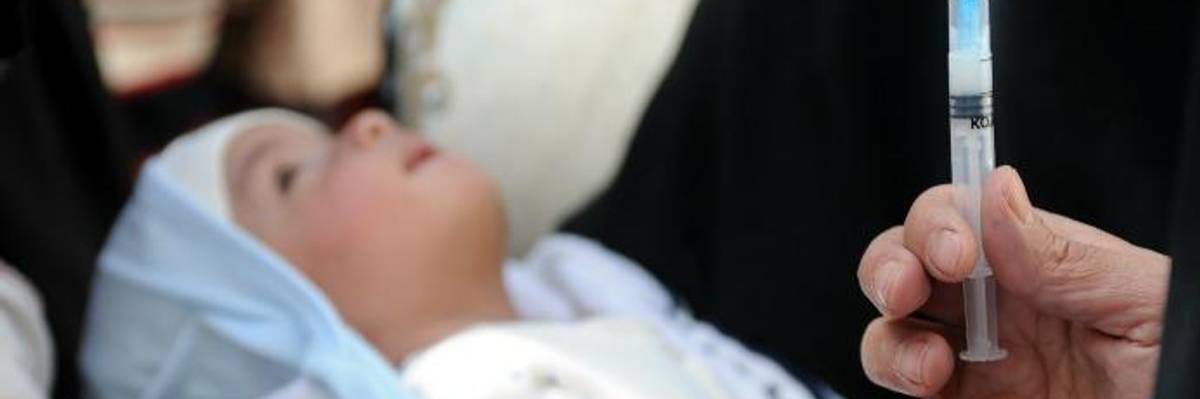
A nurse gives a baby an anti-diphtheria vaccine at a health center on March 13, 2018 in Sana'a, Yemen. (Photo: Getty/Mohammed Hamoud)
In a development revealing just how dire the situation is for Yemeni civilians and threatening to compound the catastrophe, the International Committee of the Red Cross (ICRC) on Thursday announced it is pulling 71 of its staffers out of Yemen--a move the organization admits will cripple its humanitarian efforts.
In response, Amnesty International said it marked a "bleak" new low in the ongoing conflict.
In a statement released Thursday, the ICRC cited "a series of incidents and threats," including a gunman killing one of its staff members in April. Security for its staff, the group said, is "a non-negotiable prerequisite."
ICRC director of operations Dominik Stillhart said the group's activities, including surgical services, clean water initiatives, and food assistance, "have been blocked, threatened, and directly targeted in recent weeks, and we see a vigorous attempt to instrumentalize our organization as a pawn in the conflict."
Samah Hadid, Amnesty International's Middle East Director of Campaigns, said such targeting "is a violation of international humanitarian law. In fact, deliberate attacks on humanitarian relief personnel amount to war crimes."
"If the conflict has proven too dangerous for humanitarian personnel, it is certainly too dangerous for civilians in need of urgent protection," Hadid stressed. "We repeat the call we've made countless times in the past three years of Yemen's conflict: all sides must respect and protect humanitarian personnel and facilities, and take every precaution to protect civilians caught up in the conflict."
The shakeup comes as a spokesperson for United Nations humanitarian office warns that any assault on the key Yemeni port city of Hodeidah "will impact hundreds of thousands of innocent civilians" and in a worst case scenario means that "as many as 250,000 people may lose everything--even their lives."
The U. N. estimates that over 6,400 civilians have already been killed and more than 10,000 have been injured since the conflict in the impoverished country broke out in 2015. The U.S. has played a key role in fueling the conflict through its backing of the Saudi-led coalition, and recent reporting indicates that role could deepen.
Legislative efforts to stop the U.S.-backed carnage, however, have thus far failed.
Dear Common Dreams reader, It’s been nearly 30 years since I co-founded Common Dreams with my late wife, Lina Newhouser. We had the radical notion that journalism should serve the public good, not corporate profits. It was clear to us from the outset what it would take to build such a project. No paid advertisements. No corporate sponsors. No millionaire publisher telling us what to think or do. Many people said we wouldn't last a year, but we proved those doubters wrong. Together with a tremendous team of journalists and dedicated staff, we built an independent media outlet free from the constraints of profits and corporate control. Our mission has always been simple: To inform. To inspire. To ignite change for the common good. Building Common Dreams was not easy. Our survival was never guaranteed. When you take on the most powerful forces—Wall Street greed, fossil fuel industry destruction, Big Tech lobbyists, and uber-rich oligarchs who have spent billions upon billions rigging the economy and democracy in their favor—the only bulwark you have is supporters who believe in your work. But here’s the urgent message from me today. It's never been this bad out there. And it's never been this hard to keep us going. At the very moment Common Dreams is most needed, the threats we face are intensifying. We need your support now more than ever. We don't accept corporate advertising and never will. We don't have a paywall because we don't think people should be blocked from critical news based on their ability to pay. Everything we do is funded by the donations of readers like you. When everyone does the little they can afford, we are strong. But if that support retreats or dries up, so do we. Will you donate now to make sure Common Dreams not only survives but thrives? —Craig Brown, Co-founder |
In a development revealing just how dire the situation is for Yemeni civilians and threatening to compound the catastrophe, the International Committee of the Red Cross (ICRC) on Thursday announced it is pulling 71 of its staffers out of Yemen--a move the organization admits will cripple its humanitarian efforts.
In response, Amnesty International said it marked a "bleak" new low in the ongoing conflict.
In a statement released Thursday, the ICRC cited "a series of incidents and threats," including a gunman killing one of its staff members in April. Security for its staff, the group said, is "a non-negotiable prerequisite."
ICRC director of operations Dominik Stillhart said the group's activities, including surgical services, clean water initiatives, and food assistance, "have been blocked, threatened, and directly targeted in recent weeks, and we see a vigorous attempt to instrumentalize our organization as a pawn in the conflict."
Samah Hadid, Amnesty International's Middle East Director of Campaigns, said such targeting "is a violation of international humanitarian law. In fact, deliberate attacks on humanitarian relief personnel amount to war crimes."
"If the conflict has proven too dangerous for humanitarian personnel, it is certainly too dangerous for civilians in need of urgent protection," Hadid stressed. "We repeat the call we've made countless times in the past three years of Yemen's conflict: all sides must respect and protect humanitarian personnel and facilities, and take every precaution to protect civilians caught up in the conflict."
The shakeup comes as a spokesperson for United Nations humanitarian office warns that any assault on the key Yemeni port city of Hodeidah "will impact hundreds of thousands of innocent civilians" and in a worst case scenario means that "as many as 250,000 people may lose everything--even their lives."
The U. N. estimates that over 6,400 civilians have already been killed and more than 10,000 have been injured since the conflict in the impoverished country broke out in 2015. The U.S. has played a key role in fueling the conflict through its backing of the Saudi-led coalition, and recent reporting indicates that role could deepen.
Legislative efforts to stop the U.S.-backed carnage, however, have thus far failed.
In a development revealing just how dire the situation is for Yemeni civilians and threatening to compound the catastrophe, the International Committee of the Red Cross (ICRC) on Thursday announced it is pulling 71 of its staffers out of Yemen--a move the organization admits will cripple its humanitarian efforts.
In response, Amnesty International said it marked a "bleak" new low in the ongoing conflict.
In a statement released Thursday, the ICRC cited "a series of incidents and threats," including a gunman killing one of its staff members in April. Security for its staff, the group said, is "a non-negotiable prerequisite."
ICRC director of operations Dominik Stillhart said the group's activities, including surgical services, clean water initiatives, and food assistance, "have been blocked, threatened, and directly targeted in recent weeks, and we see a vigorous attempt to instrumentalize our organization as a pawn in the conflict."
Samah Hadid, Amnesty International's Middle East Director of Campaigns, said such targeting "is a violation of international humanitarian law. In fact, deliberate attacks on humanitarian relief personnel amount to war crimes."
"If the conflict has proven too dangerous for humanitarian personnel, it is certainly too dangerous for civilians in need of urgent protection," Hadid stressed. "We repeat the call we've made countless times in the past three years of Yemen's conflict: all sides must respect and protect humanitarian personnel and facilities, and take every precaution to protect civilians caught up in the conflict."
The shakeup comes as a spokesperson for United Nations humanitarian office warns that any assault on the key Yemeni port city of Hodeidah "will impact hundreds of thousands of innocent civilians" and in a worst case scenario means that "as many as 250,000 people may lose everything--even their lives."
The U. N. estimates that over 6,400 civilians have already been killed and more than 10,000 have been injured since the conflict in the impoverished country broke out in 2015. The U.S. has played a key role in fueling the conflict through its backing of the Saudi-led coalition, and recent reporting indicates that role could deepen.
Legislative efforts to stop the U.S.-backed carnage, however, have thus far failed.