
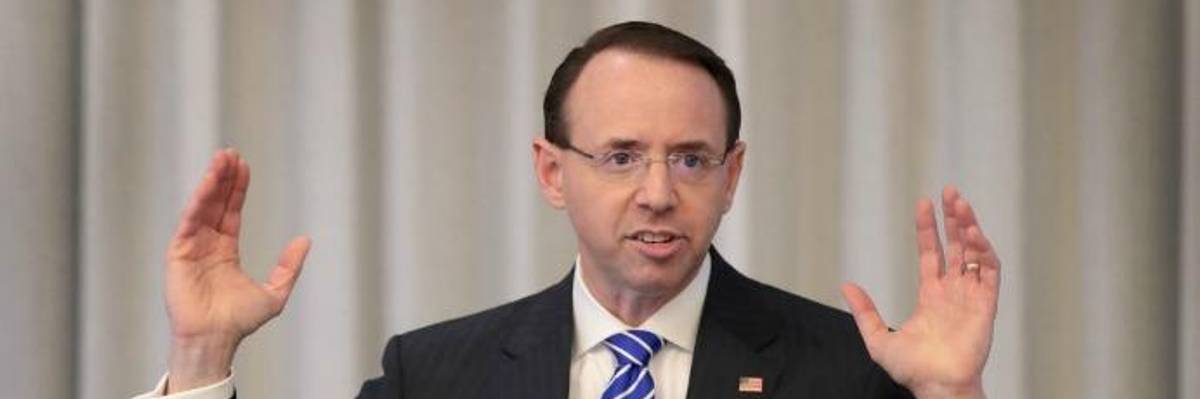
Deputy Attorney General Rod Rosenstein speaks to guests at the International Association of Defense Counsel's 2018 Corporate Counsel College on April 26, 2018 in Chicago, Illinois. Rosenstein has been overseeing Robert Mueller's probe into Russian meddling in the 2016 election since Attorney General Jeff Sessions recused himself. (Photo: Scott Olson/Getty Images)
'State of Constitutional Crisis' as DOJ Bows to Trump Demand for Probe into Alleged Surveillance of His Campaign
Legal analysts argued the Justice Department "shouldn't be pursuing political charges made by the president based on zero evidence."
Responding to President Donald Trump's demand on Sunday that the Justice Department launch a probe into whether his 2016 campaign was unlawfully surveilled by the FBI for "political purposes"--a claim the president has made repeatedly without offering any evidence--Deputy Attorney General Rod Rosenstein said he has asked the inspector general (IG) to look into Trump's allegations.
"We are in a state of constitutional crisis when we have a DOJ acting at the behest of the president."
--Kristen Clarke, Lawyers' Committee for Civil Rights Under Law
"If anyone did infiltrate or surveil participants in a presidential campaign for inappropriate purposes, we need to know about it and take appropriate action," Deputy Attorney General Rod Rosenstein said in a statement that some legal analysts characterized as a "dangerous" capitulation to a president who is himself under federal investigation.
"The IG shouldn't be pursuing political charges made by the president based on zero evidence," argued MSNBC legal analyst Matthew Miller in response to Rosenstein's statement.
Trump's demand for an investigation into the actions of the Obama administration's FBI came on the heels of his repeated threats in recent weeks to "get involved" with the Justice Department if special counsel Robert Mueller's Russia probe doesn't end quickly--warnings that critics denounced as explicit threats to obstruct justice.
"We are in a state of constitutional crisis when we have a DOJ acting at the behest of the president," Kristen Clarke, president of the Lawyers' Committee for Civil Rights Under Law, wrote on the heels of Trump's tweet, which capped off a prolonged Sunday Twitter rant in which the president continued to call Mueller's probe a "witch hunt."
If Rosenstein and Attorney General Jeff Sessions follow Trump's lead, Clarke concluded, the result will be a "complete breakdown of democracy."
While some legal analysts argued Rosenstein's statement in response to Trump's demand is evidence that the Justice Department is dropping its pretense of independence to cater to the whims of the president, others portrayed the deputy attorney general's move as an attempt to appease Trump without actually offering any concrete promises or fulfilling any of his wishes.
In an analysis of Trump's Sunday tweets and Rosenstein's subsequent announcement at DOJ, CNN's Stephen Collinson on Monday morning argued that while the president's demand does not appear to be illegal in itself, "some critics believe that Trump's repeated pattern of leaning on the Justice Department and the FBI over the Russia investigation could come close to showing intent that could amount to obstruction of justice."
Trump's Twitter outburst "also raised potential scenarios that would threaten the integrity of U.S. governance: first, that Trump could use his power to go after a political opponent and, second, that he means to derail or even end a criminal probe into his own conduct," Collinson noted. "His gambit Sunday also fits into an effort by the White House, Trump's allies on Capitol Hill, and conservative media cheerleaders to muddy the reputations and any eventual findings of special counsel Robert Mueller's team as well as to cement the President's political base."
An Urgent Message From Our Co-Founder
Dear Common Dreams reader, It’s been nearly 30 years since I co-founded Common Dreams with my late wife, Lina Newhouser. We had the radical notion that journalism should serve the public good, not corporate profits. It was clear to us from the outset what it would take to build such a project. No paid advertisements. No corporate sponsors. No millionaire publisher telling us what to think or do. Many people said we wouldn't last a year, but we proved those doubters wrong. Together with a tremendous team of journalists and dedicated staff, we built an independent media outlet free from the constraints of profits and corporate control. Our mission has always been simple: To inform. To inspire. To ignite change for the common good. Building Common Dreams was not easy. Our survival was never guaranteed. When you take on the most powerful forces—Wall Street greed, fossil fuel industry destruction, Big Tech lobbyists, and uber-rich oligarchs who have spent billions upon billions rigging the economy and democracy in their favor—the only bulwark you have is supporters who believe in your work. But here’s the urgent message from me today. It's never been this bad out there. And it's never been this hard to keep us going. At the very moment Common Dreams is most needed, the threats we face are intensifying. We need your support now more than ever. We don't accept corporate advertising and never will. We don't have a paywall because we don't think people should be blocked from critical news based on their ability to pay. Everything we do is funded by the donations of readers like you. When everyone does the little they can afford, we are strong. But if that support retreats or dries up, so do we. Will you donate now to make sure Common Dreams not only survives but thrives? —Craig Brown, Co-founder |
Responding to President Donald Trump's demand on Sunday that the Justice Department launch a probe into whether his 2016 campaign was unlawfully surveilled by the FBI for "political purposes"--a claim the president has made repeatedly without offering any evidence--Deputy Attorney General Rod Rosenstein said he has asked the inspector general (IG) to look into Trump's allegations.
"We are in a state of constitutional crisis when we have a DOJ acting at the behest of the president."
--Kristen Clarke, Lawyers' Committee for Civil Rights Under Law
"If anyone did infiltrate or surveil participants in a presidential campaign for inappropriate purposes, we need to know about it and take appropriate action," Deputy Attorney General Rod Rosenstein said in a statement that some legal analysts characterized as a "dangerous" capitulation to a president who is himself under federal investigation.
"The IG shouldn't be pursuing political charges made by the president based on zero evidence," argued MSNBC legal analyst Matthew Miller in response to Rosenstein's statement.
Trump's demand for an investigation into the actions of the Obama administration's FBI came on the heels of his repeated threats in recent weeks to "get involved" with the Justice Department if special counsel Robert Mueller's Russia probe doesn't end quickly--warnings that critics denounced as explicit threats to obstruct justice.
"We are in a state of constitutional crisis when we have a DOJ acting at the behest of the president," Kristen Clarke, president of the Lawyers' Committee for Civil Rights Under Law, wrote on the heels of Trump's tweet, which capped off a prolonged Sunday Twitter rant in which the president continued to call Mueller's probe a "witch hunt."
If Rosenstein and Attorney General Jeff Sessions follow Trump's lead, Clarke concluded, the result will be a "complete breakdown of democracy."
While some legal analysts argued Rosenstein's statement in response to Trump's demand is evidence that the Justice Department is dropping its pretense of independence to cater to the whims of the president, others portrayed the deputy attorney general's move as an attempt to appease Trump without actually offering any concrete promises or fulfilling any of his wishes.
In an analysis of Trump's Sunday tweets and Rosenstein's subsequent announcement at DOJ, CNN's Stephen Collinson on Monday morning argued that while the president's demand does not appear to be illegal in itself, "some critics believe that Trump's repeated pattern of leaning on the Justice Department and the FBI over the Russia investigation could come close to showing intent that could amount to obstruction of justice."
Trump's Twitter outburst "also raised potential scenarios that would threaten the integrity of U.S. governance: first, that Trump could use his power to go after a political opponent and, second, that he means to derail or even end a criminal probe into his own conduct," Collinson noted. "His gambit Sunday also fits into an effort by the White House, Trump's allies on Capitol Hill, and conservative media cheerleaders to muddy the reputations and any eventual findings of special counsel Robert Mueller's team as well as to cement the President's political base."
Responding to President Donald Trump's demand on Sunday that the Justice Department launch a probe into whether his 2016 campaign was unlawfully surveilled by the FBI for "political purposes"--a claim the president has made repeatedly without offering any evidence--Deputy Attorney General Rod Rosenstein said he has asked the inspector general (IG) to look into Trump's allegations.
"We are in a state of constitutional crisis when we have a DOJ acting at the behest of the president."
--Kristen Clarke, Lawyers' Committee for Civil Rights Under Law
"If anyone did infiltrate or surveil participants in a presidential campaign for inappropriate purposes, we need to know about it and take appropriate action," Deputy Attorney General Rod Rosenstein said in a statement that some legal analysts characterized as a "dangerous" capitulation to a president who is himself under federal investigation.
"The IG shouldn't be pursuing political charges made by the president based on zero evidence," argued MSNBC legal analyst Matthew Miller in response to Rosenstein's statement.
Trump's demand for an investigation into the actions of the Obama administration's FBI came on the heels of his repeated threats in recent weeks to "get involved" with the Justice Department if special counsel Robert Mueller's Russia probe doesn't end quickly--warnings that critics denounced as explicit threats to obstruct justice.
"We are in a state of constitutional crisis when we have a DOJ acting at the behest of the president," Kristen Clarke, president of the Lawyers' Committee for Civil Rights Under Law, wrote on the heels of Trump's tweet, which capped off a prolonged Sunday Twitter rant in which the president continued to call Mueller's probe a "witch hunt."
If Rosenstein and Attorney General Jeff Sessions follow Trump's lead, Clarke concluded, the result will be a "complete breakdown of democracy."
While some legal analysts argued Rosenstein's statement in response to Trump's demand is evidence that the Justice Department is dropping its pretense of independence to cater to the whims of the president, others portrayed the deputy attorney general's move as an attempt to appease Trump without actually offering any concrete promises or fulfilling any of his wishes.
In an analysis of Trump's Sunday tweets and Rosenstein's subsequent announcement at DOJ, CNN's Stephen Collinson on Monday morning argued that while the president's demand does not appear to be illegal in itself, "some critics believe that Trump's repeated pattern of leaning on the Justice Department and the FBI over the Russia investigation could come close to showing intent that could amount to obstruction of justice."
Trump's Twitter outburst "also raised potential scenarios that would threaten the integrity of U.S. governance: first, that Trump could use his power to go after a political opponent and, second, that he means to derail or even end a criminal probe into his own conduct," Collinson noted. "His gambit Sunday also fits into an effort by the White House, Trump's allies on Capitol Hill, and conservative media cheerleaders to muddy the reputations and any eventual findings of special counsel Robert Mueller's team as well as to cement the President's political base."