

SUBSCRIBE TO OUR FREE NEWSLETTER
Daily news & progressive opinion—funded by the people, not the corporations—delivered straight to your inbox.
5
#000000
#FFFFFF
To donate by check, phone, or other method, see our More Ways to Give page.
Daily news & progressive opinion—funded by the people, not the corporations—delivered straight to your inbox.
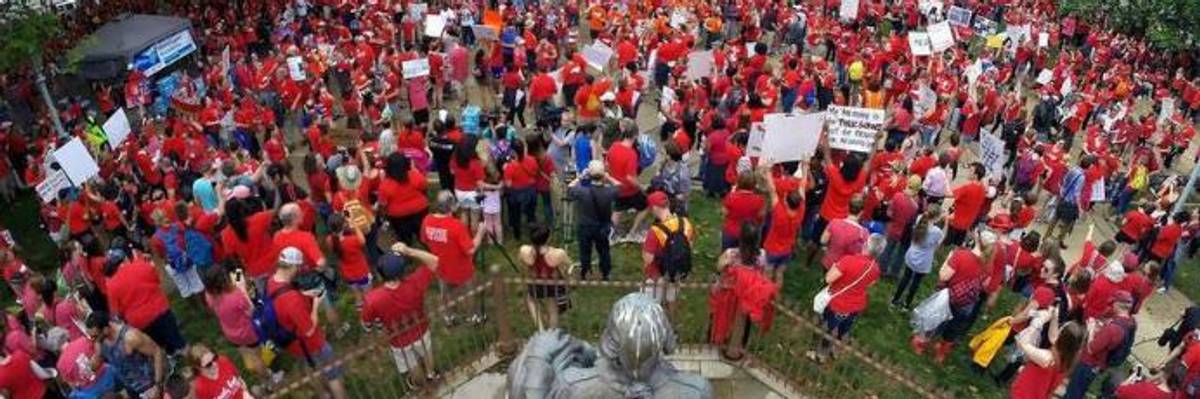
An estimated 20,000 teachers marched in Raleigh, North Carolina on Wednesday to demand that state lawmakers invest more in public education. (Photo: Chuck Liddy/News & Observer)
Drawing inspiration from a wave of public education protests that have swept across several states in recent months, nearly 20,000 North Carolina teachers descended on Raleigh, the state capital, on Wednesday to "march for students and rally for respect."
Wednesday's event is "the beginning of a six-month stretch of time to hold our legislators accountable for prioritizing corporate tax cuts, instead of our classrooms," and work toward the ultimate goal of "electing more pro-public education leaders in North Carolina to return our state back to a beacon for public schools," the North Carolina Association of Educators (NCAE) said in a statement that laid out a list of expectations for lawmakers.
"These specific public education priorities will give every student an opportunity to succeed, and help recruit and retain educators as we face a critical shortage in our classrooms and school buildings," asserted NCAE president Mark Jewell. "North Carolina public school educators, parents, and our communities demand better for our students."
North Carolina, according to the NCAE, spends $2,400 less per student than the national average, and pays educators about $9,600 less. "When accounting for inflation," the statement noted, "our students and educators lag even further behind."
Local television news crews captured videos of teachers marching and chanting, "What do we want? Funding! When do we want it? Now!"
"We saw Kentucky, Oklahoma and Arizona, of course, and that momentum that has been building in these 'right-to-work states' is inspiring," Kristin Beller, a teachers' union leader in Wake County, North Carolina, told the Guardian, which noted that Wednesday's mass action is "a bold move for North Carolina as teachers in in the state lack collective bargaining rights--something they hope helps launch a political movement."
While Wednesday's one-day demonstration was motivated by the same issues that have spurred recent strikes and walkouts in Arizona, Colorado, Kentucky, Oklahoma, and West Viriginia, as the News & Observer explained, most participants in North Carolina used personal days to take part in "the largest act of organized teacher political action in state history."
To work around vacation day rules, the newspaper reports, "organizers of Wednesday's march encouraged teachers to use a provision in state law that allows them to take personal leave with at least five days' advance notice--as long as a substitute is available and the teacher pays a $50 'required substitute deduction.'" Dozens of districts canceled classes, meaning those educators won't be forced to pay the sub fee.
Teachers and reporters posted photos, videos, and updates from Raleigh with the hashtags #RedforEd, #RedforEdNC, and #NCTeacherRally.
Dear Common Dreams reader, It’s been nearly 30 years since I co-founded Common Dreams with my late wife, Lina Newhouser. We had the radical notion that journalism should serve the public good, not corporate profits. It was clear to us from the outset what it would take to build such a project. No paid advertisements. No corporate sponsors. No millionaire publisher telling us what to think or do. Many people said we wouldn't last a year, but we proved those doubters wrong. Together with a tremendous team of journalists and dedicated staff, we built an independent media outlet free from the constraints of profits and corporate control. Our mission has always been simple: To inform. To inspire. To ignite change for the common good. Building Common Dreams was not easy. Our survival was never guaranteed. When you take on the most powerful forces—Wall Street greed, fossil fuel industry destruction, Big Tech lobbyists, and uber-rich oligarchs who have spent billions upon billions rigging the economy and democracy in their favor—the only bulwark you have is supporters who believe in your work. But here’s the urgent message from me today. It's never been this bad out there. And it's never been this hard to keep us going. At the very moment Common Dreams is most needed, the threats we face are intensifying. We need your support now more than ever. We don't accept corporate advertising and never will. We don't have a paywall because we don't think people should be blocked from critical news based on their ability to pay. Everything we do is funded by the donations of readers like you. When everyone does the little they can afford, we are strong. But if that support retreats or dries up, so do we. Will you donate now to make sure Common Dreams not only survives but thrives? —Craig Brown, Co-founder |
Drawing inspiration from a wave of public education protests that have swept across several states in recent months, nearly 20,000 North Carolina teachers descended on Raleigh, the state capital, on Wednesday to "march for students and rally for respect."
Wednesday's event is "the beginning of a six-month stretch of time to hold our legislators accountable for prioritizing corporate tax cuts, instead of our classrooms," and work toward the ultimate goal of "electing more pro-public education leaders in North Carolina to return our state back to a beacon for public schools," the North Carolina Association of Educators (NCAE) said in a statement that laid out a list of expectations for lawmakers.
"These specific public education priorities will give every student an opportunity to succeed, and help recruit and retain educators as we face a critical shortage in our classrooms and school buildings," asserted NCAE president Mark Jewell. "North Carolina public school educators, parents, and our communities demand better for our students."
North Carolina, according to the NCAE, spends $2,400 less per student than the national average, and pays educators about $9,600 less. "When accounting for inflation," the statement noted, "our students and educators lag even further behind."
Local television news crews captured videos of teachers marching and chanting, "What do we want? Funding! When do we want it? Now!"
"We saw Kentucky, Oklahoma and Arizona, of course, and that momentum that has been building in these 'right-to-work states' is inspiring," Kristin Beller, a teachers' union leader in Wake County, North Carolina, told the Guardian, which noted that Wednesday's mass action is "a bold move for North Carolina as teachers in in the state lack collective bargaining rights--something they hope helps launch a political movement."
While Wednesday's one-day demonstration was motivated by the same issues that have spurred recent strikes and walkouts in Arizona, Colorado, Kentucky, Oklahoma, and West Viriginia, as the News & Observer explained, most participants in North Carolina used personal days to take part in "the largest act of organized teacher political action in state history."
To work around vacation day rules, the newspaper reports, "organizers of Wednesday's march encouraged teachers to use a provision in state law that allows them to take personal leave with at least five days' advance notice--as long as a substitute is available and the teacher pays a $50 'required substitute deduction.'" Dozens of districts canceled classes, meaning those educators won't be forced to pay the sub fee.
Teachers and reporters posted photos, videos, and updates from Raleigh with the hashtags #RedforEd, #RedforEdNC, and #NCTeacherRally.
Drawing inspiration from a wave of public education protests that have swept across several states in recent months, nearly 20,000 North Carolina teachers descended on Raleigh, the state capital, on Wednesday to "march for students and rally for respect."
Wednesday's event is "the beginning of a six-month stretch of time to hold our legislators accountable for prioritizing corporate tax cuts, instead of our classrooms," and work toward the ultimate goal of "electing more pro-public education leaders in North Carolina to return our state back to a beacon for public schools," the North Carolina Association of Educators (NCAE) said in a statement that laid out a list of expectations for lawmakers.
"These specific public education priorities will give every student an opportunity to succeed, and help recruit and retain educators as we face a critical shortage in our classrooms and school buildings," asserted NCAE president Mark Jewell. "North Carolina public school educators, parents, and our communities demand better for our students."
North Carolina, according to the NCAE, spends $2,400 less per student than the national average, and pays educators about $9,600 less. "When accounting for inflation," the statement noted, "our students and educators lag even further behind."
Local television news crews captured videos of teachers marching and chanting, "What do we want? Funding! When do we want it? Now!"
"We saw Kentucky, Oklahoma and Arizona, of course, and that momentum that has been building in these 'right-to-work states' is inspiring," Kristin Beller, a teachers' union leader in Wake County, North Carolina, told the Guardian, which noted that Wednesday's mass action is "a bold move for North Carolina as teachers in in the state lack collective bargaining rights--something they hope helps launch a political movement."
While Wednesday's one-day demonstration was motivated by the same issues that have spurred recent strikes and walkouts in Arizona, Colorado, Kentucky, Oklahoma, and West Viriginia, as the News & Observer explained, most participants in North Carolina used personal days to take part in "the largest act of organized teacher political action in state history."
To work around vacation day rules, the newspaper reports, "organizers of Wednesday's march encouraged teachers to use a provision in state law that allows them to take personal leave with at least five days' advance notice--as long as a substitute is available and the teacher pays a $50 'required substitute deduction.'" Dozens of districts canceled classes, meaning those educators won't be forced to pay the sub fee.
Teachers and reporters posted photos, videos, and updates from Raleigh with the hashtags #RedforEd, #RedforEdNC, and #NCTeacherRally.

