SUBSCRIBE TO OUR FREE NEWSLETTER
Daily news & progressive opinion—funded by the people, not the corporations—delivered straight to your inbox.
5
#000000
#FFFFFF
To donate by check, phone, or other method, see our More Ways to Give page.
Daily news & progressive opinion—funded by the people, not the corporations—delivered straight to your inbox.
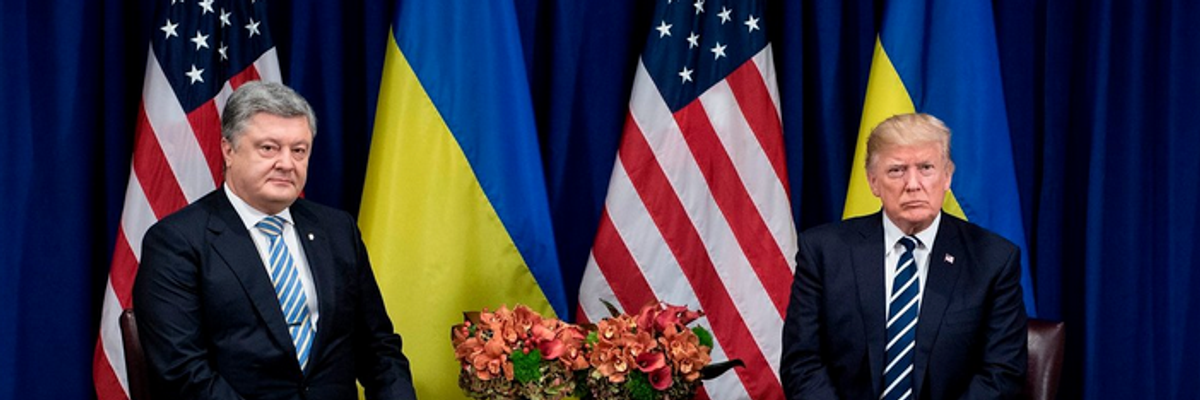
President Petro O. Poroshenko of Ukraine and Mr. Trump in New York last year. The Trump administration is selling sophisticated anti-tank missiles, called Javelins, to Ukraine. (Photo: Brendan Smialowski/Agence France-Presse/Getty Images)
New reporting by the New York Times on Wednesday strongly suggests that the government of Ukraine has ended its cooperation with the ongoing probe by Special Counsel Robert Mueller into alleged interference in the 2016 elections due to concerns that further involvement with the investigation could potentially imperil a weapons deal it wants the Trump administration to approve.
The Times reporting centers around multiple investigations by the Ukrainians focused on dealings inside the country by former top Trump aide Paul Manafort, now under indictment in the U.S. for money laundering and other schemes. Manafort, of course, has featured prominently in the Mueller probe.
According to the newspaper:
The cases [involving Manafort's dealings] are just too sensitive for a government deeply reliant on United States financial and military aid, and keenly aware of Mr. Trump's distaste for the investigation by the special counsel, Robert S. Mueller III, into possible collusion between Russia and his campaign, some lawmakers say.
The decision to halt the investigations by an anticorruption prosecutor was handed down at a delicate moment for Ukraine, as the Trump administration was finalizing plans to sell the country sophisticated anti-tank missiles, called Javelins.
Ukraine MP Volodymyr Ariev--described as an ally of President Petro O. Poroshenko, opendly admitted the government's intention was to put investigations what he described as "the long-term box."
"In every possible way, we will avoid irritating the top American officials," Ariev told the Times. "We shouldn't spoil relations with the administration."
The reporting also notes that Ukrainian law enforcement may also have dinged the Mueller probe in other ways, including by allowing "a potential witness to possible collusion between the Trump campaign and Russia to leave for Russia, putting him out of reach for questioning."
Dear Common Dreams reader, It’s been nearly 30 years since I co-founded Common Dreams with my late wife, Lina Newhouser. We had the radical notion that journalism should serve the public good, not corporate profits. It was clear to us from the outset what it would take to build such a project. No paid advertisements. No corporate sponsors. No millionaire publisher telling us what to think or do. Many people said we wouldn't last a year, but we proved those doubters wrong. Together with a tremendous team of journalists and dedicated staff, we built an independent media outlet free from the constraints of profits and corporate control. Our mission has always been simple: To inform. To inspire. To ignite change for the common good. Building Common Dreams was not easy. Our survival was never guaranteed. When you take on the most powerful forces—Wall Street greed, fossil fuel industry destruction, Big Tech lobbyists, and uber-rich oligarchs who have spent billions upon billions rigging the economy and democracy in their favor—the only bulwark you have is supporters who believe in your work. But here’s the urgent message from me today. It's never been this bad out there. And it's never been this hard to keep us going. At the very moment Common Dreams is most needed, the threats we face are intensifying. We need your support now more than ever. We don't accept corporate advertising and never will. We don't have a paywall because we don't think people should be blocked from critical news based on their ability to pay. Everything we do is funded by the donations of readers like you. When everyone does the little they can afford, we are strong. But if that support retreats or dries up, so do we. Will you donate now to make sure Common Dreams not only survives but thrives? —Craig Brown, Co-founder |
New reporting by the New York Times on Wednesday strongly suggests that the government of Ukraine has ended its cooperation with the ongoing probe by Special Counsel Robert Mueller into alleged interference in the 2016 elections due to concerns that further involvement with the investigation could potentially imperil a weapons deal it wants the Trump administration to approve.
The Times reporting centers around multiple investigations by the Ukrainians focused on dealings inside the country by former top Trump aide Paul Manafort, now under indictment in the U.S. for money laundering and other schemes. Manafort, of course, has featured prominently in the Mueller probe.
According to the newspaper:
The cases [involving Manafort's dealings] are just too sensitive for a government deeply reliant on United States financial and military aid, and keenly aware of Mr. Trump's distaste for the investigation by the special counsel, Robert S. Mueller III, into possible collusion between Russia and his campaign, some lawmakers say.
The decision to halt the investigations by an anticorruption prosecutor was handed down at a delicate moment for Ukraine, as the Trump administration was finalizing plans to sell the country sophisticated anti-tank missiles, called Javelins.
Ukraine MP Volodymyr Ariev--described as an ally of President Petro O. Poroshenko, opendly admitted the government's intention was to put investigations what he described as "the long-term box."
"In every possible way, we will avoid irritating the top American officials," Ariev told the Times. "We shouldn't spoil relations with the administration."
The reporting also notes that Ukrainian law enforcement may also have dinged the Mueller probe in other ways, including by allowing "a potential witness to possible collusion between the Trump campaign and Russia to leave for Russia, putting him out of reach for questioning."
New reporting by the New York Times on Wednesday strongly suggests that the government of Ukraine has ended its cooperation with the ongoing probe by Special Counsel Robert Mueller into alleged interference in the 2016 elections due to concerns that further involvement with the investigation could potentially imperil a weapons deal it wants the Trump administration to approve.
The Times reporting centers around multiple investigations by the Ukrainians focused on dealings inside the country by former top Trump aide Paul Manafort, now under indictment in the U.S. for money laundering and other schemes. Manafort, of course, has featured prominently in the Mueller probe.
According to the newspaper:
The cases [involving Manafort's dealings] are just too sensitive for a government deeply reliant on United States financial and military aid, and keenly aware of Mr. Trump's distaste for the investigation by the special counsel, Robert S. Mueller III, into possible collusion between Russia and his campaign, some lawmakers say.
The decision to halt the investigations by an anticorruption prosecutor was handed down at a delicate moment for Ukraine, as the Trump administration was finalizing plans to sell the country sophisticated anti-tank missiles, called Javelins.
Ukraine MP Volodymyr Ariev--described as an ally of President Petro O. Poroshenko, opendly admitted the government's intention was to put investigations what he described as "the long-term box."
"In every possible way, we will avoid irritating the top American officials," Ariev told the Times. "We shouldn't spoil relations with the administration."
The reporting also notes that Ukrainian law enforcement may also have dinged the Mueller probe in other ways, including by allowing "a potential witness to possible collusion between the Trump campaign and Russia to leave for Russia, putting him out of reach for questioning."