
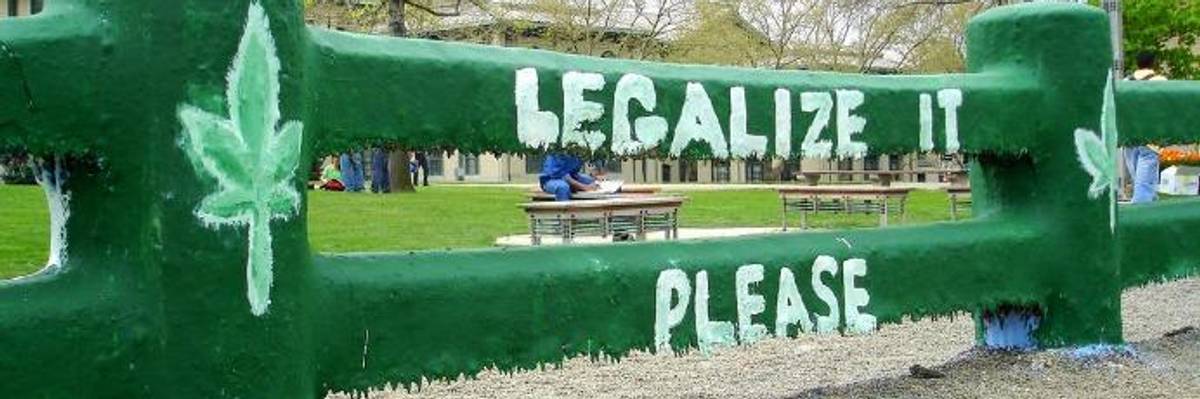
"The time has come to decriminalize marijuana," Sen. Chuck Schumer (D-N.Y.) said Friday. (Photo: Elston/flickr/cc)
Marijuana Decriminalization Strides Forward as Schumer Announces New Federal Bill
Schumer, the top Senate Democrat, says it's "simply the right thing to do."
In a positive step to address the failed war on drugs, the Senate's top Democrat, Chuck Schumer of New York, announced Friday that he will soon put forth legislation to effectively decriminalize marijuana at the federal level, calling it "the right thing to do for America."
"The time has come to decriminalize marijuana," stated Schumer. "My thinking--as well as the general population's views--on the issue has evolved, and so I believe there's no better time than the present to get this done. It's simply the right thing to do."
"When I first came to Congress in 1981, only 1 in 4 Americans believed marijuana should be made legal. Today, that number has climbed to nearly two thirds, a record high," he writes at Medium.
The Drug Policy Alliance gave the announcement cautious praise, writing on Twitter: "We're glad to see @SenSchumer come around and finally support federal marijuana reform! Looking forward to seeing more details about his bill, but it sounds like he wants to de-schedule marijuana & completely remove it from the Controlled Substances Act."
Schumer first announced the move Thursday--the day before the drug's unofficial holiday--to VICE News. The legislation is expected within the next week, the news outlet reported.
The key change Schumer's legislation would effect is removing marijuana from the list of "Schedule 1" drugs, where it sits alongside heroin and LSD. In a Twitter thread, the senator outlines the other changes it would bring about:
Schumer's formal announcement comes a day after Sen. Bernie Sanders (I-Vt.) announced he became the third co-sponsor of the Marijuana Justice Act, introduced by Sen. Cory Booker (D-N.J.). Sens. Ron Wyden (D-Ore.) and Kirsten Gilibrand (N.Y.) are already co-sponsors, and Rep. Barbara Lee (D-Calif.) introduced a companion bill in the House. Lee argued the legislation was especially pressing given the Trump administration's "doubling down on unjust marijuana criminalization policies."
Like Schumer's expected legislation, Booker's bill would take marijuana off the list of scheduled substances. Booker's would also establish a $500 million fund to annually reinvest in communities most impacted by the war on drugs, incentivize states to legalize marijuana, and expunge federal marijuana use and possession crimes.
In a CNN op-ed on Friday, Drug Policy Alliance staffers Jolene Forman and Suchitra Rajagopalan argue that now is the time to "look beyond just legalizing" marijuana and make sure legislation recognizes the disproportionate impact marijuana criminalization has had on non-white communities.
"Marijuana legalization isn't--and shouldn't be--simply about greater access to marijuana," they write. "We must center the people who have been most harmed by decades of racialized drug policies. If we don't, marijuana legalization won't fulfill its potential to repair the devastation that mass criminalization has wrought on black and brown communities."
An Urgent Message From Our Co-Founder
Dear Common Dreams reader, It’s been nearly 30 years since I co-founded Common Dreams with my late wife, Lina Newhouser. We had the radical notion that journalism should serve the public good, not corporate profits. It was clear to us from the outset what it would take to build such a project. No paid advertisements. No corporate sponsors. No millionaire publisher telling us what to think or do. Many people said we wouldn't last a year, but we proved those doubters wrong. Together with a tremendous team of journalists and dedicated staff, we built an independent media outlet free from the constraints of profits and corporate control. Our mission has always been simple: To inform. To inspire. To ignite change for the common good. Building Common Dreams was not easy. Our survival was never guaranteed. When you take on the most powerful forces—Wall Street greed, fossil fuel industry destruction, Big Tech lobbyists, and uber-rich oligarchs who have spent billions upon billions rigging the economy and democracy in their favor—the only bulwark you have is supporters who believe in your work. But here’s the urgent message from me today. It's never been this bad out there. And it's never been this hard to keep us going. At the very moment Common Dreams is most needed, the threats we face are intensifying. We need your support now more than ever. We don't accept corporate advertising and never will. We don't have a paywall because we don't think people should be blocked from critical news based on their ability to pay. Everything we do is funded by the donations of readers like you. When everyone does the little they can afford, we are strong. But if that support retreats or dries up, so do we. Will you donate now to make sure Common Dreams not only survives but thrives? —Craig Brown, Co-founder |
In a positive step to address the failed war on drugs, the Senate's top Democrat, Chuck Schumer of New York, announced Friday that he will soon put forth legislation to effectively decriminalize marijuana at the federal level, calling it "the right thing to do for America."
"The time has come to decriminalize marijuana," stated Schumer. "My thinking--as well as the general population's views--on the issue has evolved, and so I believe there's no better time than the present to get this done. It's simply the right thing to do."
"When I first came to Congress in 1981, only 1 in 4 Americans believed marijuana should be made legal. Today, that number has climbed to nearly two thirds, a record high," he writes at Medium.
The Drug Policy Alliance gave the announcement cautious praise, writing on Twitter: "We're glad to see @SenSchumer come around and finally support federal marijuana reform! Looking forward to seeing more details about his bill, but it sounds like he wants to de-schedule marijuana & completely remove it from the Controlled Substances Act."
Schumer first announced the move Thursday--the day before the drug's unofficial holiday--to VICE News. The legislation is expected within the next week, the news outlet reported.
The key change Schumer's legislation would effect is removing marijuana from the list of "Schedule 1" drugs, where it sits alongside heroin and LSD. In a Twitter thread, the senator outlines the other changes it would bring about:
Schumer's formal announcement comes a day after Sen. Bernie Sanders (I-Vt.) announced he became the third co-sponsor of the Marijuana Justice Act, introduced by Sen. Cory Booker (D-N.J.). Sens. Ron Wyden (D-Ore.) and Kirsten Gilibrand (N.Y.) are already co-sponsors, and Rep. Barbara Lee (D-Calif.) introduced a companion bill in the House. Lee argued the legislation was especially pressing given the Trump administration's "doubling down on unjust marijuana criminalization policies."
Like Schumer's expected legislation, Booker's bill would take marijuana off the list of scheduled substances. Booker's would also establish a $500 million fund to annually reinvest in communities most impacted by the war on drugs, incentivize states to legalize marijuana, and expunge federal marijuana use and possession crimes.
In a CNN op-ed on Friday, Drug Policy Alliance staffers Jolene Forman and Suchitra Rajagopalan argue that now is the time to "look beyond just legalizing" marijuana and make sure legislation recognizes the disproportionate impact marijuana criminalization has had on non-white communities.
"Marijuana legalization isn't--and shouldn't be--simply about greater access to marijuana," they write. "We must center the people who have been most harmed by decades of racialized drug policies. If we don't, marijuana legalization won't fulfill its potential to repair the devastation that mass criminalization has wrought on black and brown communities."
In a positive step to address the failed war on drugs, the Senate's top Democrat, Chuck Schumer of New York, announced Friday that he will soon put forth legislation to effectively decriminalize marijuana at the federal level, calling it "the right thing to do for America."
"The time has come to decriminalize marijuana," stated Schumer. "My thinking--as well as the general population's views--on the issue has evolved, and so I believe there's no better time than the present to get this done. It's simply the right thing to do."
"When I first came to Congress in 1981, only 1 in 4 Americans believed marijuana should be made legal. Today, that number has climbed to nearly two thirds, a record high," he writes at Medium.
The Drug Policy Alliance gave the announcement cautious praise, writing on Twitter: "We're glad to see @SenSchumer come around and finally support federal marijuana reform! Looking forward to seeing more details about his bill, but it sounds like he wants to de-schedule marijuana & completely remove it from the Controlled Substances Act."
Schumer first announced the move Thursday--the day before the drug's unofficial holiday--to VICE News. The legislation is expected within the next week, the news outlet reported.
The key change Schumer's legislation would effect is removing marijuana from the list of "Schedule 1" drugs, where it sits alongside heroin and LSD. In a Twitter thread, the senator outlines the other changes it would bring about:
Schumer's formal announcement comes a day after Sen. Bernie Sanders (I-Vt.) announced he became the third co-sponsor of the Marijuana Justice Act, introduced by Sen. Cory Booker (D-N.J.). Sens. Ron Wyden (D-Ore.) and Kirsten Gilibrand (N.Y.) are already co-sponsors, and Rep. Barbara Lee (D-Calif.) introduced a companion bill in the House. Lee argued the legislation was especially pressing given the Trump administration's "doubling down on unjust marijuana criminalization policies."
Like Schumer's expected legislation, Booker's bill would take marijuana off the list of scheduled substances. Booker's would also establish a $500 million fund to annually reinvest in communities most impacted by the war on drugs, incentivize states to legalize marijuana, and expunge federal marijuana use and possession crimes.
In a CNN op-ed on Friday, Drug Policy Alliance staffers Jolene Forman and Suchitra Rajagopalan argue that now is the time to "look beyond just legalizing" marijuana and make sure legislation recognizes the disproportionate impact marijuana criminalization has had on non-white communities.
"Marijuana legalization isn't--and shouldn't be--simply about greater access to marijuana," they write. "We must center the people who have been most harmed by decades of racialized drug policies. If we don't, marijuana legalization won't fulfill its potential to repair the devastation that mass criminalization has wrought on black and brown communities."