SUBSCRIBE TO OUR FREE NEWSLETTER
Daily news & progressive opinion—funded by the people, not the corporations—delivered straight to your inbox.
5
#000000
#FFFFFF
To donate by check, phone, or other method, see our More Ways to Give page.
Daily news & progressive opinion—funded by the people, not the corporations—delivered straight to your inbox.
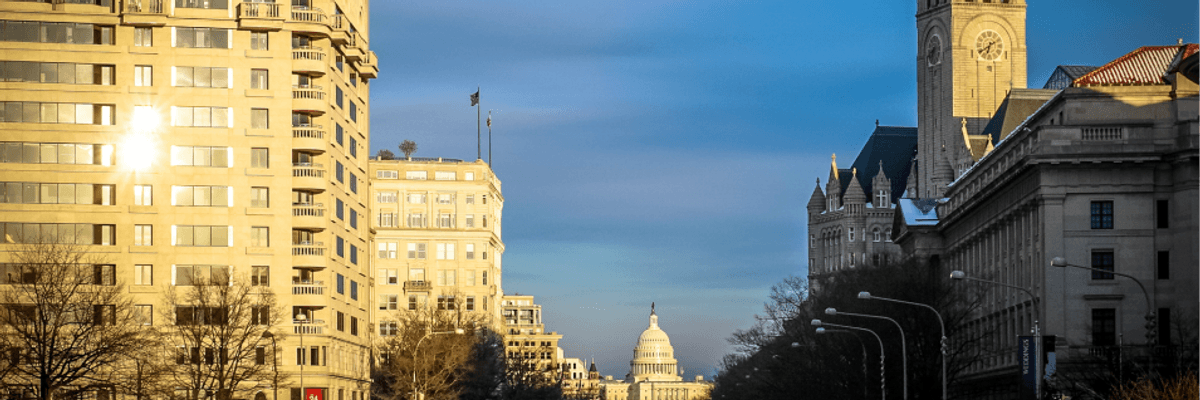
The Trump International Hotel in Washington, D.C. has been the site of regular anti-Trump demonstrations since President Donald Trump took office in 2017. (Photo: Ted Eytan/Flickr/cc)
A lawsuit alleging that President Donald Trump has violated constitutional law by profiting from his Washington, D.C. hotel will proceed, after a federal judge in Maryland rejected the Trump administration's bid to have the case thrown out on Wednesday.
The attorneys general of Washington, D.C. and Maryland allege that Trump is in violation of the Constitution's emoluments clauses, which bar the president from receiving gifts from foreign or state governments, by continuing to benefit from the business of the Trump International Hotel.
"If the president would like to avoid the case going further and curtail the serious harms caused by his unconstitutional conduct, now would be a good time to divest from his businesses." --Noah Bookbinder, CREW"The basic principal here is Donald Trump is not above the law, and the court recognized that and said that we can enforce the nation's original anti-corruption law," Maryland Attorney General Brian Frosh told the Washington Post.
Foreign heads of state and state officials have stayed in and held events at the hotel frequently since Trump took office. Maine Governor Paul LePage stayed at the property last year just before the president included a national monument that LePage had opposed in a review of national parks. A public relations firm also spent $270,000 on behalf of the Saudi government at the hotel, as the country was fighting to roll back a law allowing the families of September 11 victims to sue Saudi Arabia for any alleged involvement in the attacks.
Trump gave up running the hotel when he became president last year, but he still owns and can withdraw funds from his business at any time.
Though a similar ethics lawsuits against the president, filed by the Citizens for Ethics and Responsibility in Washington (CREW) was thrown out in December, the watchdog group is now serving as co-counsel on the attorneys generals' suit.
The judge ruled that Maryland and the District of Columbia could reasonably claim to have been harmed by the business of the Trump International Hotel, which may have an unfair advantage over hotels and convention centers in the area.
If the ruling goes unchallenged, the plaintiffs could obtain financial records of Trump's business to determine exactly how much money the organization has received from foreign and state governments.
"The president's violations of the emoluments clauses are immediate and serious, and it was vital for civic-minded leaders inside and outside of government to take decisive action to protect the constitution and the interests of the people," said CREW's executive director, Noah Bookbinder, in a statement. "If the president would like to avoid the case going further and curtail the serious harms caused by his unconstitutional conduct, now would be a good time to divest from his businesses and end his violations of the emoluments clauses of the Constitution. We need to know that the president is acting in the best interest of the country, not his companies."
Dear Common Dreams reader, It’s been nearly 30 years since I co-founded Common Dreams with my late wife, Lina Newhouser. We had the radical notion that journalism should serve the public good, not corporate profits. It was clear to us from the outset what it would take to build such a project. No paid advertisements. No corporate sponsors. No millionaire publisher telling us what to think or do. Many people said we wouldn't last a year, but we proved those doubters wrong. Together with a tremendous team of journalists and dedicated staff, we built an independent media outlet free from the constraints of profits and corporate control. Our mission has always been simple: To inform. To inspire. To ignite change for the common good. Building Common Dreams was not easy. Our survival was never guaranteed. When you take on the most powerful forces—Wall Street greed, fossil fuel industry destruction, Big Tech lobbyists, and uber-rich oligarchs who have spent billions upon billions rigging the economy and democracy in their favor—the only bulwark you have is supporters who believe in your work. But here’s the urgent message from me today. It's never been this bad out there. And it's never been this hard to keep us going. At the very moment Common Dreams is most needed, the threats we face are intensifying. We need your support now more than ever. We don't accept corporate advertising and never will. We don't have a paywall because we don't think people should be blocked from critical news based on their ability to pay. Everything we do is funded by the donations of readers like you. When everyone does the little they can afford, we are strong. But if that support retreats or dries up, so do we. Will you donate now to make sure Common Dreams not only survives but thrives? —Craig Brown, Co-founder |
A lawsuit alleging that President Donald Trump has violated constitutional law by profiting from his Washington, D.C. hotel will proceed, after a federal judge in Maryland rejected the Trump administration's bid to have the case thrown out on Wednesday.
The attorneys general of Washington, D.C. and Maryland allege that Trump is in violation of the Constitution's emoluments clauses, which bar the president from receiving gifts from foreign or state governments, by continuing to benefit from the business of the Trump International Hotel.
"If the president would like to avoid the case going further and curtail the serious harms caused by his unconstitutional conduct, now would be a good time to divest from his businesses." --Noah Bookbinder, CREW"The basic principal here is Donald Trump is not above the law, and the court recognized that and said that we can enforce the nation's original anti-corruption law," Maryland Attorney General Brian Frosh told the Washington Post.
Foreign heads of state and state officials have stayed in and held events at the hotel frequently since Trump took office. Maine Governor Paul LePage stayed at the property last year just before the president included a national monument that LePage had opposed in a review of national parks. A public relations firm also spent $270,000 on behalf of the Saudi government at the hotel, as the country was fighting to roll back a law allowing the families of September 11 victims to sue Saudi Arabia for any alleged involvement in the attacks.
Trump gave up running the hotel when he became president last year, but he still owns and can withdraw funds from his business at any time.
Though a similar ethics lawsuits against the president, filed by the Citizens for Ethics and Responsibility in Washington (CREW) was thrown out in December, the watchdog group is now serving as co-counsel on the attorneys generals' suit.
The judge ruled that Maryland and the District of Columbia could reasonably claim to have been harmed by the business of the Trump International Hotel, which may have an unfair advantage over hotels and convention centers in the area.
If the ruling goes unchallenged, the plaintiffs could obtain financial records of Trump's business to determine exactly how much money the organization has received from foreign and state governments.
"The president's violations of the emoluments clauses are immediate and serious, and it was vital for civic-minded leaders inside and outside of government to take decisive action to protect the constitution and the interests of the people," said CREW's executive director, Noah Bookbinder, in a statement. "If the president would like to avoid the case going further and curtail the serious harms caused by his unconstitutional conduct, now would be a good time to divest from his businesses and end his violations of the emoluments clauses of the Constitution. We need to know that the president is acting in the best interest of the country, not his companies."
A lawsuit alleging that President Donald Trump has violated constitutional law by profiting from his Washington, D.C. hotel will proceed, after a federal judge in Maryland rejected the Trump administration's bid to have the case thrown out on Wednesday.
The attorneys general of Washington, D.C. and Maryland allege that Trump is in violation of the Constitution's emoluments clauses, which bar the president from receiving gifts from foreign or state governments, by continuing to benefit from the business of the Trump International Hotel.
"If the president would like to avoid the case going further and curtail the serious harms caused by his unconstitutional conduct, now would be a good time to divest from his businesses." --Noah Bookbinder, CREW"The basic principal here is Donald Trump is not above the law, and the court recognized that and said that we can enforce the nation's original anti-corruption law," Maryland Attorney General Brian Frosh told the Washington Post.
Foreign heads of state and state officials have stayed in and held events at the hotel frequently since Trump took office. Maine Governor Paul LePage stayed at the property last year just before the president included a national monument that LePage had opposed in a review of national parks. A public relations firm also spent $270,000 on behalf of the Saudi government at the hotel, as the country was fighting to roll back a law allowing the families of September 11 victims to sue Saudi Arabia for any alleged involvement in the attacks.
Trump gave up running the hotel when he became president last year, but he still owns and can withdraw funds from his business at any time.
Though a similar ethics lawsuits against the president, filed by the Citizens for Ethics and Responsibility in Washington (CREW) was thrown out in December, the watchdog group is now serving as co-counsel on the attorneys generals' suit.
The judge ruled that Maryland and the District of Columbia could reasonably claim to have been harmed by the business of the Trump International Hotel, which may have an unfair advantage over hotels and convention centers in the area.
If the ruling goes unchallenged, the plaintiffs could obtain financial records of Trump's business to determine exactly how much money the organization has received from foreign and state governments.
"The president's violations of the emoluments clauses are immediate and serious, and it was vital for civic-minded leaders inside and outside of government to take decisive action to protect the constitution and the interests of the people," said CREW's executive director, Noah Bookbinder, in a statement. "If the president would like to avoid the case going further and curtail the serious harms caused by his unconstitutional conduct, now would be a good time to divest from his businesses and end his violations of the emoluments clauses of the Constitution. We need to know that the president is acting in the best interest of the country, not his companies."