SUBSCRIBE TO OUR FREE NEWSLETTER
Daily news & progressive opinion—funded by the people, not the corporations—delivered straight to your inbox.
5
#000000
#FFFFFF
To donate by check, phone, or other method, see our More Ways to Give page.
Daily news & progressive opinion—funded by the people, not the corporations—delivered straight to your inbox.
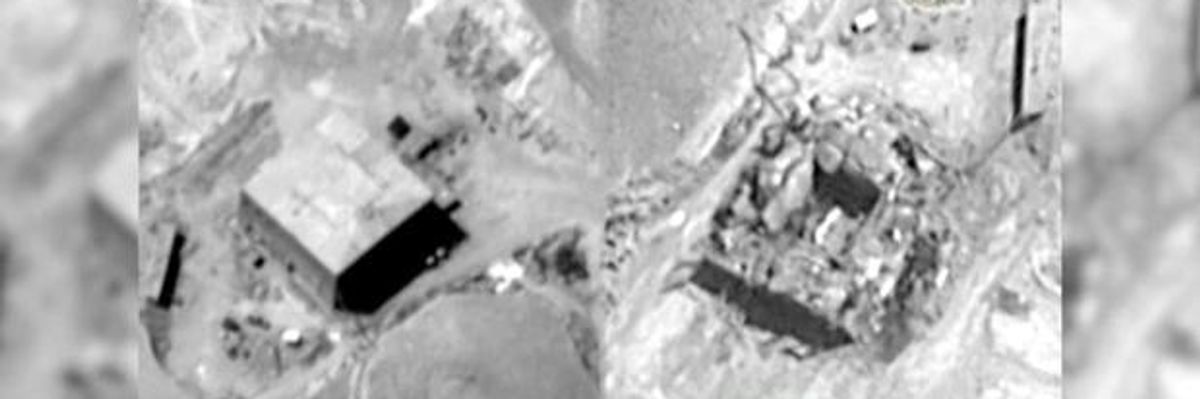
A still frame taken from video material released on March 21, 2018 shows a combination image of what the Israeli military describes is before and after an Israeli air strike on a suspected Syrian nuclear reactor site near Deir al-Zor on Sept 6, 2007. (IDF Handout via Reuters)
Israel on Wednesday admitted it bombed a suspected Syrian nuclear facility 11 years ago, and Israeli offials used the confirmation to boast about their country's military might and again threaten Iran.
"The message from the 2007 attack on the reactor is that Israel will not tolerate construction that can pose an existential threat," military chief Lt. Gen. Gadi Eisenkot said in a statement. "This was the message in 1981 [when Israel bombed a nuclear plant in Baghdad,], this is the message in 2007, and this is the future message to our enemies."
The overnight operation dubbed "Outside the Box" took place from Sept. 5-6, 2007, when F16s and F15s carried out the airstrikes against what the U.S. and Israel say was a reactor built with help from North Korea.
Israel--a nuclear-armed power but not a signatory of the nuclear Non-Proliferation Treaty (NPT)--argues that the facility in Syria's Deir ez-Zor region was "in its last stages of construction." Syria, which is a party to the treaty, has denied it was building a reactor.
As with its United Nations Security Council-condemned strike on the Iraqi facility, Israel argued that purpose of the Syrian facility was to produce a bomb.
According to James Jeffrey, George W. Bush's deputy national security adviser, the U.S. president backed the attack at the time.
"(He) made it clear that we were very happy that events had eliminated this threat and that if there were any threats to Israel that would emerge from this situation, the United States would stand with Israel, period," Jeffrey said Wednesday.
Defense Minister Avigdor Lieberman on Wednesday used the admission to threaten the entire region.
"The motivation of our enemies increased in recent years, but so did the strength of the IDF. Air Force and intelligence capabilities intensified and expanded [vastly] from the capabilities we had in 2007," Liberman said. "Everyone in the Middle East would do well to internalize this equation."
Another minister, Israel Katz, also tweeted out a not-so-veiled threat: "The courageous decision of the Israeli government almost 11 years ago to destroy the nuclear reactor in Syria and the successful operation following it sends a clear message: Israel will never allow nuclear weapons to countries like Iran who threaten its existence."
Israeli Prime Minister Benjamin Netanyahu, who has continues to argue without proof that Iran is on its way to producing nuclear bombs, said: "The Government of Israel, the IDF, and the Mossad prevented Syria from developing a nuclear capability. For this they are deserving of all praise. Israel's policy has been and remains consistent--to prevent our enemies from arming themselves with nuclear weapons."
Dear Common Dreams reader, It’s been nearly 30 years since I co-founded Common Dreams with my late wife, Lina Newhouser. We had the radical notion that journalism should serve the public good, not corporate profits. It was clear to us from the outset what it would take to build such a project. No paid advertisements. No corporate sponsors. No millionaire publisher telling us what to think or do. Many people said we wouldn't last a year, but we proved those doubters wrong. Together with a tremendous team of journalists and dedicated staff, we built an independent media outlet free from the constraints of profits and corporate control. Our mission has always been simple: To inform. To inspire. To ignite change for the common good. Building Common Dreams was not easy. Our survival was never guaranteed. When you take on the most powerful forces—Wall Street greed, fossil fuel industry destruction, Big Tech lobbyists, and uber-rich oligarchs who have spent billions upon billions rigging the economy and democracy in their favor—the only bulwark you have is supporters who believe in your work. But here’s the urgent message from me today. It's never been this bad out there. And it's never been this hard to keep us going. At the very moment Common Dreams is most needed, the threats we face are intensifying. We need your support now more than ever. We don't accept corporate advertising and never will. We don't have a paywall because we don't think people should be blocked from critical news based on their ability to pay. Everything we do is funded by the donations of readers like you. When everyone does the little they can afford, we are strong. But if that support retreats or dries up, so do we. Will you donate now to make sure Common Dreams not only survives but thrives? —Craig Brown, Co-founder |
Israel on Wednesday admitted it bombed a suspected Syrian nuclear facility 11 years ago, and Israeli offials used the confirmation to boast about their country's military might and again threaten Iran.
"The message from the 2007 attack on the reactor is that Israel will not tolerate construction that can pose an existential threat," military chief Lt. Gen. Gadi Eisenkot said in a statement. "This was the message in 1981 [when Israel bombed a nuclear plant in Baghdad,], this is the message in 2007, and this is the future message to our enemies."
The overnight operation dubbed "Outside the Box" took place from Sept. 5-6, 2007, when F16s and F15s carried out the airstrikes against what the U.S. and Israel say was a reactor built with help from North Korea.
Israel--a nuclear-armed power but not a signatory of the nuclear Non-Proliferation Treaty (NPT)--argues that the facility in Syria's Deir ez-Zor region was "in its last stages of construction." Syria, which is a party to the treaty, has denied it was building a reactor.
As with its United Nations Security Council-condemned strike on the Iraqi facility, Israel argued that purpose of the Syrian facility was to produce a bomb.
According to James Jeffrey, George W. Bush's deputy national security adviser, the U.S. president backed the attack at the time.
"(He) made it clear that we were very happy that events had eliminated this threat and that if there were any threats to Israel that would emerge from this situation, the United States would stand with Israel, period," Jeffrey said Wednesday.
Defense Minister Avigdor Lieberman on Wednesday used the admission to threaten the entire region.
"The motivation of our enemies increased in recent years, but so did the strength of the IDF. Air Force and intelligence capabilities intensified and expanded [vastly] from the capabilities we had in 2007," Liberman said. "Everyone in the Middle East would do well to internalize this equation."
Another minister, Israel Katz, also tweeted out a not-so-veiled threat: "The courageous decision of the Israeli government almost 11 years ago to destroy the nuclear reactor in Syria and the successful operation following it sends a clear message: Israel will never allow nuclear weapons to countries like Iran who threaten its existence."
Israeli Prime Minister Benjamin Netanyahu, who has continues to argue without proof that Iran is on its way to producing nuclear bombs, said: "The Government of Israel, the IDF, and the Mossad prevented Syria from developing a nuclear capability. For this they are deserving of all praise. Israel's policy has been and remains consistent--to prevent our enemies from arming themselves with nuclear weapons."
Israel on Wednesday admitted it bombed a suspected Syrian nuclear facility 11 years ago, and Israeli offials used the confirmation to boast about their country's military might and again threaten Iran.
"The message from the 2007 attack on the reactor is that Israel will not tolerate construction that can pose an existential threat," military chief Lt. Gen. Gadi Eisenkot said in a statement. "This was the message in 1981 [when Israel bombed a nuclear plant in Baghdad,], this is the message in 2007, and this is the future message to our enemies."
The overnight operation dubbed "Outside the Box" took place from Sept. 5-6, 2007, when F16s and F15s carried out the airstrikes against what the U.S. and Israel say was a reactor built with help from North Korea.
Israel--a nuclear-armed power but not a signatory of the nuclear Non-Proliferation Treaty (NPT)--argues that the facility in Syria's Deir ez-Zor region was "in its last stages of construction." Syria, which is a party to the treaty, has denied it was building a reactor.
As with its United Nations Security Council-condemned strike on the Iraqi facility, Israel argued that purpose of the Syrian facility was to produce a bomb.
According to James Jeffrey, George W. Bush's deputy national security adviser, the U.S. president backed the attack at the time.
"(He) made it clear that we were very happy that events had eliminated this threat and that if there were any threats to Israel that would emerge from this situation, the United States would stand with Israel, period," Jeffrey said Wednesday.
Defense Minister Avigdor Lieberman on Wednesday used the admission to threaten the entire region.
"The motivation of our enemies increased in recent years, but so did the strength of the IDF. Air Force and intelligence capabilities intensified and expanded [vastly] from the capabilities we had in 2007," Liberman said. "Everyone in the Middle East would do well to internalize this equation."
Another minister, Israel Katz, also tweeted out a not-so-veiled threat: "The courageous decision of the Israeli government almost 11 years ago to destroy the nuclear reactor in Syria and the successful operation following it sends a clear message: Israel will never allow nuclear weapons to countries like Iran who threaten its existence."
Israeli Prime Minister Benjamin Netanyahu, who has continues to argue without proof that Iran is on its way to producing nuclear bombs, said: "The Government of Israel, the IDF, and the Mossad prevented Syria from developing a nuclear capability. For this they are deserving of all praise. Israel's policy has been and remains consistent--to prevent our enemies from arming themselves with nuclear weapons."