SUBSCRIBE TO OUR FREE NEWSLETTER
Daily news & progressive opinion—funded by the people, not the corporations—delivered straight to your inbox.
5
#000000
#FFFFFF
To donate by check, phone, or other method, see our More Ways to Give page.
Daily news & progressive opinion—funded by the people, not the corporations—delivered straight to your inbox.
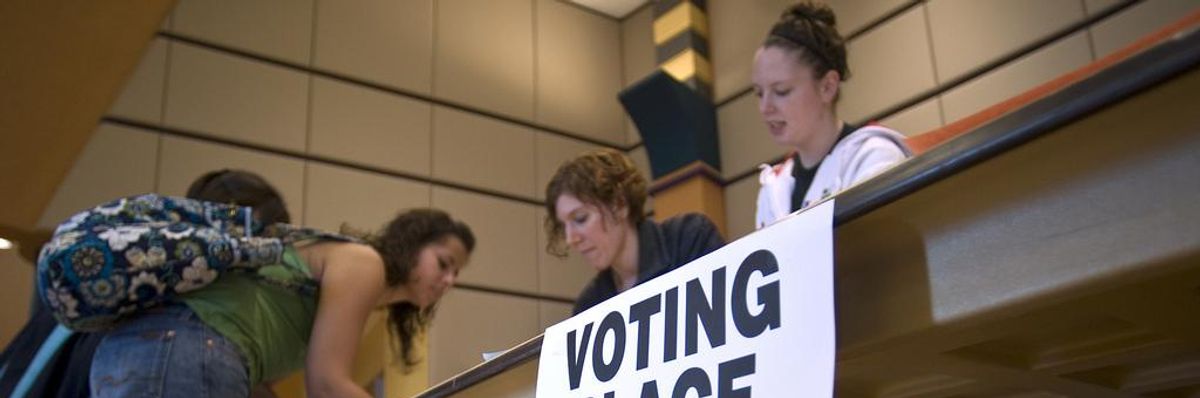
Civil rights advocates and secretaries of states are warning against a provision in a DHS reauthorization bill that would let the president dispatch Secret Service to polling places. (Photo: Penn State/flickr/cc)
Civil rights advocates and top election officials are expressing alarm over a section in the Department of Homeland Security reauthorization bill that would allow the president to send Secret Service agents to polling places.
"Who in their right mind would give this vulgar talking yam this kind of power?" quipped Charles P. Pierce at Esquire.
The House passed its version of the legislation on July 20, 2017. It includes a provision that would amend the federal law barring troops at polling sites by adding the text: "This section shall not prevent any officer or agent of the United States Secret Service from providing armed protective services authorized under section 3056 or pursuant to a presidential memorandum at any place where a general or special election is held."
The Senate Homeland Security and Governmental Affairs Committee passed the bill on Wednesday, though Ben Voelkel, a spokesman for committee chairman Sen. Ron Johnson (R-Wis.), told the Boston Globe it didn't include the provision in question. If the full Senate passes the bill, the House and Senate versions would need to be reconciled.
Given the potential threat, 19 bipartisan secretaries of state and elections commissioners sent a letter (pdf) to Senate Majority Leader Mitch McConnell (R-Ky.) and Minority Leader Charles Schumer, (D-N.Y) urging them to keep the provision, which they say has "unprecedented and shocking language," out of the final version.
"This is an alarming proposal which raises the possibility that armed federal agents will be patrolling neighborhood precincts and vote centers," the letter says.
Referring to current federal code, they write: "This longstanding and carefully crafted statute ensures the right of voters to cast their ballots under the limited authority of civil officers rather than law enforcement. Secretaries of State across the country agree that there is no discernible need for federal Secret Service agents to intrude, at the discretion of the president, who may also be a candidate in that election, into the thousands of citadels where democracy is enshrined."
Among the signatories is Ohio Secretary of State Jon Husted, who said in a statement Friday, "The fact that the U.S. Senate would even consider enacting a law that would allow a president to place Secret Service agents in polling places is shocking."
Fellow signatory Massachusetts Secretary of State William F. Galvin told the Globe, "This is worthy of a Third World country," adding: "I'm not going to tolerate people showing up to our polling places. I would not want to have federal agents showing up in largely Hispanic areas."
Kristen Clarke, president and executive director of the Lawyers' Committee for Civil Rights Under Law, said Monday that the plan "is both chilling and unprecedented," and pointed to the administration's efforts to suppress the vote.
"History has shown that the presence of law enforcement at the polls has the effect of chilling voter turnout, especially among minority communities. Any plans to send armed guards to polling places must be considered alongside President Trump's recent issuance of an executive order disbanding his failed Commission on Election Integrity. It was clear from the start that President Trump launched the Commission to lay the groundwork to promote voter suppression efforts across the country," she said.
"Two months after shuttering the Commission," she continued, "President Trump now seeks to activate one of our federal government's most secretive law enforcement agencies to depress and discourage minority voter participation in our midterm elections. In no uncertain terms, we condemn any plan to activate the Secret Service at our nation's polling sites."
Former Labor Secretary Robert Reich, for his part, said, "This is what dictators do in banana republics," and encouraged people to "spread the word, and resist."
Dear Common Dreams reader, It’s been nearly 30 years since I co-founded Common Dreams with my late wife, Lina Newhouser. We had the radical notion that journalism should serve the public good, not corporate profits. It was clear to us from the outset what it would take to build such a project. No paid advertisements. No corporate sponsors. No millionaire publisher telling us what to think or do. Many people said we wouldn't last a year, but we proved those doubters wrong. Together with a tremendous team of journalists and dedicated staff, we built an independent media outlet free from the constraints of profits and corporate control. Our mission has always been simple: To inform. To inspire. To ignite change for the common good. Building Common Dreams was not easy. Our survival was never guaranteed. When you take on the most powerful forces—Wall Street greed, fossil fuel industry destruction, Big Tech lobbyists, and uber-rich oligarchs who have spent billions upon billions rigging the economy and democracy in their favor—the only bulwark you have is supporters who believe in your work. But here’s the urgent message from me today. It's never been this bad out there. And it's never been this hard to keep us going. At the very moment Common Dreams is most needed, the threats we face are intensifying. We need your support now more than ever. We don't accept corporate advertising and never will. We don't have a paywall because we don't think people should be blocked from critical news based on their ability to pay. Everything we do is funded by the donations of readers like you. When everyone does the little they can afford, we are strong. But if that support retreats or dries up, so do we. Will you donate now to make sure Common Dreams not only survives but thrives? —Craig Brown, Co-founder |
Civil rights advocates and top election officials are expressing alarm over a section in the Department of Homeland Security reauthorization bill that would allow the president to send Secret Service agents to polling places.
"Who in their right mind would give this vulgar talking yam this kind of power?" quipped Charles P. Pierce at Esquire.
The House passed its version of the legislation on July 20, 2017. It includes a provision that would amend the federal law barring troops at polling sites by adding the text: "This section shall not prevent any officer or agent of the United States Secret Service from providing armed protective services authorized under section 3056 or pursuant to a presidential memorandum at any place where a general or special election is held."
The Senate Homeland Security and Governmental Affairs Committee passed the bill on Wednesday, though Ben Voelkel, a spokesman for committee chairman Sen. Ron Johnson (R-Wis.), told the Boston Globe it didn't include the provision in question. If the full Senate passes the bill, the House and Senate versions would need to be reconciled.
Given the potential threat, 19 bipartisan secretaries of state and elections commissioners sent a letter (pdf) to Senate Majority Leader Mitch McConnell (R-Ky.) and Minority Leader Charles Schumer, (D-N.Y) urging them to keep the provision, which they say has "unprecedented and shocking language," out of the final version.
"This is an alarming proposal which raises the possibility that armed federal agents will be patrolling neighborhood precincts and vote centers," the letter says.
Referring to current federal code, they write: "This longstanding and carefully crafted statute ensures the right of voters to cast their ballots under the limited authority of civil officers rather than law enforcement. Secretaries of State across the country agree that there is no discernible need for federal Secret Service agents to intrude, at the discretion of the president, who may also be a candidate in that election, into the thousands of citadels where democracy is enshrined."
Among the signatories is Ohio Secretary of State Jon Husted, who said in a statement Friday, "The fact that the U.S. Senate would even consider enacting a law that would allow a president to place Secret Service agents in polling places is shocking."
Fellow signatory Massachusetts Secretary of State William F. Galvin told the Globe, "This is worthy of a Third World country," adding: "I'm not going to tolerate people showing up to our polling places. I would not want to have federal agents showing up in largely Hispanic areas."
Kristen Clarke, president and executive director of the Lawyers' Committee for Civil Rights Under Law, said Monday that the plan "is both chilling and unprecedented," and pointed to the administration's efforts to suppress the vote.
"History has shown that the presence of law enforcement at the polls has the effect of chilling voter turnout, especially among minority communities. Any plans to send armed guards to polling places must be considered alongside President Trump's recent issuance of an executive order disbanding his failed Commission on Election Integrity. It was clear from the start that President Trump launched the Commission to lay the groundwork to promote voter suppression efforts across the country," she said.
"Two months after shuttering the Commission," she continued, "President Trump now seeks to activate one of our federal government's most secretive law enforcement agencies to depress and discourage minority voter participation in our midterm elections. In no uncertain terms, we condemn any plan to activate the Secret Service at our nation's polling sites."
Former Labor Secretary Robert Reich, for his part, said, "This is what dictators do in banana republics," and encouraged people to "spread the word, and resist."
Civil rights advocates and top election officials are expressing alarm over a section in the Department of Homeland Security reauthorization bill that would allow the president to send Secret Service agents to polling places.
"Who in their right mind would give this vulgar talking yam this kind of power?" quipped Charles P. Pierce at Esquire.
The House passed its version of the legislation on July 20, 2017. It includes a provision that would amend the federal law barring troops at polling sites by adding the text: "This section shall not prevent any officer or agent of the United States Secret Service from providing armed protective services authorized under section 3056 or pursuant to a presidential memorandum at any place where a general or special election is held."
The Senate Homeland Security and Governmental Affairs Committee passed the bill on Wednesday, though Ben Voelkel, a spokesman for committee chairman Sen. Ron Johnson (R-Wis.), told the Boston Globe it didn't include the provision in question. If the full Senate passes the bill, the House and Senate versions would need to be reconciled.
Given the potential threat, 19 bipartisan secretaries of state and elections commissioners sent a letter (pdf) to Senate Majority Leader Mitch McConnell (R-Ky.) and Minority Leader Charles Schumer, (D-N.Y) urging them to keep the provision, which they say has "unprecedented and shocking language," out of the final version.
"This is an alarming proposal which raises the possibility that armed federal agents will be patrolling neighborhood precincts and vote centers," the letter says.
Referring to current federal code, they write: "This longstanding and carefully crafted statute ensures the right of voters to cast their ballots under the limited authority of civil officers rather than law enforcement. Secretaries of State across the country agree that there is no discernible need for federal Secret Service agents to intrude, at the discretion of the president, who may also be a candidate in that election, into the thousands of citadels where democracy is enshrined."
Among the signatories is Ohio Secretary of State Jon Husted, who said in a statement Friday, "The fact that the U.S. Senate would even consider enacting a law that would allow a president to place Secret Service agents in polling places is shocking."
Fellow signatory Massachusetts Secretary of State William F. Galvin told the Globe, "This is worthy of a Third World country," adding: "I'm not going to tolerate people showing up to our polling places. I would not want to have federal agents showing up in largely Hispanic areas."
Kristen Clarke, president and executive director of the Lawyers' Committee for Civil Rights Under Law, said Monday that the plan "is both chilling and unprecedented," and pointed to the administration's efforts to suppress the vote.
"History has shown that the presence of law enforcement at the polls has the effect of chilling voter turnout, especially among minority communities. Any plans to send armed guards to polling places must be considered alongside President Trump's recent issuance of an executive order disbanding his failed Commission on Election Integrity. It was clear from the start that President Trump launched the Commission to lay the groundwork to promote voter suppression efforts across the country," she said.
"Two months after shuttering the Commission," she continued, "President Trump now seeks to activate one of our federal government's most secretive law enforcement agencies to depress and discourage minority voter participation in our midterm elections. In no uncertain terms, we condemn any plan to activate the Secret Service at our nation's polling sites."
Former Labor Secretary Robert Reich, for his part, said, "This is what dictators do in banana republics," and encouraged people to "spread the word, and resist."