

SUBSCRIBE TO OUR FREE NEWSLETTER
Daily news & progressive opinion—funded by the people, not the corporations—delivered straight to your inbox.
5
#000000
#FFFFFF
To donate by check, phone, or other method, see our More Ways to Give page.
Daily news & progressive opinion—funded by the people, not the corporations—delivered straight to your inbox.
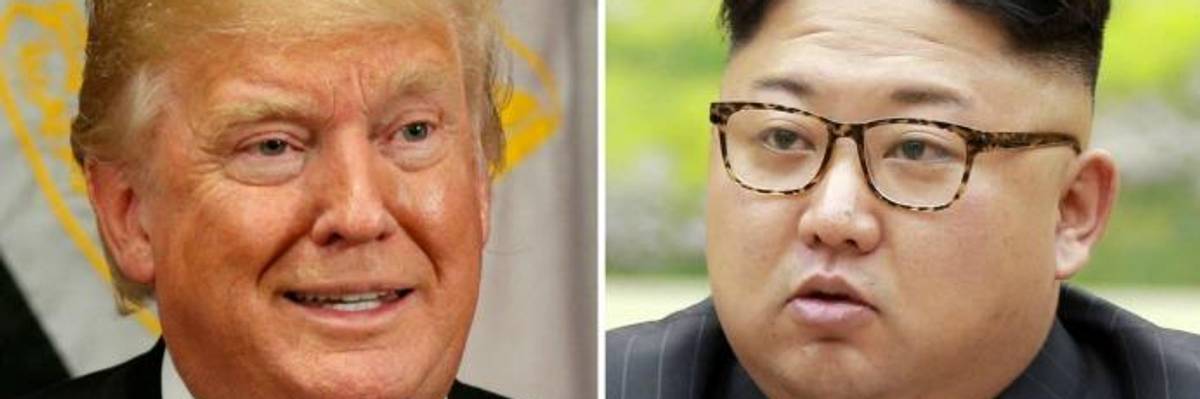
Beatrice Fihn, executive director of International Campaign to Abolish Nuclear Weapons (ICAN), argued that lasting peace and security can only be achieved if the U.S. and North Korea "join the majority of countries in pursuing permanent denuclearization through The Treaty on the Prohibition of Nuclear Weapons." (Photo: Reuters)
While President Donald Trump was quick to implore the media to give him "credit" for the announcement late Thursday that he is set to meet with Kim Jong-un in person some time in May, analysts and anti-war groups argued in response to the news that it was South Korea's persistent diplomatic efforts--not Trump's "fire and fury" threats--that led to the potentially historic breakthrough.
"It's a mistake to believe that 'maximum pressure' forced North Korea to dialogue; it was Moon's masterful diplomatic stroke."
--Christine Ahn, Women Cross DMZ
"Kim Jong-un reiterating his country's commitments not to test nuclear weapons or ballistic missiles during ongoing diplomacy is excellent news, as is President Trump accepting Kim's invitation to meet in person for the first time," said Peace Action president Kevin Martin in a statement on Thursday. "But let the record show, it wasn't Trump's bluster or the 'maximum pressure' campaign that brought North Korea to the negotiating table, it was South Korean President Moon Jae-in's willingness to engage without preconditions."
Christine Ahn, a Korea expert and founder of the anti-war group Women Cross DMZ, echoed Peace Action's stance in a series of tweets on Thursday, arguing that crediting Trump's aggressive tactics and U.S. sanctions--as some media outlets did in response to the news--is "a dangerous rewriting of what happened."
Thursday's announcement--delivered by South Korean officials outside the White House--comes on the heels of a meeting between a South Korean delegation and Kim Jong-un in Pyongyang earlier this week, during which Kim vowed to halt missile tests during diplomatic talks.
As Common Dreams reported on Thursday, a coalition of grassroots peace organizations sent an open letter to the White House following the meeting calling on Trump to reciprocate North Korea's diplomatic overtures by canceling planned war games close to North Korea's borders.
In a statement celebrating the growing possibility of deescalation of nuclear tensions on the Korean Peninsula, Beatrice Fihn, executive director of International Campaign to Abolish Nuclear Weapons (ICAN), argued that lasting peace and security can only be achieved if the U.S. and North Korea "join the majority of countries in pursuing permanent denuclearization through The Treaty on the Prohibition of Nuclear Weapons."
Dear Common Dreams reader, It’s been nearly 30 years since I co-founded Common Dreams with my late wife, Lina Newhouser. We had the radical notion that journalism should serve the public good, not corporate profits. It was clear to us from the outset what it would take to build such a project. No paid advertisements. No corporate sponsors. No millionaire publisher telling us what to think or do. Many people said we wouldn't last a year, but we proved those doubters wrong. Together with a tremendous team of journalists and dedicated staff, we built an independent media outlet free from the constraints of profits and corporate control. Our mission has always been simple: To inform. To inspire. To ignite change for the common good. Building Common Dreams was not easy. Our survival was never guaranteed. When you take on the most powerful forces—Wall Street greed, fossil fuel industry destruction, Big Tech lobbyists, and uber-rich oligarchs who have spent billions upon billions rigging the economy and democracy in their favor—the only bulwark you have is supporters who believe in your work. But here’s the urgent message from me today. It's never been this bad out there. And it's never been this hard to keep us going. At the very moment Common Dreams is most needed, the threats we face are intensifying. We need your support now more than ever. We don't accept corporate advertising and never will. We don't have a paywall because we don't think people should be blocked from critical news based on their ability to pay. Everything we do is funded by the donations of readers like you. When everyone does the little they can afford, we are strong. But if that support retreats or dries up, so do we. Will you donate now to make sure Common Dreams not only survives but thrives? —Craig Brown, Co-founder |
While President Donald Trump was quick to implore the media to give him "credit" for the announcement late Thursday that he is set to meet with Kim Jong-un in person some time in May, analysts and anti-war groups argued in response to the news that it was South Korea's persistent diplomatic efforts--not Trump's "fire and fury" threats--that led to the potentially historic breakthrough.
"It's a mistake to believe that 'maximum pressure' forced North Korea to dialogue; it was Moon's masterful diplomatic stroke."
--Christine Ahn, Women Cross DMZ
"Kim Jong-un reiterating his country's commitments not to test nuclear weapons or ballistic missiles during ongoing diplomacy is excellent news, as is President Trump accepting Kim's invitation to meet in person for the first time," said Peace Action president Kevin Martin in a statement on Thursday. "But let the record show, it wasn't Trump's bluster or the 'maximum pressure' campaign that brought North Korea to the negotiating table, it was South Korean President Moon Jae-in's willingness to engage without preconditions."
Christine Ahn, a Korea expert and founder of the anti-war group Women Cross DMZ, echoed Peace Action's stance in a series of tweets on Thursday, arguing that crediting Trump's aggressive tactics and U.S. sanctions--as some media outlets did in response to the news--is "a dangerous rewriting of what happened."
Thursday's announcement--delivered by South Korean officials outside the White House--comes on the heels of a meeting between a South Korean delegation and Kim Jong-un in Pyongyang earlier this week, during which Kim vowed to halt missile tests during diplomatic talks.
As Common Dreams reported on Thursday, a coalition of grassroots peace organizations sent an open letter to the White House following the meeting calling on Trump to reciprocate North Korea's diplomatic overtures by canceling planned war games close to North Korea's borders.
In a statement celebrating the growing possibility of deescalation of nuclear tensions on the Korean Peninsula, Beatrice Fihn, executive director of International Campaign to Abolish Nuclear Weapons (ICAN), argued that lasting peace and security can only be achieved if the U.S. and North Korea "join the majority of countries in pursuing permanent denuclearization through The Treaty on the Prohibition of Nuclear Weapons."
While President Donald Trump was quick to implore the media to give him "credit" for the announcement late Thursday that he is set to meet with Kim Jong-un in person some time in May, analysts and anti-war groups argued in response to the news that it was South Korea's persistent diplomatic efforts--not Trump's "fire and fury" threats--that led to the potentially historic breakthrough.
"It's a mistake to believe that 'maximum pressure' forced North Korea to dialogue; it was Moon's masterful diplomatic stroke."
--Christine Ahn, Women Cross DMZ
"Kim Jong-un reiterating his country's commitments not to test nuclear weapons or ballistic missiles during ongoing diplomacy is excellent news, as is President Trump accepting Kim's invitation to meet in person for the first time," said Peace Action president Kevin Martin in a statement on Thursday. "But let the record show, it wasn't Trump's bluster or the 'maximum pressure' campaign that brought North Korea to the negotiating table, it was South Korean President Moon Jae-in's willingness to engage without preconditions."
Christine Ahn, a Korea expert and founder of the anti-war group Women Cross DMZ, echoed Peace Action's stance in a series of tweets on Thursday, arguing that crediting Trump's aggressive tactics and U.S. sanctions--as some media outlets did in response to the news--is "a dangerous rewriting of what happened."
Thursday's announcement--delivered by South Korean officials outside the White House--comes on the heels of a meeting between a South Korean delegation and Kim Jong-un in Pyongyang earlier this week, during which Kim vowed to halt missile tests during diplomatic talks.
As Common Dreams reported on Thursday, a coalition of grassroots peace organizations sent an open letter to the White House following the meeting calling on Trump to reciprocate North Korea's diplomatic overtures by canceling planned war games close to North Korea's borders.
In a statement celebrating the growing possibility of deescalation of nuclear tensions on the Korean Peninsula, Beatrice Fihn, executive director of International Campaign to Abolish Nuclear Weapons (ICAN), argued that lasting peace and security can only be achieved if the U.S. and North Korea "join the majority of countries in pursuing permanent denuclearization through The Treaty on the Prohibition of Nuclear Weapons."

