SUBSCRIBE TO OUR FREE NEWSLETTER
Daily news & progressive opinion—funded by the people, not the corporations—delivered straight to your inbox.
5
#000000
#FFFFFF
To donate by check, phone, or other method, see our More Ways to Give page.
Daily news & progressive opinion—funded by the people, not the corporations—delivered straight to your inbox.
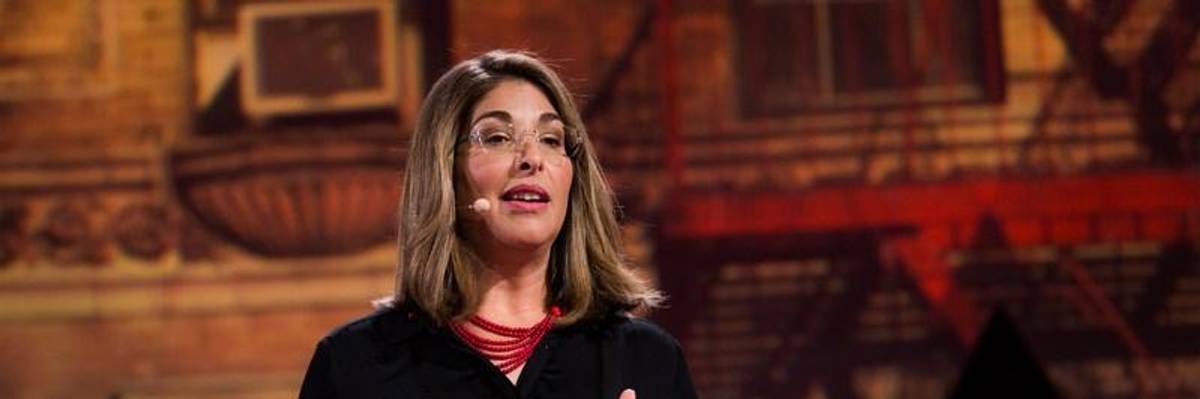
Naomi Klein delivering her Sept. 20, 2017 TED Talk "How shocking events can spark positive change." (Photo: TED)
How can people today--who are facing "non-stop shocks" like record-breaking storms and militarized police--use these crises "to catalyze a kind of evolutionary leap" towards a more just, equitable, and habitable world?
In a recent TED Talk, available online this week, author and activist Naomi Klein laid out what she sees as two crucial ingredients for making that push forward--imagination and organizing. She said that "it's in the interplay between the two where revolutionary power lies."
She pointed to successes seen in The New Deal, which brought about key safety net gains. But we can do better, she argued.
One obstacle is the dominant structure of movements based largely on a sort of silo-fication of issues. While these movements are making strides forward and calling for bold changes, "what we're still missing is that coherent picture of the world we're fighting for," she said.
She pointed to the sort of big picture view captured by The Leap Manifesto, shaped by a broad range of movement leaders, which recognized the confluence of their issues to map out common "yeses" about what a more just Canada could be.
"The shocking events that fill us with dread today can transform us, and they can transform the world for the better," she concludes. "But first we need to picture the world that we're fighting for. And we have to dream it up together. Right now, every alarm in our house is going off simultaneously. It's time to listen. It's time to leap.
Watch the full six-minute TEDGlobal>NYC, delivered on Sept. 20, 2017, below:
Dear Common Dreams reader, It’s been nearly 30 years since I co-founded Common Dreams with my late wife, Lina Newhouser. We had the radical notion that journalism should serve the public good, not corporate profits. It was clear to us from the outset what it would take to build such a project. No paid advertisements. No corporate sponsors. No millionaire publisher telling us what to think or do. Many people said we wouldn't last a year, but we proved those doubters wrong. Together with a tremendous team of journalists and dedicated staff, we built an independent media outlet free from the constraints of profits and corporate control. Our mission has always been simple: To inform. To inspire. To ignite change for the common good. Building Common Dreams was not easy. Our survival was never guaranteed. When you take on the most powerful forces—Wall Street greed, fossil fuel industry destruction, Big Tech lobbyists, and uber-rich oligarchs who have spent billions upon billions rigging the economy and democracy in their favor—the only bulwark you have is supporters who believe in your work. But here’s the urgent message from me today. It's never been this bad out there. And it's never been this hard to keep us going. At the very moment Common Dreams is most needed, the threats we face are intensifying. We need your support now more than ever. We don't accept corporate advertising and never will. We don't have a paywall because we don't think people should be blocked from critical news based on their ability to pay. Everything we do is funded by the donations of readers like you. When everyone does the little they can afford, we are strong. But if that support retreats or dries up, so do we. Will you donate now to make sure Common Dreams not only survives but thrives? —Craig Brown, Co-founder |
How can people today--who are facing "non-stop shocks" like record-breaking storms and militarized police--use these crises "to catalyze a kind of evolutionary leap" towards a more just, equitable, and habitable world?
In a recent TED Talk, available online this week, author and activist Naomi Klein laid out what she sees as two crucial ingredients for making that push forward--imagination and organizing. She said that "it's in the interplay between the two where revolutionary power lies."
She pointed to successes seen in The New Deal, which brought about key safety net gains. But we can do better, she argued.
One obstacle is the dominant structure of movements based largely on a sort of silo-fication of issues. While these movements are making strides forward and calling for bold changes, "what we're still missing is that coherent picture of the world we're fighting for," she said.
She pointed to the sort of big picture view captured by The Leap Manifesto, shaped by a broad range of movement leaders, which recognized the confluence of their issues to map out common "yeses" about what a more just Canada could be.
"The shocking events that fill us with dread today can transform us, and they can transform the world for the better," she concludes. "But first we need to picture the world that we're fighting for. And we have to dream it up together. Right now, every alarm in our house is going off simultaneously. It's time to listen. It's time to leap.
Watch the full six-minute TEDGlobal>NYC, delivered on Sept. 20, 2017, below:
How can people today--who are facing "non-stop shocks" like record-breaking storms and militarized police--use these crises "to catalyze a kind of evolutionary leap" towards a more just, equitable, and habitable world?
In a recent TED Talk, available online this week, author and activist Naomi Klein laid out what she sees as two crucial ingredients for making that push forward--imagination and organizing. She said that "it's in the interplay between the two where revolutionary power lies."
She pointed to successes seen in The New Deal, which brought about key safety net gains. But we can do better, she argued.
One obstacle is the dominant structure of movements based largely on a sort of silo-fication of issues. While these movements are making strides forward and calling for bold changes, "what we're still missing is that coherent picture of the world we're fighting for," she said.
She pointed to the sort of big picture view captured by The Leap Manifesto, shaped by a broad range of movement leaders, which recognized the confluence of their issues to map out common "yeses" about what a more just Canada could be.
"The shocking events that fill us with dread today can transform us, and they can transform the world for the better," she concludes. "But first we need to picture the world that we're fighting for. And we have to dream it up together. Right now, every alarm in our house is going off simultaneously. It's time to listen. It's time to leap.
Watch the full six-minute TEDGlobal>NYC, delivered on Sept. 20, 2017, below: