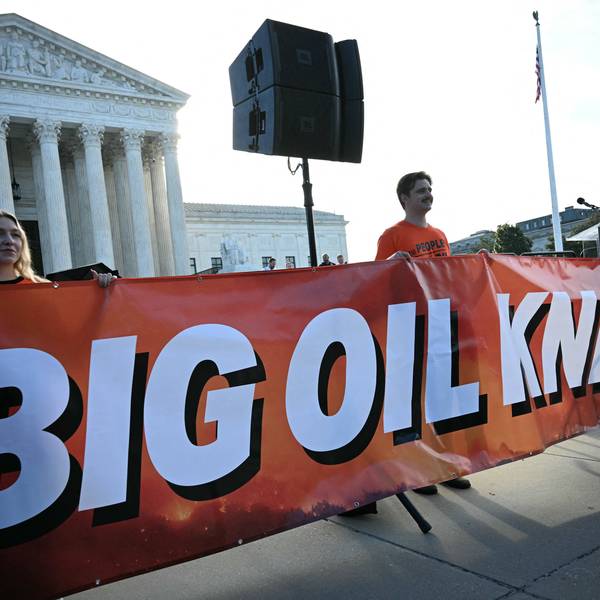
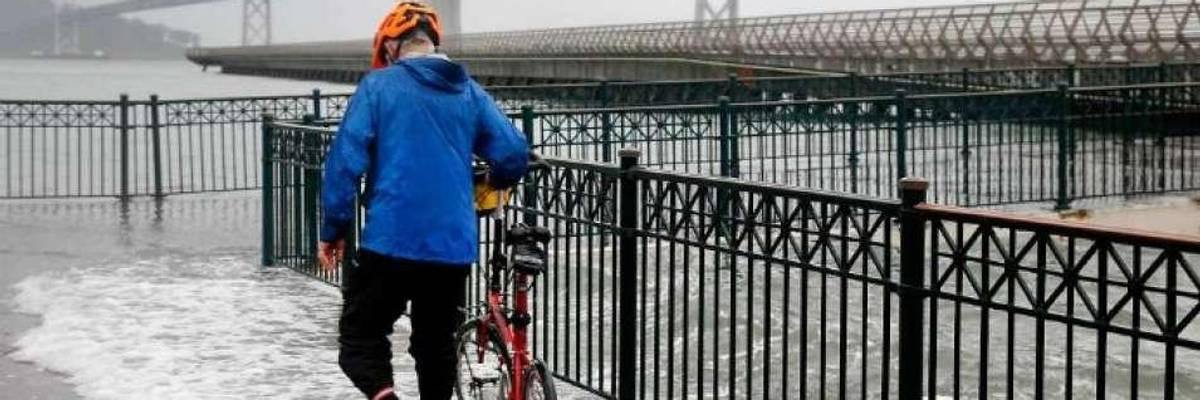
an Francisco and Oakland have filed lawsuits in California state court to hold oil and natural gas companies accountable for contributing to climate change. (Photo: Paul Chinn, The Chronicle)
Federal Judge's Unprecedented Order on Climate Science 'Could Open Floodgates' for Big Oil Lawsuits
"The court is forcing these companies to go on the record about their understanding of climate science, which they have desperately tried to avoid doing."
With a decision that could have far-reaching implications, a federal judge in California has ordered the first ever U.S. court hearing on climate science for a "public nuisance" lawsuit, meaning that major oil and gas companies for the first time may have to go on the record regarding what they knew about the planetary impacts of their products--and when.
"At the core of the plaintiff's lawsuit is the idea that these companies have long known about risks of their products...yet they took a course of action that resisted regulation and sought to keep them on the market as long as possible."
--Michael Burger,
Columbia University
"This will be the closest that we have seen to a trial on climate science in the United States, to date," Michael Burger, a lawyer who heads the Sabin Center for Climate Change Law at Columbia University, told McClatchy's D.C. Bureau.
Last year, the cities of San Francisco and Oakland filed the lawsuit against five major oil and gas companies--BP, Chevron, ConocoPhillips, ExxonMobil, and Shell--in hopes of holding them to account for fossil fuel production's massive contributions to global warming and the impact the climate crisis is having on coastal communities.
On March 21, U.S. District Court Judge William Alsup will allow the cities as well as the fossil fuel companies named in the complaint (pdf) "to conduct a two-part tutorial on the subject of global warming and climate change," according to a notice (pdf) filed by the judge.
"The first part will trace the history of scientific study of climate change, beginning with scientific inquiry into the formation and melting of the ice ages, periods of historical cooling and warming, smog, ozone, nuclear winter, volcanoes, and global warming," the filing explained. "The second part will set forth the best science now available on global warming, glacier melt, sea rise, and coastal flooding."
Attorneys from both sides will have an hour for each part, but may defer to expert testimonies. Alsup filed a second notice (pdf) earlier this week that featured a list of questions he expects each side to address. The judge's order for the tutorial came the same day he denied (pdf) the cities' motion to remand the case to state court.
Although ExxonMobil now publicly takes the stance that carbon emissions are warming the planet and "action must be taken" to "assess the risks" posed by such warming, as McClatchy notes, "the hearing and ongoing trial will focus more on who knew what, when, and what they did in response."
The cities alleged in their complaint, citing recent damning reports about secret industry research, that Exxon and the other companies have continued to promote oil and gas production "despite knowing--since at least the late 1970s and early 1980s if not earlier--that massive fossil fuel usage would cause dangerous global warming."
As Burger explained, "At the core of the plaintiff's lawsuit is the idea that these companies have long known about risks of their products...yet they took a course of action that resisted regulation and sought to keep them on the market as long as possible."
By ordering the tutorial, "the court is forcing these companies to go on the record about their understanding of climate science," added EarthRights International general counsel Marco Simmons, "which they have desperately tried to avoid doing."
In a piece for Forbes, business attorney Brian H. Potts concludes that Alsup's decision to proceed with the case in federal court "could open the floodgates for climate change litigation in federal courts around the country."
"As a result of this decision, coal, oil, and natural gas producers could face federal common law nuisance claims all over the country," he writes. "The size and scale of these suits could mirror the tobacco litigation that began in the 1990s."
We are at a crossroads
This country and this world are at a monumental crossroads. In a few short weeks, US voters will have an opportunity to beat back the forces of fascism and confront the billionaires who are rigging the economy, our media system, and our democracy, making it increasingly impossible for ordinary people to get by. We’re not just talking about the election. We’re talking about what must be done once these fascist elements are vanquished from power. We need a bolder set of solutions than what either major party has so far been willing to offer and a working-class movement ready to fight like hell for it. Trump didn't emerge from nowhere. The conditions that fueled MAGA authoritarianism were created by decades of radical neoliberal economic policies and a corrupt political system dominated by corporate interests. They slashed taxes on the super-rich, promising that the benefits would trickle down. They said giveaways to the corporate titans would make life more affordable for the rest of us. It was all bullshit. And when a bitter, betrayed populace searches for someone to blame, right-wing demagogues have little trouble finding scapegoats. People know when they're being lied to, but you won't hear any of this from the corporate media. Only independent journalism—powered and funded by people who believe in building a better world—can deliver truly trustworthy daily news. Our Fall Campaign is underway, and we need your help. To power our newsroom through the rest of the year, we need to raise $125,000 by midnight on October 31. So if you share our vision, please contribute whatever you can to sustain our work. |
With a decision that could have far-reaching implications, a federal judge in California has ordered the first ever U.S. court hearing on climate science for a "public nuisance" lawsuit, meaning that major oil and gas companies for the first time may have to go on the record regarding what they knew about the planetary impacts of their products--and when.
"At the core of the plaintiff's lawsuit is the idea that these companies have long known about risks of their products...yet they took a course of action that resisted regulation and sought to keep them on the market as long as possible."
--Michael Burger,
Columbia University
"This will be the closest that we have seen to a trial on climate science in the United States, to date," Michael Burger, a lawyer who heads the Sabin Center for Climate Change Law at Columbia University, told McClatchy's D.C. Bureau.
Last year, the cities of San Francisco and Oakland filed the lawsuit against five major oil and gas companies--BP, Chevron, ConocoPhillips, ExxonMobil, and Shell--in hopes of holding them to account for fossil fuel production's massive contributions to global warming and the impact the climate crisis is having on coastal communities.
On March 21, U.S. District Court Judge William Alsup will allow the cities as well as the fossil fuel companies named in the complaint (pdf) "to conduct a two-part tutorial on the subject of global warming and climate change," according to a notice (pdf) filed by the judge.
"The first part will trace the history of scientific study of climate change, beginning with scientific inquiry into the formation and melting of the ice ages, periods of historical cooling and warming, smog, ozone, nuclear winter, volcanoes, and global warming," the filing explained. "The second part will set forth the best science now available on global warming, glacier melt, sea rise, and coastal flooding."
Attorneys from both sides will have an hour for each part, but may defer to expert testimonies. Alsup filed a second notice (pdf) earlier this week that featured a list of questions he expects each side to address. The judge's order for the tutorial came the same day he denied (pdf) the cities' motion to remand the case to state court.
Although ExxonMobil now publicly takes the stance that carbon emissions are warming the planet and "action must be taken" to "assess the risks" posed by such warming, as McClatchy notes, "the hearing and ongoing trial will focus more on who knew what, when, and what they did in response."
The cities alleged in their complaint, citing recent damning reports about secret industry research, that Exxon and the other companies have continued to promote oil and gas production "despite knowing--since at least the late 1970s and early 1980s if not earlier--that massive fossil fuel usage would cause dangerous global warming."
As Burger explained, "At the core of the plaintiff's lawsuit is the idea that these companies have long known about risks of their products...yet they took a course of action that resisted regulation and sought to keep them on the market as long as possible."
By ordering the tutorial, "the court is forcing these companies to go on the record about their understanding of climate science," added EarthRights International general counsel Marco Simmons, "which they have desperately tried to avoid doing."
In a piece for Forbes, business attorney Brian H. Potts concludes that Alsup's decision to proceed with the case in federal court "could open the floodgates for climate change litigation in federal courts around the country."
"As a result of this decision, coal, oil, and natural gas producers could face federal common law nuisance claims all over the country," he writes. "The size and scale of these suits could mirror the tobacco litigation that began in the 1990s."
With a decision that could have far-reaching implications, a federal judge in California has ordered the first ever U.S. court hearing on climate science for a "public nuisance" lawsuit, meaning that major oil and gas companies for the first time may have to go on the record regarding what they knew about the planetary impacts of their products--and when.
"At the core of the plaintiff's lawsuit is the idea that these companies have long known about risks of their products...yet they took a course of action that resisted regulation and sought to keep them on the market as long as possible."
--Michael Burger,
Columbia University
"This will be the closest that we have seen to a trial on climate science in the United States, to date," Michael Burger, a lawyer who heads the Sabin Center for Climate Change Law at Columbia University, told McClatchy's D.C. Bureau.
Last year, the cities of San Francisco and Oakland filed the lawsuit against five major oil and gas companies--BP, Chevron, ConocoPhillips, ExxonMobil, and Shell--in hopes of holding them to account for fossil fuel production's massive contributions to global warming and the impact the climate crisis is having on coastal communities.
On March 21, U.S. District Court Judge William Alsup will allow the cities as well as the fossil fuel companies named in the complaint (pdf) "to conduct a two-part tutorial on the subject of global warming and climate change," according to a notice (pdf) filed by the judge.
"The first part will trace the history of scientific study of climate change, beginning with scientific inquiry into the formation and melting of the ice ages, periods of historical cooling and warming, smog, ozone, nuclear winter, volcanoes, and global warming," the filing explained. "The second part will set forth the best science now available on global warming, glacier melt, sea rise, and coastal flooding."
Attorneys from both sides will have an hour for each part, but may defer to expert testimonies. Alsup filed a second notice (pdf) earlier this week that featured a list of questions he expects each side to address. The judge's order for the tutorial came the same day he denied (pdf) the cities' motion to remand the case to state court.
Although ExxonMobil now publicly takes the stance that carbon emissions are warming the planet and "action must be taken" to "assess the risks" posed by such warming, as McClatchy notes, "the hearing and ongoing trial will focus more on who knew what, when, and what they did in response."
The cities alleged in their complaint, citing recent damning reports about secret industry research, that Exxon and the other companies have continued to promote oil and gas production "despite knowing--since at least the late 1970s and early 1980s if not earlier--that massive fossil fuel usage would cause dangerous global warming."
As Burger explained, "At the core of the plaintiff's lawsuit is the idea that these companies have long known about risks of their products...yet they took a course of action that resisted regulation and sought to keep them on the market as long as possible."
By ordering the tutorial, "the court is forcing these companies to go on the record about their understanding of climate science," added EarthRights International general counsel Marco Simmons, "which they have desperately tried to avoid doing."
In a piece for Forbes, business attorney Brian H. Potts concludes that Alsup's decision to proceed with the case in federal court "could open the floodgates for climate change litigation in federal courts around the country."
"As a result of this decision, coal, oil, and natural gas producers could face federal common law nuisance claims all over the country," he writes. "The size and scale of these suits could mirror the tobacco litigation that began in the 1990s."