SUBSCRIBE TO OUR FREE NEWSLETTER
Daily news & progressive opinion—funded by the people, not the corporations—delivered straight to your inbox.
5
#000000
#FFFFFF
To donate by check, phone, or other method, see our More Ways to Give page.

Jared Kushner's rough week got a little worse on Wednesday, when the New York Times reported that the family real estate company of President Donald Trump's son-in-law and senior adviser received millions of dollars in loans from two financial firms after Kushner met with their top executives at the White House.
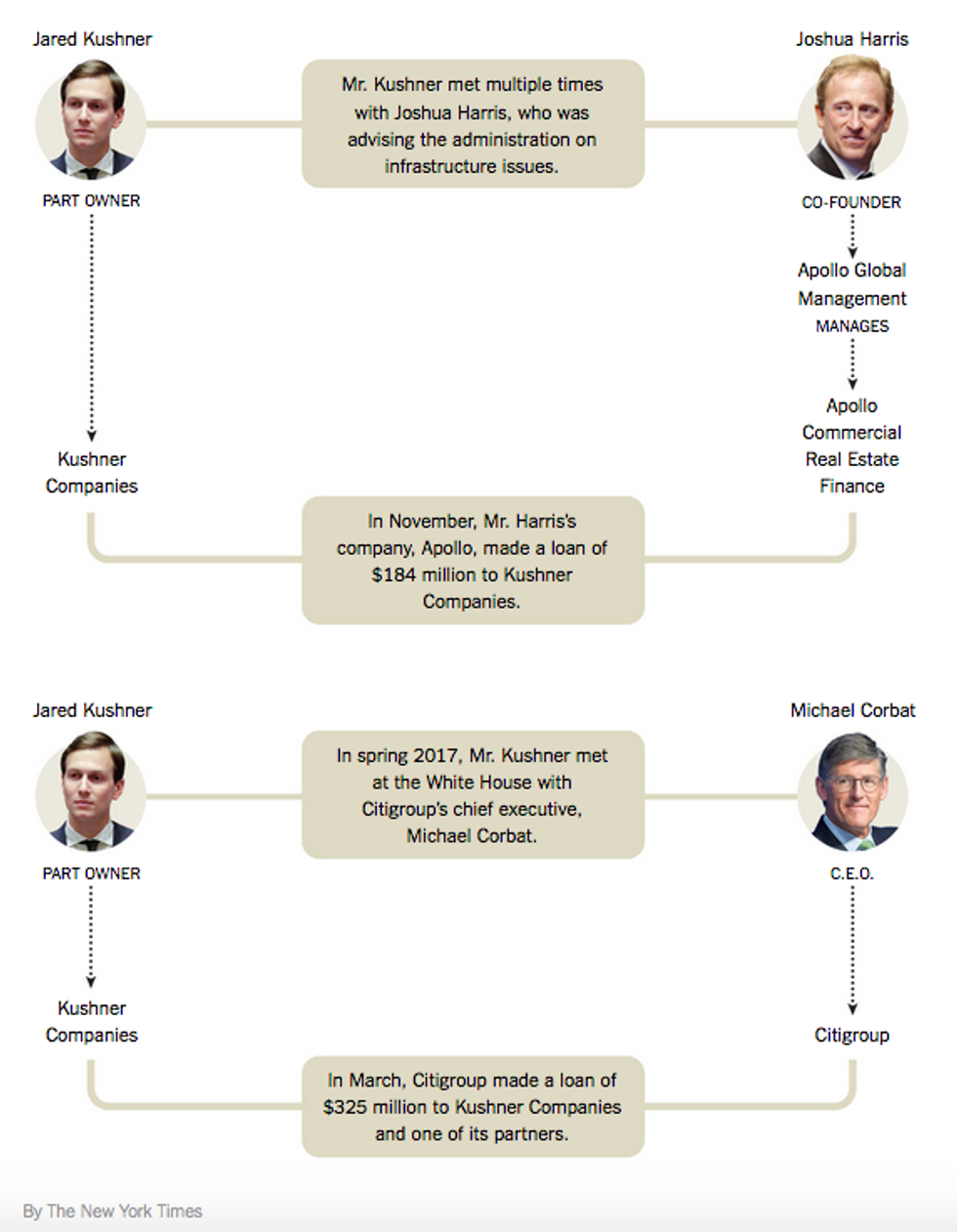
The new report outlines Kushner's meetings with Joshua Harris, co-founder of the private equity firm Apollo Global Management, as well as Michael Corbat, chief executive of Citigroup, before each lender gave millions in loans to Kushner Companies, of which Jared Kushner remains a part owner.
Harris reportedly came to the White House multiple times to advise the Trump administration on infrastructure policy and to discuss with Kushner the possibility of a position in the administration. In November, Apollo lent Kushner Companies $184 million to refinance a Chicago skyscraper.
And after Corbat met with Kushner last spring, supposedly to discuss financial and trade policy, Citigroup lent the Kushner Companies and another partner $325 million to finance Brooklyn office buildings, according to the Times report.
While representatives for all three businesses denied any wrongdoing, and a spokesman for Jared Kushner's attorney insisted that the senior adviser to the president "has taken no part of any business, loans, or projects with or for" Kushner Companies since starting his position in the Trump administration, the report has raised concerns among ethics experts, including former White House legal counsel and current chair of Citizens for Responsibility and Ethics in Washington (CREW), Norm Eisen:
CREW on Thursday pointed to reports that the New York State Department of Financial Services as well as federal authorities are looking into Kushner's banking relationships:
The Times report on Wednesday followed a revelation from the Washington Post on Tuesday that "officials in at least four countries"--United Arab Emirates, China, Israel and Mexico--had "privately discussed" how they could manipulate Kushner "by taking advantage of his complex business arrangements, financial difficulties, and lack of foreign policy experience."
Following the Post report, investigative reporter Marcy Wheeler described in a Times op-ed how the precedent set by the indictments of former Trump campaign chairman Paul Manafort as well as 13 Russians associated with a troll farm tied to alleged election tampering--and the guilty plea from Manafort's colleague, Rick Gates--"may pose a real danger to Jared Kushner" because in all three cases, the defendants were accused of "pretending to engage in American politics in good faith but secretly serving someone else's interest."
Wheeler notes that "Kushner has been famously tardy in disclosing his business interests and ties with foreigners in his application for a security clearance"--which was downgraded last week--meaning that "he has conducted an entire year of foreign policy without officially disclosing all the personal interests he may have been serving."
Special Counsel Robert Mueller, who is leading the federal probe into allegations that Russians tried to influence the 2016 election and the Trump campaign colluded with the Russians and obstructed justice, "appears to be doing something more: restoring the regulatory teeth to ensure that those engaging in American politics are doing what they publicly claim they are," Wheeler concludes. "If Mr. Mueller extends this effort to foreign policy, Mr. Kushner may be in real trouble."
Jared Kushner's rough week got a little worse on Wednesday, when the New York Times reported that the family real estate company of President Donald Trump's son-in-law and senior adviser received millions of dollars in loans from two financial firms after Kushner met with their top executives at the White House.
The new report outlines Kushner's meetings with Joshua Harris, co-founder of the private equity firm Apollo Global Management, as well as Michael Corbat, chief executive of Citigroup, before each lender gave millions in loans to Kushner Companies, of which Jared Kushner remains a part owner.
Harris reportedly came to the White House multiple times to advise the Trump administration on infrastructure policy and to discuss with Kushner the possibility of a position in the administration. In November, Apollo lent Kushner Companies $184 million to refinance a Chicago skyscraper.
And after Corbat met with Kushner last spring, supposedly to discuss financial and trade policy, Citigroup lent the Kushner Companies and another partner $325 million to finance Brooklyn office buildings, according to the Times report.
While representatives for all three businesses denied any wrongdoing, and a spokesman for Jared Kushner's attorney insisted that the senior adviser to the president "has taken no part of any business, loans, or projects with or for" Kushner Companies since starting his position in the Trump administration, the report has raised concerns among ethics experts, including former White House legal counsel and current chair of Citizens for Responsibility and Ethics in Washington (CREW), Norm Eisen:
CREW on Thursday pointed to reports that the New York State Department of Financial Services as well as federal authorities are looking into Kushner's banking relationships:
The Times report on Wednesday followed a revelation from the Washington Post on Tuesday that "officials in at least four countries"--United Arab Emirates, China, Israel and Mexico--had "privately discussed" how they could manipulate Kushner "by taking advantage of his complex business arrangements, financial difficulties, and lack of foreign policy experience."
Following the Post report, investigative reporter Marcy Wheeler described in a Times op-ed how the precedent set by the indictments of former Trump campaign chairman Paul Manafort as well as 13 Russians associated with a troll farm tied to alleged election tampering--and the guilty plea from Manafort's colleague, Rick Gates--"may pose a real danger to Jared Kushner" because in all three cases, the defendants were accused of "pretending to engage in American politics in good faith but secretly serving someone else's interest."
Wheeler notes that "Kushner has been famously tardy in disclosing his business interests and ties with foreigners in his application for a security clearance"--which was downgraded last week--meaning that "he has conducted an entire year of foreign policy without officially disclosing all the personal interests he may have been serving."
Special Counsel Robert Mueller, who is leading the federal probe into allegations that Russians tried to influence the 2016 election and the Trump campaign colluded with the Russians and obstructed justice, "appears to be doing something more: restoring the regulatory teeth to ensure that those engaging in American politics are doing what they publicly claim they are," Wheeler concludes. "If Mr. Mueller extends this effort to foreign policy, Mr. Kushner may be in real trouble."
Jared Kushner's rough week got a little worse on Wednesday, when the New York Times reported that the family real estate company of President Donald Trump's son-in-law and senior adviser received millions of dollars in loans from two financial firms after Kushner met with their top executives at the White House.
The new report outlines Kushner's meetings with Joshua Harris, co-founder of the private equity firm Apollo Global Management, as well as Michael Corbat, chief executive of Citigroup, before each lender gave millions in loans to Kushner Companies, of which Jared Kushner remains a part owner.
Harris reportedly came to the White House multiple times to advise the Trump administration on infrastructure policy and to discuss with Kushner the possibility of a position in the administration. In November, Apollo lent Kushner Companies $184 million to refinance a Chicago skyscraper.
And after Corbat met with Kushner last spring, supposedly to discuss financial and trade policy, Citigroup lent the Kushner Companies and another partner $325 million to finance Brooklyn office buildings, according to the Times report.
While representatives for all three businesses denied any wrongdoing, and a spokesman for Jared Kushner's attorney insisted that the senior adviser to the president "has taken no part of any business, loans, or projects with or for" Kushner Companies since starting his position in the Trump administration, the report has raised concerns among ethics experts, including former White House legal counsel and current chair of Citizens for Responsibility and Ethics in Washington (CREW), Norm Eisen:
CREW on Thursday pointed to reports that the New York State Department of Financial Services as well as federal authorities are looking into Kushner's banking relationships:
The Times report on Wednesday followed a revelation from the Washington Post on Tuesday that "officials in at least four countries"--United Arab Emirates, China, Israel and Mexico--had "privately discussed" how they could manipulate Kushner "by taking advantage of his complex business arrangements, financial difficulties, and lack of foreign policy experience."
Following the Post report, investigative reporter Marcy Wheeler described in a Times op-ed how the precedent set by the indictments of former Trump campaign chairman Paul Manafort as well as 13 Russians associated with a troll farm tied to alleged election tampering--and the guilty plea from Manafort's colleague, Rick Gates--"may pose a real danger to Jared Kushner" because in all three cases, the defendants were accused of "pretending to engage in American politics in good faith but secretly serving someone else's interest."
Wheeler notes that "Kushner has been famously tardy in disclosing his business interests and ties with foreigners in his application for a security clearance"--which was downgraded last week--meaning that "he has conducted an entire year of foreign policy without officially disclosing all the personal interests he may have been serving."
Special Counsel Robert Mueller, who is leading the federal probe into allegations that Russians tried to influence the 2016 election and the Trump campaign colluded with the Russians and obstructed justice, "appears to be doing something more: restoring the regulatory teeth to ensure that those engaging in American politics are doing what they publicly claim they are," Wheeler concludes. "If Mr. Mueller extends this effort to foreign policy, Mr. Kushner may be in real trouble."