SUBSCRIBE TO OUR FREE NEWSLETTER
Daily news & progressive opinion—funded by the people, not the corporations—delivered straight to your inbox.
5
#000000
#FFFFFF
To donate by check, phone, or other method, see our More Ways to Give page.
Daily news & progressive opinion—funded by the people, not the corporations—delivered straight to your inbox.
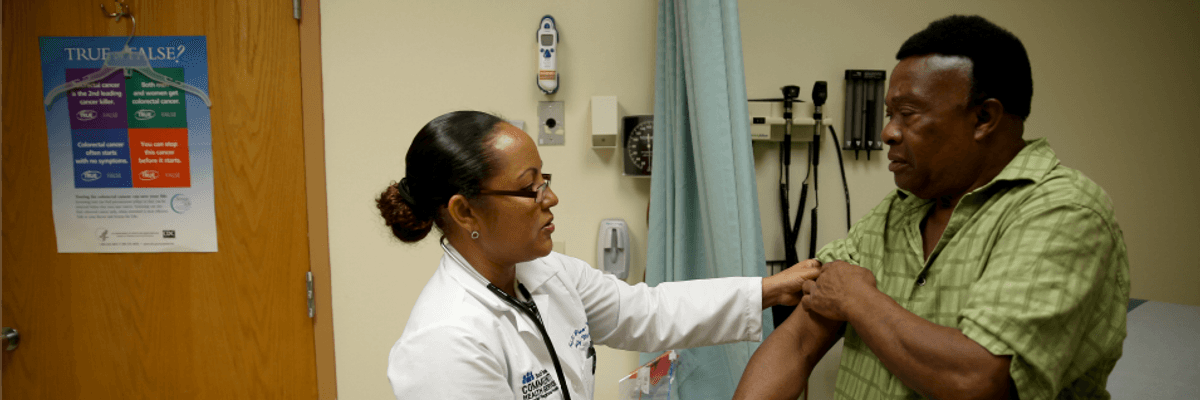
Bankruptcy brought on by medical debt affects about two million American households per year--a statistic that's unheard of in countries with universal government-funded healthcare. (Photo: Joe Raedle/Getty Images)
A CBS-affiliated local TV station in Seattle is sending notices to about 1,000 area residents telling them that the station has wiped out a portion of their overdue medical bills.
After interviewing a woman who was unable to afford cancer treatment due to the hospital bills she would incur, KIRO-TV worked with a New York-based charity called RIP Medical Debt to buy $1 million worth of debt owed by people in the station's coverage area.
"I am a cancer survivor," Jesse Jones, who reported on the woman's story for KIRO, told Poynter. "When you have $200,000 in medical bills, even with insurance, you are on the hook for some of that...I said 'Let's talk about the people who have issues, big issues with the bills that have forced them into bankruptcy, forcing them to make choices about whether to get treatment.'"
According to its website, RIP Medical Debt, a 501(c)3 organization that was founded by former debt collectors, "locates, buys and forgives medical debt across America, the only industrialized nation on earth with personal medical debt."
The group works with donors like KIRO and forgives debts held by hospitals' and doctors' neediest patients, as a tax-free gift to each patient. The TV station did not see the names of any of the people whose debt they were clearing.
KIRO was able to spend only $12,000 to purchase and forgive $1 million in overdue medical bills--similarly to how collection agencies can buy a $1,000 medical bill for as little as $10, leaving the debtor owing more and more as the bill goes unpaid and interest accrues.
While personal medical debt is unheard of in countries with universal healthcare systems, American debtors' reliance on random acts of kindness like the ones administered by RIP Medical Debt has become troublingly commonplace, with patients turning to crowdfunding websites like GoFundMe to solicit donations in order to help pay their bills.
Medical bills are the number one underlying cause of personal bankruptcies in the U.S., with medical bankruptcies affecting nearly two million Americans per year.
Since purchasing its viewers' medical debt, KIRO has heard from a number of people in the Seattle area who want to contribute to debt purchasing and forgiveness. The station has set up a website where viewers can donate to upcoming efforts.
Dear Common Dreams reader, It’s been nearly 30 years since I co-founded Common Dreams with my late wife, Lina Newhouser. We had the radical notion that journalism should serve the public good, not corporate profits. It was clear to us from the outset what it would take to build such a project. No paid advertisements. No corporate sponsors. No millionaire publisher telling us what to think or do. Many people said we wouldn't last a year, but we proved those doubters wrong. Together with a tremendous team of journalists and dedicated staff, we built an independent media outlet free from the constraints of profits and corporate control. Our mission has always been simple: To inform. To inspire. To ignite change for the common good. Building Common Dreams was not easy. Our survival was never guaranteed. When you take on the most powerful forces—Wall Street greed, fossil fuel industry destruction, Big Tech lobbyists, and uber-rich oligarchs who have spent billions upon billions rigging the economy and democracy in their favor—the only bulwark you have is supporters who believe in your work. But here’s the urgent message from me today. It's never been this bad out there. And it's never been this hard to keep us going. At the very moment Common Dreams is most needed, the threats we face are intensifying. We need your support now more than ever. We don't accept corporate advertising and never will. We don't have a paywall because we don't think people should be blocked from critical news based on their ability to pay. Everything we do is funded by the donations of readers like you. When everyone does the little they can afford, we are strong. But if that support retreats or dries up, so do we. Will you donate now to make sure Common Dreams not only survives but thrives? —Craig Brown, Co-founder |
A CBS-affiliated local TV station in Seattle is sending notices to about 1,000 area residents telling them that the station has wiped out a portion of their overdue medical bills.
After interviewing a woman who was unable to afford cancer treatment due to the hospital bills she would incur, KIRO-TV worked with a New York-based charity called RIP Medical Debt to buy $1 million worth of debt owed by people in the station's coverage area.
"I am a cancer survivor," Jesse Jones, who reported on the woman's story for KIRO, told Poynter. "When you have $200,000 in medical bills, even with insurance, you are on the hook for some of that...I said 'Let's talk about the people who have issues, big issues with the bills that have forced them into bankruptcy, forcing them to make choices about whether to get treatment.'"
According to its website, RIP Medical Debt, a 501(c)3 organization that was founded by former debt collectors, "locates, buys and forgives medical debt across America, the only industrialized nation on earth with personal medical debt."
The group works with donors like KIRO and forgives debts held by hospitals' and doctors' neediest patients, as a tax-free gift to each patient. The TV station did not see the names of any of the people whose debt they were clearing.
KIRO was able to spend only $12,000 to purchase and forgive $1 million in overdue medical bills--similarly to how collection agencies can buy a $1,000 medical bill for as little as $10, leaving the debtor owing more and more as the bill goes unpaid and interest accrues.
While personal medical debt is unheard of in countries with universal healthcare systems, American debtors' reliance on random acts of kindness like the ones administered by RIP Medical Debt has become troublingly commonplace, with patients turning to crowdfunding websites like GoFundMe to solicit donations in order to help pay their bills.
Medical bills are the number one underlying cause of personal bankruptcies in the U.S., with medical bankruptcies affecting nearly two million Americans per year.
Since purchasing its viewers' medical debt, KIRO has heard from a number of people in the Seattle area who want to contribute to debt purchasing and forgiveness. The station has set up a website where viewers can donate to upcoming efforts.
A CBS-affiliated local TV station in Seattle is sending notices to about 1,000 area residents telling them that the station has wiped out a portion of their overdue medical bills.
After interviewing a woman who was unable to afford cancer treatment due to the hospital bills she would incur, KIRO-TV worked with a New York-based charity called RIP Medical Debt to buy $1 million worth of debt owed by people in the station's coverage area.
"I am a cancer survivor," Jesse Jones, who reported on the woman's story for KIRO, told Poynter. "When you have $200,000 in medical bills, even with insurance, you are on the hook for some of that...I said 'Let's talk about the people who have issues, big issues with the bills that have forced them into bankruptcy, forcing them to make choices about whether to get treatment.'"
According to its website, RIP Medical Debt, a 501(c)3 organization that was founded by former debt collectors, "locates, buys and forgives medical debt across America, the only industrialized nation on earth with personal medical debt."
The group works with donors like KIRO and forgives debts held by hospitals' and doctors' neediest patients, as a tax-free gift to each patient. The TV station did not see the names of any of the people whose debt they were clearing.
KIRO was able to spend only $12,000 to purchase and forgive $1 million in overdue medical bills--similarly to how collection agencies can buy a $1,000 medical bill for as little as $10, leaving the debtor owing more and more as the bill goes unpaid and interest accrues.
While personal medical debt is unheard of in countries with universal healthcare systems, American debtors' reliance on random acts of kindness like the ones administered by RIP Medical Debt has become troublingly commonplace, with patients turning to crowdfunding websites like GoFundMe to solicit donations in order to help pay their bills.
Medical bills are the number one underlying cause of personal bankruptcies in the U.S., with medical bankruptcies affecting nearly two million Americans per year.
Since purchasing its viewers' medical debt, KIRO has heard from a number of people in the Seattle area who want to contribute to debt purchasing and forgiveness. The station has set up a website where viewers can donate to upcoming efforts.