

SUBSCRIBE TO OUR FREE NEWSLETTER
Daily news & progressive opinion—funded by the people, not the corporations—delivered straight to your inbox.
5
#000000
#FFFFFF
To donate by check, phone, or other method, see our More Ways to Give page.
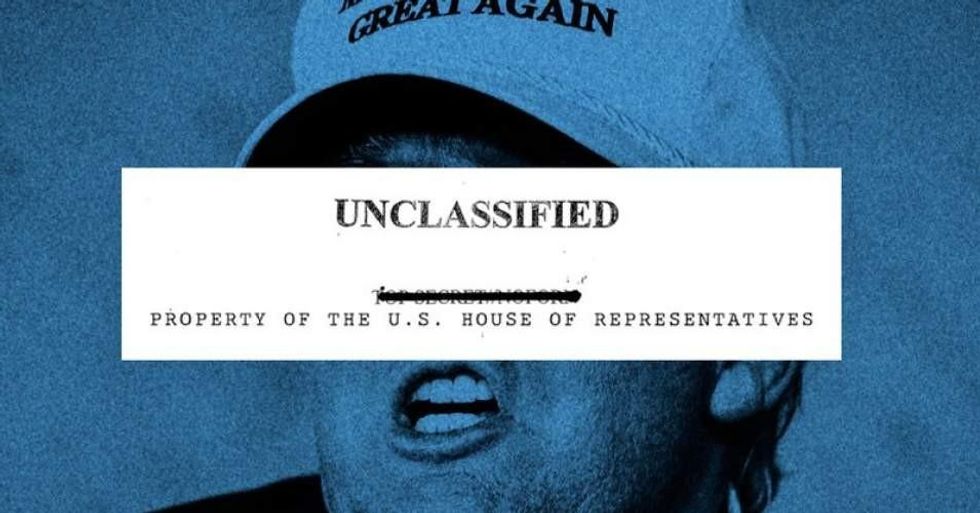
Appearing to exploit a highly controversial and misleading memo written by Congressional Republicans in the exact way many critics warned he might, President Donald Trump on Saturday morning claimed in a tweet that the contents of the document--released Friday to critical rebuke--"totally vindicated" him in terms of the ongoing probe by Special Counsel Robert Mueller.
For apparent emphasis, the president put his own name in quotation marks--"Trump"--in the tweet.
But informed critics immediately pushed back on the president's claim, pointing out not only the serious and shortcomings of the memo but also the manner by which its contents surreptitiously--if not ironically--validate and give credence to the Mueller probe.
The memo "does no such thing," writes Renato Mariotti, a former federal prosecutor and now a Democratic candidate for attorney general in Illinois, in the New York Times on Saturday.
"In fact," Mariotti explains, "Mr. Trump's approval of the release of the memo and his comments that releasing it could make it easier for him to fire Mr. Rosenstein could help [Mueller] prove that Mr. Trump fired James B. Comey, then the F.B.I. director, with a "corrupt" intent -- in other words, the intent to wrongfully impede the administration of justice -- as the law requires."
As many have pointed out, including The New Yorker's John Cassidy, CNN's Jake Tapper responded to Trump's tweet by noting how the memo, in the end, actually undermines the argument Republicans and their allies in the right-wing media are trying to make about what it shows.
While the Republican-generated memo seeks to make it seem like the entire FBI and intelligence investigation was triggered by opposition research paid for by the Clinton campaign, that narrative is specifically challenged by the role Papodopoulos played in sparking inquiries in the Trump campaign, not to mention that the research group that commissioned the so-called "Steele Dossier" was originally paid for by Republican rivals of Trump.
As Jay Willis wrote for GQ--in a column headlined The Nunes Memo Means Whatever Fox News Says It Means--on Friday night: "Nothing in the Memo justifies getting rid of Mueller, or Deputy Attorney General Rod Rosenstein, or anyone else, and there is still no evidence that the vast Deep State conspiracy to undermine Donald Trump is anything more than a Sean Hannity fever dream. But as usual, what the The Memo actually says is far less relevant to Donald Trump than what his supplicative water-carriers in the right-wing media say that it says. If every Fox News personality kicks off their show this weekend by reassuring the president that The Memo is the bombshell he wants it to be, it won't be long until he believes it with every fiber of his being."
Meanwhile in a fiery interview on CNN, Watergate reporter Carl Bernstein decried the memo as a red herring, one that Trump--"a demagogic, authoritarian president"--was in the process of exploiting for his own purposes.
So does the "Memo" vindicate "Trump"?
Appearing to exploit a highly controversial and misleading memo written by Congressional Republicans in the exact way many critics warned he might, President Donald Trump on Saturday morning claimed in a tweet that the contents of the document--released Friday to critical rebuke--"totally vindicated" him in terms of the ongoing probe by Special Counsel Robert Mueller.
For apparent emphasis, the president put his own name in quotation marks--"Trump"--in the tweet.
But informed critics immediately pushed back on the president's claim, pointing out not only the serious and shortcomings of the memo but also the manner by which its contents surreptitiously--if not ironically--validate and give credence to the Mueller probe.
The memo "does no such thing," writes Renato Mariotti, a former federal prosecutor and now a Democratic candidate for attorney general in Illinois, in the New York Times on Saturday.
"In fact," Mariotti explains, "Mr. Trump's approval of the release of the memo and his comments that releasing it could make it easier for him to fire Mr. Rosenstein could help [Mueller] prove that Mr. Trump fired James B. Comey, then the F.B.I. director, with a "corrupt" intent -- in other words, the intent to wrongfully impede the administration of justice -- as the law requires."
As many have pointed out, including The New Yorker's John Cassidy, CNN's Jake Tapper responded to Trump's tweet by noting how the memo, in the end, actually undermines the argument Republicans and their allies in the right-wing media are trying to make about what it shows.
While the Republican-generated memo seeks to make it seem like the entire FBI and intelligence investigation was triggered by opposition research paid for by the Clinton campaign, that narrative is specifically challenged by the role Papodopoulos played in sparking inquiries in the Trump campaign, not to mention that the research group that commissioned the so-called "Steele Dossier" was originally paid for by Republican rivals of Trump.
As Jay Willis wrote for GQ--in a column headlined The Nunes Memo Means Whatever Fox News Says It Means--on Friday night: "Nothing in the Memo justifies getting rid of Mueller, or Deputy Attorney General Rod Rosenstein, or anyone else, and there is still no evidence that the vast Deep State conspiracy to undermine Donald Trump is anything more than a Sean Hannity fever dream. But as usual, what the The Memo actually says is far less relevant to Donald Trump than what his supplicative water-carriers in the right-wing media say that it says. If every Fox News personality kicks off their show this weekend by reassuring the president that The Memo is the bombshell he wants it to be, it won't be long until he believes it with every fiber of his being."
Meanwhile in a fiery interview on CNN, Watergate reporter Carl Bernstein decried the memo as a red herring, one that Trump--"a demagogic, authoritarian president"--was in the process of exploiting for his own purposes.
So does the "Memo" vindicate "Trump"?
Appearing to exploit a highly controversial and misleading memo written by Congressional Republicans in the exact way many critics warned he might, President Donald Trump on Saturday morning claimed in a tweet that the contents of the document--released Friday to critical rebuke--"totally vindicated" him in terms of the ongoing probe by Special Counsel Robert Mueller.
For apparent emphasis, the president put his own name in quotation marks--"Trump"--in the tweet.
But informed critics immediately pushed back on the president's claim, pointing out not only the serious and shortcomings of the memo but also the manner by which its contents surreptitiously--if not ironically--validate and give credence to the Mueller probe.
The memo "does no such thing," writes Renato Mariotti, a former federal prosecutor and now a Democratic candidate for attorney general in Illinois, in the New York Times on Saturday.
"In fact," Mariotti explains, "Mr. Trump's approval of the release of the memo and his comments that releasing it could make it easier for him to fire Mr. Rosenstein could help [Mueller] prove that Mr. Trump fired James B. Comey, then the F.B.I. director, with a "corrupt" intent -- in other words, the intent to wrongfully impede the administration of justice -- as the law requires."
As many have pointed out, including The New Yorker's John Cassidy, CNN's Jake Tapper responded to Trump's tweet by noting how the memo, in the end, actually undermines the argument Republicans and their allies in the right-wing media are trying to make about what it shows.
While the Republican-generated memo seeks to make it seem like the entire FBI and intelligence investigation was triggered by opposition research paid for by the Clinton campaign, that narrative is specifically challenged by the role Papodopoulos played in sparking inquiries in the Trump campaign, not to mention that the research group that commissioned the so-called "Steele Dossier" was originally paid for by Republican rivals of Trump.
As Jay Willis wrote for GQ--in a column headlined The Nunes Memo Means Whatever Fox News Says It Means--on Friday night: "Nothing in the Memo justifies getting rid of Mueller, or Deputy Attorney General Rod Rosenstein, or anyone else, and there is still no evidence that the vast Deep State conspiracy to undermine Donald Trump is anything more than a Sean Hannity fever dream. But as usual, what the The Memo actually says is far less relevant to Donald Trump than what his supplicative water-carriers in the right-wing media say that it says. If every Fox News personality kicks off their show this weekend by reassuring the president that The Memo is the bombshell he wants it to be, it won't be long until he believes it with every fiber of his being."
Meanwhile in a fiery interview on CNN, Watergate reporter Carl Bernstein decried the memo as a red herring, one that Trump--"a demagogic, authoritarian president"--was in the process of exploiting for his own purposes.
So does the "Memo" vindicate "Trump"?

