
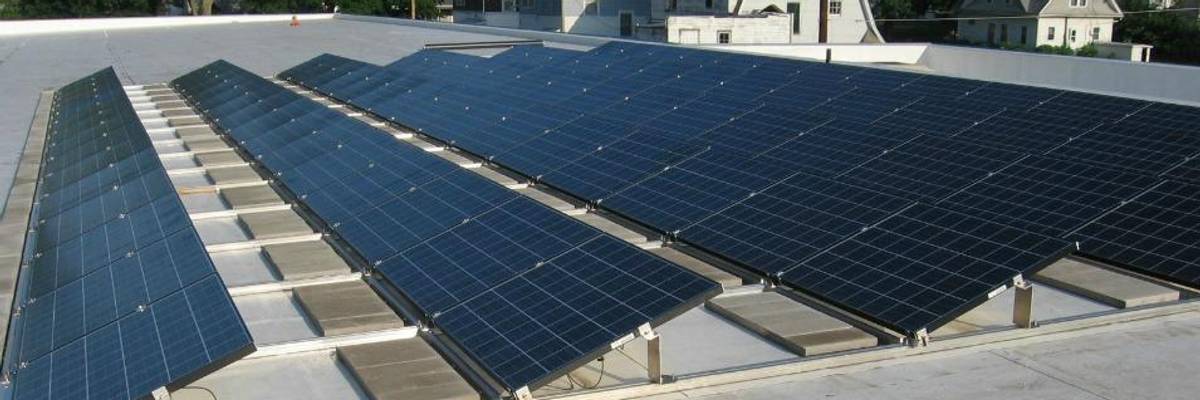
SunPower is halting a $20 million expansion that would have created hundreds of American jobs in one of the country's fastest-growing sectors, as a result of President Donald Trump's tariffs on solar imports. (Photo: Marshalltown Public Library/Flickr/cc)
Trump-Imposed Tariffs Claim First Victim as Solar Company Halts Hiring, $20 Million Expansion
"It's not hypothetical. These were positions that we were recruiting for that we are going to stop."
President Donald Trump's decision to impose a 30 percent tariff on all solar technology imports has claimed its first victims in the fast-growing solar energy job market.
The California-based company SunPower announced Friday that as a result of the tariffs, it will hold off on a $20 million plan to expand its operations in the U.S., including hiring hundreds of Americans.
"It's not hypothetical," CEO Tom Werner told Reuters. "These were positions that we were recruiting for that we are going to stop."
Two foreign-owned solar companies, Suniva and SolarWorld, lobbied for the tariffs, arguing that cheap imports from China have caused their panel prices to fall since 2016. But after it was announced earlier this week, Trump's decision caused concern in the U.S. solar energy industry.
"While tariffs in this case will not create adequate cell or module manufacturing to meet U.S. demand, or keep foreign-owned Suniva and SolarWorld afloat, they will create a crisis in a part of our economy that has been thriving, which will ultimately cost tens of thousands of hard-working, blue-collar Americans their jobs," said Abigail Ross Hopper, president of the Solar Energy Industry Association.
Employment in the solar sector grew 17 times as fast as the U.S. economy in 2017, according to the International Renewable Energy Agency. The industry employs more than twice the Americans who work in coal, despite Trump's insistence that the coal industry will return to the dominance it once held in U.S. energy production.
The tariffs are set to go into effect on February 7. Companies will be able to apply for an exemption on February 22.
SunPower says it plans to apply to be excluded from the tariffs, arguing that its solar panels, which are largely manufactured in the Philippines and Mexico, are more efficient than other models and cost more.
An exemption would allow the company to continue recruiting for jobs in research and development, manufacturing, and sales in California and Texas.
We are at a crossroads
This country and this world are at a monumental crossroads. In a few short weeks, US voters will have an opportunity to beat back the forces of fascism and confront the billionaires who are rigging the economy, our media system, and our democracy, making it increasingly impossible for ordinary people to get by. We’re not just talking about the election. We’re talking about what must be done once these fascist elements are vanquished from power. We need a bolder set of solutions than what either major party has so far been willing to offer and a working-class movement ready to fight like hell for it. Trump didn't emerge from nowhere. The conditions that fueled MAGA authoritarianism were created by decades of radical neoliberal economic policies and a corrupt political system dominated by corporate interests. They slashed taxes on the super-rich, promising that the benefits would trickle down. They said giveaways to the corporate titans would make life more affordable for the rest of us. It was all bullshit. And when a bitter, betrayed populace searches for someone to blame, right-wing demagogues have little trouble finding scapegoats. People know when they're being lied to, but you won't hear any of this from the corporate media. Only independent journalism—powered and funded by people who believe in building a better world—can deliver truly trustworthy daily news. Our Fall Campaign is underway, and we need your help. To power our newsroom through the rest of the year, we need to raise $125,000 by midnight on October 31. So if you share our vision, please contribute whatever you can to sustain our work. |
President Donald Trump's decision to impose a 30 percent tariff on all solar technology imports has claimed its first victims in the fast-growing solar energy job market.
The California-based company SunPower announced Friday that as a result of the tariffs, it will hold off on a $20 million plan to expand its operations in the U.S., including hiring hundreds of Americans.
"It's not hypothetical," CEO Tom Werner told Reuters. "These were positions that we were recruiting for that we are going to stop."
Two foreign-owned solar companies, Suniva and SolarWorld, lobbied for the tariffs, arguing that cheap imports from China have caused their panel prices to fall since 2016. But after it was announced earlier this week, Trump's decision caused concern in the U.S. solar energy industry.
"While tariffs in this case will not create adequate cell or module manufacturing to meet U.S. demand, or keep foreign-owned Suniva and SolarWorld afloat, they will create a crisis in a part of our economy that has been thriving, which will ultimately cost tens of thousands of hard-working, blue-collar Americans their jobs," said Abigail Ross Hopper, president of the Solar Energy Industry Association.
Employment in the solar sector grew 17 times as fast as the U.S. economy in 2017, according to the International Renewable Energy Agency. The industry employs more than twice the Americans who work in coal, despite Trump's insistence that the coal industry will return to the dominance it once held in U.S. energy production.
The tariffs are set to go into effect on February 7. Companies will be able to apply for an exemption on February 22.
SunPower says it plans to apply to be excluded from the tariffs, arguing that its solar panels, which are largely manufactured in the Philippines and Mexico, are more efficient than other models and cost more.
An exemption would allow the company to continue recruiting for jobs in research and development, manufacturing, and sales in California and Texas.
President Donald Trump's decision to impose a 30 percent tariff on all solar technology imports has claimed its first victims in the fast-growing solar energy job market.
The California-based company SunPower announced Friday that as a result of the tariffs, it will hold off on a $20 million plan to expand its operations in the U.S., including hiring hundreds of Americans.
"It's not hypothetical," CEO Tom Werner told Reuters. "These were positions that we were recruiting for that we are going to stop."
Two foreign-owned solar companies, Suniva and SolarWorld, lobbied for the tariffs, arguing that cheap imports from China have caused their panel prices to fall since 2016. But after it was announced earlier this week, Trump's decision caused concern in the U.S. solar energy industry.
"While tariffs in this case will not create adequate cell or module manufacturing to meet U.S. demand, or keep foreign-owned Suniva and SolarWorld afloat, they will create a crisis in a part of our economy that has been thriving, which will ultimately cost tens of thousands of hard-working, blue-collar Americans their jobs," said Abigail Ross Hopper, president of the Solar Energy Industry Association.
Employment in the solar sector grew 17 times as fast as the U.S. economy in 2017, according to the International Renewable Energy Agency. The industry employs more than twice the Americans who work in coal, despite Trump's insistence that the coal industry will return to the dominance it once held in U.S. energy production.
The tariffs are set to go into effect on February 7. Companies will be able to apply for an exemption on February 22.
SunPower says it plans to apply to be excluded from the tariffs, arguing that its solar panels, which are largely manufactured in the Philippines and Mexico, are more efficient than other models and cost more.
An exemption would allow the company to continue recruiting for jobs in research and development, manufacturing, and sales in California and Texas.