SUBSCRIBE TO OUR FREE NEWSLETTER
Daily news & progressive opinion—funded by the people, not the corporations—delivered straight to your inbox.
5
#000000
#FFFFFF
To donate by check, phone, or other method, see our More Ways to Give page.
Daily news & progressive opinion—funded by the people, not the corporations—delivered straight to your inbox.
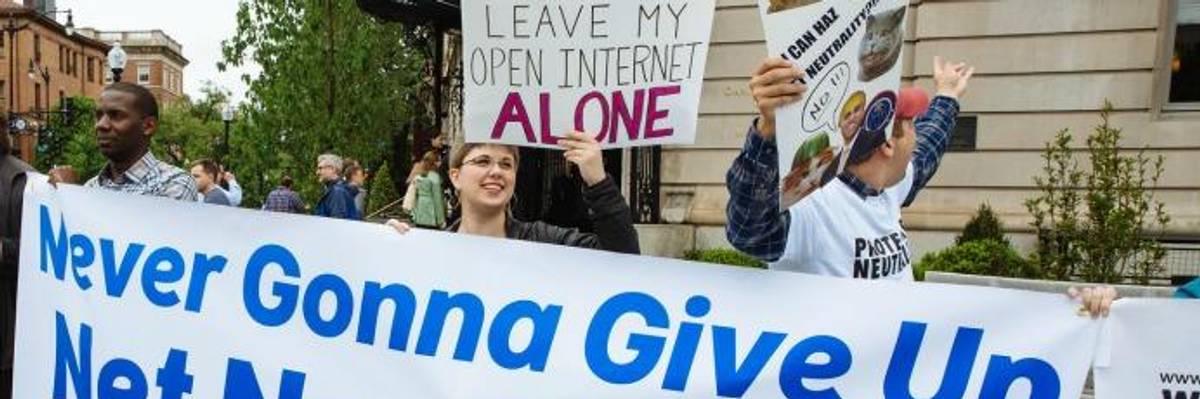
The Federal Communications Commission's move to roll back net neutrality has led to nationwide protests. (Photo: Maria Merkulova/Free Press/Flickr/cc)
In response to a recent move by the Republican-controlled FCC to roll back net neutrality, Democratic Gov. Andrew Cuomo signed an executive order on Wednesday to make New York the second state this week to ensure the consumer protections.
Paired with action taken by Montana on Monday, the orders to preserve net neutrality are being celebrated by free speech and consumer protection advocates, who have mounted a national movement against the FCC ruling, which critics warn enables internet service providers (ISPs) to choose to slow down or block access to certain content.
Cuomo's executive order (pdf) unequivocally states that in order to receive a state contract, ISPs cannot "block, throttle, or prioritize internet content or applications or require that end users pay different or higher rates to access specific types of content or applications." Similar to the order signed by Montana's Democratic governor, Steve Bullock, the Cuomo order attempts to work around a preemption in the FCC repeal that aims to prevent states from enacting their own net neutrality rules.
"The FCC's dangerous ruling goes against the core values of our democracy, and New York will do everything in our power to protect net neutrality and the free exchange of ideas," Cuomo vowed in a statement. "With this executive order, we reaffirm our commitment to freedom and democracy and help ensure that the internet remains free and open to all."
Cuomo's order declares, "the internet is an essential service that should be available to all New Yorkers," and "the free exchange of information, including the ability to access the content of their choosing secured with net neutrality protections is expected and relied upon by all New Yorkers."
It also chastizes the FCC for opting "to do away with free and open internet protections in order to satisfy corporate interests that are not aligned with those of New Yorkers," and outlines ways the internet is often utilized by businesses, students, educational institutions, state employees, and residents who are accessing government services or seeking to stay in touch with friends and family.
While Cuomo's order attempts to maintain net neutrality protections for residents of his state, New York's elected officials are also involved in efforts to fight the FCC at the federal level. Last week, New York Attorney General Eric Schneiderman announced he is leading a coalition of attorneys general from 21 states and D.C. who have filed a lawsuit to challenge the FCC ruling.
While welcoming all efforts to thwart the FCC, open internet advocates continue to argue the best path to ensure net neutrality protections is to nullify the agency's rule changes, which Congress can do by passing a Congressional Review Act resolution.
Dear Common Dreams reader, It’s been nearly 30 years since I co-founded Common Dreams with my late wife, Lina Newhouser. We had the radical notion that journalism should serve the public good, not corporate profits. It was clear to us from the outset what it would take to build such a project. No paid advertisements. No corporate sponsors. No millionaire publisher telling us what to think or do. Many people said we wouldn't last a year, but we proved those doubters wrong. Together with a tremendous team of journalists and dedicated staff, we built an independent media outlet free from the constraints of profits and corporate control. Our mission has always been simple: To inform. To inspire. To ignite change for the common good. Building Common Dreams was not easy. Our survival was never guaranteed. When you take on the most powerful forces—Wall Street greed, fossil fuel industry destruction, Big Tech lobbyists, and uber-rich oligarchs who have spent billions upon billions rigging the economy and democracy in their favor—the only bulwark you have is supporters who believe in your work. But here’s the urgent message from me today. It's never been this bad out there. And it's never been this hard to keep us going. At the very moment Common Dreams is most needed, the threats we face are intensifying. We need your support now more than ever. We don't accept corporate advertising and never will. We don't have a paywall because we don't think people should be blocked from critical news based on their ability to pay. Everything we do is funded by the donations of readers like you. When everyone does the little they can afford, we are strong. But if that support retreats or dries up, so do we. Will you donate now to make sure Common Dreams not only survives but thrives? —Craig Brown, Co-founder |
In response to a recent move by the Republican-controlled FCC to roll back net neutrality, Democratic Gov. Andrew Cuomo signed an executive order on Wednesday to make New York the second state this week to ensure the consumer protections.
Paired with action taken by Montana on Monday, the orders to preserve net neutrality are being celebrated by free speech and consumer protection advocates, who have mounted a national movement against the FCC ruling, which critics warn enables internet service providers (ISPs) to choose to slow down or block access to certain content.
Cuomo's executive order (pdf) unequivocally states that in order to receive a state contract, ISPs cannot "block, throttle, or prioritize internet content or applications or require that end users pay different or higher rates to access specific types of content or applications." Similar to the order signed by Montana's Democratic governor, Steve Bullock, the Cuomo order attempts to work around a preemption in the FCC repeal that aims to prevent states from enacting their own net neutrality rules.
"The FCC's dangerous ruling goes against the core values of our democracy, and New York will do everything in our power to protect net neutrality and the free exchange of ideas," Cuomo vowed in a statement. "With this executive order, we reaffirm our commitment to freedom and democracy and help ensure that the internet remains free and open to all."
Cuomo's order declares, "the internet is an essential service that should be available to all New Yorkers," and "the free exchange of information, including the ability to access the content of their choosing secured with net neutrality protections is expected and relied upon by all New Yorkers."
It also chastizes the FCC for opting "to do away with free and open internet protections in order to satisfy corporate interests that are not aligned with those of New Yorkers," and outlines ways the internet is often utilized by businesses, students, educational institutions, state employees, and residents who are accessing government services or seeking to stay in touch with friends and family.
While Cuomo's order attempts to maintain net neutrality protections for residents of his state, New York's elected officials are also involved in efforts to fight the FCC at the federal level. Last week, New York Attorney General Eric Schneiderman announced he is leading a coalition of attorneys general from 21 states and D.C. who have filed a lawsuit to challenge the FCC ruling.
While welcoming all efforts to thwart the FCC, open internet advocates continue to argue the best path to ensure net neutrality protections is to nullify the agency's rule changes, which Congress can do by passing a Congressional Review Act resolution.
In response to a recent move by the Republican-controlled FCC to roll back net neutrality, Democratic Gov. Andrew Cuomo signed an executive order on Wednesday to make New York the second state this week to ensure the consumer protections.
Paired with action taken by Montana on Monday, the orders to preserve net neutrality are being celebrated by free speech and consumer protection advocates, who have mounted a national movement against the FCC ruling, which critics warn enables internet service providers (ISPs) to choose to slow down or block access to certain content.
Cuomo's executive order (pdf) unequivocally states that in order to receive a state contract, ISPs cannot "block, throttle, or prioritize internet content or applications or require that end users pay different or higher rates to access specific types of content or applications." Similar to the order signed by Montana's Democratic governor, Steve Bullock, the Cuomo order attempts to work around a preemption in the FCC repeal that aims to prevent states from enacting their own net neutrality rules.
"The FCC's dangerous ruling goes against the core values of our democracy, and New York will do everything in our power to protect net neutrality and the free exchange of ideas," Cuomo vowed in a statement. "With this executive order, we reaffirm our commitment to freedom and democracy and help ensure that the internet remains free and open to all."
Cuomo's order declares, "the internet is an essential service that should be available to all New Yorkers," and "the free exchange of information, including the ability to access the content of their choosing secured with net neutrality protections is expected and relied upon by all New Yorkers."
It also chastizes the FCC for opting "to do away with free and open internet protections in order to satisfy corporate interests that are not aligned with those of New Yorkers," and outlines ways the internet is often utilized by businesses, students, educational institutions, state employees, and residents who are accessing government services or seeking to stay in touch with friends and family.
While Cuomo's order attempts to maintain net neutrality protections for residents of his state, New York's elected officials are also involved in efforts to fight the FCC at the federal level. Last week, New York Attorney General Eric Schneiderman announced he is leading a coalition of attorneys general from 21 states and D.C. who have filed a lawsuit to challenge the FCC ruling.
While welcoming all efforts to thwart the FCC, open internet advocates continue to argue the best path to ensure net neutrality protections is to nullify the agency's rule changes, which Congress can do by passing a Congressional Review Act resolution.