SUBSCRIBE TO OUR FREE NEWSLETTER
Daily news & progressive opinion—funded by the people, not the corporations—delivered straight to your inbox.
5
#000000
#FFFFFF
To donate by check, phone, or other method, see our More Ways to Give page.
Daily news & progressive opinion—funded by the people, not the corporations—delivered straight to your inbox.
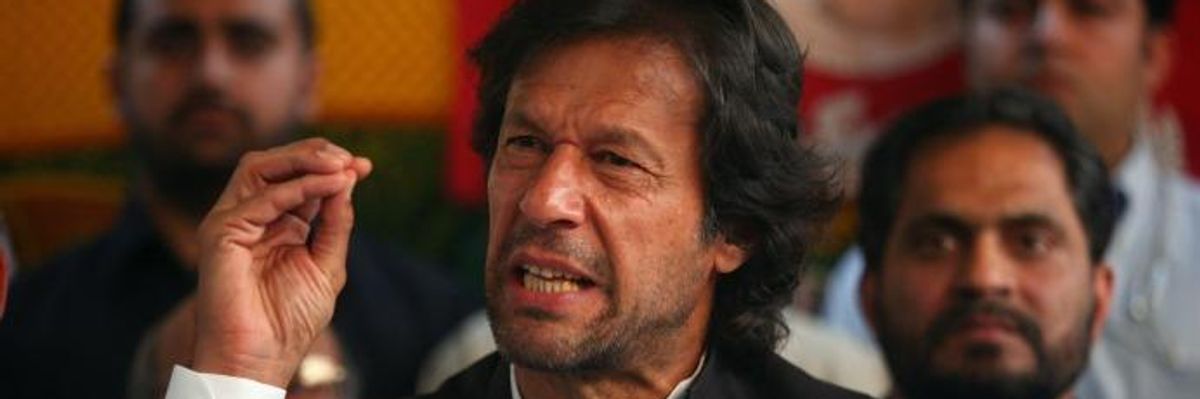
Pakistani opposition politician and cricket legend, Imran Khan, speaks out against President Pervez Musharraf and emergency rule at a press conference in Islamabad, Pakistan. (Photo: John Moore/Getty Images)
Amid reports that President Donald Trump is preparing to announce cuts to U.S. security assistance to Pakistan, a chorus of Pakistani officials slammed the move, including Imran Khan--a political leader and fierce opponent of the American drone program--who denounced Trump for attempting to "humiliate and insult" his country and urged the government to never again be used as an American "gun for hire."
"While Pakistan does not seek a conflict with the U.S., it cannot continue being the scapegoat for U.S. failures in Afghanistan."
-- Imran Khan
"The lesson we must learn is never to be used by others for short-term paltry financial benefits," Khan said in a scathing statement issued through a spokesperson on Thursday. "We became a U.S. proxy for a war against the Soviet Union when it entered Afghanistan and we allowed the CIA to create, train, and arm Jihadi groups on our soil and a decade later we tried to eliminate them as terrorists on U.S. orders. The time has come to stand firm and give a strong response to the U.S."
Such a response would include removing "excessive U.S. diplomatic, non-diplomatic, and intelligence personnel," denying the U.S. unfettered use of its facilities, and "creating a cooperative framework with China, Russia, and Iran to seek peace in Afghanistan," Khan said.
"It is time for Pakistan to delink from the U.S.," Khan concluded. "While Pakistan does not seek a conflict with the U.S., it cannot continue being the scapegoat for U.S. failures in Afghanistan."
This video mash-up posted to Khan's Twitter feed early Thursday morning highlights the numerous times he has condemned the post-9/11 arrangement between the U.S. and Pakistan, both recently and over the years, including an unapologetic critique of the damage inflicted on the Pakistani people as a result:
The White House plan to cut off security assistance to Pakistan--which could be officially announced as early as Thursday--comes just days after Trump threatened to slash aid on Twitter and accused Pakistan of peddling "lies and deceit" about its counterterrorism efforts.
On Monday, U.S. Ambassador to the United Nations confirmed that the Trump administration would withhold $255 million in aid from Pakistan.
Pakistan quickly moved to retaliate by attempting to further isolate the U.S. from the international community. Just 24 hours after Trump's Twitter threats, "Pakistan's central bank announced that it will be replacing the dollar with the yuan for bilateral trade and investment with Beijing," CNBC reported on Wednesday.
"For the past four years, we have been clearing the debris. Our forces are fighting in an exemplary manner, there is an unending saga of sacrifices."
--Khawaja Asif, Pakistan's Foreign Minister
While analysts have warned that Trump's rash funding cuts would have a destabilizing effect that could reverberate throughout the Middle East, a chorus of Pakistani officials echoed Khan in concluding that the time has come for Pakistan to no longer "blindly trust the U.S."
Speaking to the media on Wednesday, Pakistan's Ambassador to the United Nations Maleeha Lodhi suggested that Pakistan would "review its cooperation if it is not appreciated."
"For the past four years, we have been clearing the debris. Our forces are fighting in an exemplary manner, there is an unending saga of sacrifices," added Pakistani Foreign Minister Khawaja Asif in a series tweets on Tuesday. "We are feeling sorry as you are not happy but we will not compromise on our prestige anymore."
Asif also offered to pay for a American firm to check Trump's claim that the U.S. "has foolishly given Pakistan more than 33 billion dollars in aid over the last 15 years." An audit, Asif said, would show the world "who is lying and deceiving."
Contrary to Trump's insistence that the U.S. has "given" Pakistan aid for nothing in return, Pakistan claims that the U.S. still owes billions of dollars in reimbursement for "services the country provided in the war on terror."
But as Khan's statement observes, Pakistan has lost far more than just money:
The losses suffered by Pakistan as a result of going into the U.S.-led "war on terror," which has also bred more violence and terror in Pakistan, have been enormous: our society has been radicalized and polarized; we have suffered 70 thousand dead and over $100 billion in losses to the economy. All this, despite Pakistan having nothing to do with 9/11. Now, after suffering on all fronts, after hearing the constant U.S. refrain of "do more" and after being humiliated by an ungrateful Donald Trump, the government of Pakistan is saying "what I had said from the start: that Pakistan should not become a part of the U.S.-led so-called war on terror."
Pakistani officials also convened a National Security Committee (NSC) meeting chaired by Prime Minister Shahid Khaqan Abbasi on Tuesday in response to Trump's threats.
After the meeting came to a close, the NSC issued a statement slamming Trump for undermining "the trust between two nations built over generations" and "negat[ing] the decades of sacrifices made by the Pakistani nation."
"The huge sacrifices made by Pakistan, including the loss of tens of thousands of lives of Pakistani civilians and security personnel, and the pain of their families, [cannot] be trivialized so heartlessly by pushing all of it behind a monetary value--and that too an imagined one," the statement concluded.
Dear Common Dreams reader, It’s been nearly 30 years since I co-founded Common Dreams with my late wife, Lina Newhouser. We had the radical notion that journalism should serve the public good, not corporate profits. It was clear to us from the outset what it would take to build such a project. No paid advertisements. No corporate sponsors. No millionaire publisher telling us what to think or do. Many people said we wouldn't last a year, but we proved those doubters wrong. Together with a tremendous team of journalists and dedicated staff, we built an independent media outlet free from the constraints of profits and corporate control. Our mission has always been simple: To inform. To inspire. To ignite change for the common good. Building Common Dreams was not easy. Our survival was never guaranteed. When you take on the most powerful forces—Wall Street greed, fossil fuel industry destruction, Big Tech lobbyists, and uber-rich oligarchs who have spent billions upon billions rigging the economy and democracy in their favor—the only bulwark you have is supporters who believe in your work. But here’s the urgent message from me today. It's never been this bad out there. And it's never been this hard to keep us going. At the very moment Common Dreams is most needed, the threats we face are intensifying. We need your support now more than ever. We don't accept corporate advertising and never will. We don't have a paywall because we don't think people should be blocked from critical news based on their ability to pay. Everything we do is funded by the donations of readers like you. When everyone does the little they can afford, we are strong. But if that support retreats or dries up, so do we. Will you donate now to make sure Common Dreams not only survives but thrives? —Craig Brown, Co-founder |
Amid reports that President Donald Trump is preparing to announce cuts to U.S. security assistance to Pakistan, a chorus of Pakistani officials slammed the move, including Imran Khan--a political leader and fierce opponent of the American drone program--who denounced Trump for attempting to "humiliate and insult" his country and urged the government to never again be used as an American "gun for hire."
"While Pakistan does not seek a conflict with the U.S., it cannot continue being the scapegoat for U.S. failures in Afghanistan."
-- Imran Khan
"The lesson we must learn is never to be used by others for short-term paltry financial benefits," Khan said in a scathing statement issued through a spokesperson on Thursday. "We became a U.S. proxy for a war against the Soviet Union when it entered Afghanistan and we allowed the CIA to create, train, and arm Jihadi groups on our soil and a decade later we tried to eliminate them as terrorists on U.S. orders. The time has come to stand firm and give a strong response to the U.S."
Such a response would include removing "excessive U.S. diplomatic, non-diplomatic, and intelligence personnel," denying the U.S. unfettered use of its facilities, and "creating a cooperative framework with China, Russia, and Iran to seek peace in Afghanistan," Khan said.
"It is time for Pakistan to delink from the U.S.," Khan concluded. "While Pakistan does not seek a conflict with the U.S., it cannot continue being the scapegoat for U.S. failures in Afghanistan."
This video mash-up posted to Khan's Twitter feed early Thursday morning highlights the numerous times he has condemned the post-9/11 arrangement between the U.S. and Pakistan, both recently and over the years, including an unapologetic critique of the damage inflicted on the Pakistani people as a result:
The White House plan to cut off security assistance to Pakistan--which could be officially announced as early as Thursday--comes just days after Trump threatened to slash aid on Twitter and accused Pakistan of peddling "lies and deceit" about its counterterrorism efforts.
On Monday, U.S. Ambassador to the United Nations confirmed that the Trump administration would withhold $255 million in aid from Pakistan.
Pakistan quickly moved to retaliate by attempting to further isolate the U.S. from the international community. Just 24 hours after Trump's Twitter threats, "Pakistan's central bank announced that it will be replacing the dollar with the yuan for bilateral trade and investment with Beijing," CNBC reported on Wednesday.
"For the past four years, we have been clearing the debris. Our forces are fighting in an exemplary manner, there is an unending saga of sacrifices."
--Khawaja Asif, Pakistan's Foreign Minister
While analysts have warned that Trump's rash funding cuts would have a destabilizing effect that could reverberate throughout the Middle East, a chorus of Pakistani officials echoed Khan in concluding that the time has come for Pakistan to no longer "blindly trust the U.S."
Speaking to the media on Wednesday, Pakistan's Ambassador to the United Nations Maleeha Lodhi suggested that Pakistan would "review its cooperation if it is not appreciated."
"For the past four years, we have been clearing the debris. Our forces are fighting in an exemplary manner, there is an unending saga of sacrifices," added Pakistani Foreign Minister Khawaja Asif in a series tweets on Tuesday. "We are feeling sorry as you are not happy but we will not compromise on our prestige anymore."
Asif also offered to pay for a American firm to check Trump's claim that the U.S. "has foolishly given Pakistan more than 33 billion dollars in aid over the last 15 years." An audit, Asif said, would show the world "who is lying and deceiving."
Contrary to Trump's insistence that the U.S. has "given" Pakistan aid for nothing in return, Pakistan claims that the U.S. still owes billions of dollars in reimbursement for "services the country provided in the war on terror."
But as Khan's statement observes, Pakistan has lost far more than just money:
The losses suffered by Pakistan as a result of going into the U.S.-led "war on terror," which has also bred more violence and terror in Pakistan, have been enormous: our society has been radicalized and polarized; we have suffered 70 thousand dead and over $100 billion in losses to the economy. All this, despite Pakistan having nothing to do with 9/11. Now, after suffering on all fronts, after hearing the constant U.S. refrain of "do more" and after being humiliated by an ungrateful Donald Trump, the government of Pakistan is saying "what I had said from the start: that Pakistan should not become a part of the U.S.-led so-called war on terror."
Pakistani officials also convened a National Security Committee (NSC) meeting chaired by Prime Minister Shahid Khaqan Abbasi on Tuesday in response to Trump's threats.
After the meeting came to a close, the NSC issued a statement slamming Trump for undermining "the trust between two nations built over generations" and "negat[ing] the decades of sacrifices made by the Pakistani nation."
"The huge sacrifices made by Pakistan, including the loss of tens of thousands of lives of Pakistani civilians and security personnel, and the pain of their families, [cannot] be trivialized so heartlessly by pushing all of it behind a monetary value--and that too an imagined one," the statement concluded.
Amid reports that President Donald Trump is preparing to announce cuts to U.S. security assistance to Pakistan, a chorus of Pakistani officials slammed the move, including Imran Khan--a political leader and fierce opponent of the American drone program--who denounced Trump for attempting to "humiliate and insult" his country and urged the government to never again be used as an American "gun for hire."
"While Pakistan does not seek a conflict with the U.S., it cannot continue being the scapegoat for U.S. failures in Afghanistan."
-- Imran Khan
"The lesson we must learn is never to be used by others for short-term paltry financial benefits," Khan said in a scathing statement issued through a spokesperson on Thursday. "We became a U.S. proxy for a war against the Soviet Union when it entered Afghanistan and we allowed the CIA to create, train, and arm Jihadi groups on our soil and a decade later we tried to eliminate them as terrorists on U.S. orders. The time has come to stand firm and give a strong response to the U.S."
Such a response would include removing "excessive U.S. diplomatic, non-diplomatic, and intelligence personnel," denying the U.S. unfettered use of its facilities, and "creating a cooperative framework with China, Russia, and Iran to seek peace in Afghanistan," Khan said.
"It is time for Pakistan to delink from the U.S.," Khan concluded. "While Pakistan does not seek a conflict with the U.S., it cannot continue being the scapegoat for U.S. failures in Afghanistan."
This video mash-up posted to Khan's Twitter feed early Thursday morning highlights the numerous times he has condemned the post-9/11 arrangement between the U.S. and Pakistan, both recently and over the years, including an unapologetic critique of the damage inflicted on the Pakistani people as a result:
The White House plan to cut off security assistance to Pakistan--which could be officially announced as early as Thursday--comes just days after Trump threatened to slash aid on Twitter and accused Pakistan of peddling "lies and deceit" about its counterterrorism efforts.
On Monday, U.S. Ambassador to the United Nations confirmed that the Trump administration would withhold $255 million in aid from Pakistan.
Pakistan quickly moved to retaliate by attempting to further isolate the U.S. from the international community. Just 24 hours after Trump's Twitter threats, "Pakistan's central bank announced that it will be replacing the dollar with the yuan for bilateral trade and investment with Beijing," CNBC reported on Wednesday.
"For the past four years, we have been clearing the debris. Our forces are fighting in an exemplary manner, there is an unending saga of sacrifices."
--Khawaja Asif, Pakistan's Foreign Minister
While analysts have warned that Trump's rash funding cuts would have a destabilizing effect that could reverberate throughout the Middle East, a chorus of Pakistani officials echoed Khan in concluding that the time has come for Pakistan to no longer "blindly trust the U.S."
Speaking to the media on Wednesday, Pakistan's Ambassador to the United Nations Maleeha Lodhi suggested that Pakistan would "review its cooperation if it is not appreciated."
"For the past four years, we have been clearing the debris. Our forces are fighting in an exemplary manner, there is an unending saga of sacrifices," added Pakistani Foreign Minister Khawaja Asif in a series tweets on Tuesday. "We are feeling sorry as you are not happy but we will not compromise on our prestige anymore."
Asif also offered to pay for a American firm to check Trump's claim that the U.S. "has foolishly given Pakistan more than 33 billion dollars in aid over the last 15 years." An audit, Asif said, would show the world "who is lying and deceiving."
Contrary to Trump's insistence that the U.S. has "given" Pakistan aid for nothing in return, Pakistan claims that the U.S. still owes billions of dollars in reimbursement for "services the country provided in the war on terror."
But as Khan's statement observes, Pakistan has lost far more than just money:
The losses suffered by Pakistan as a result of going into the U.S.-led "war on terror," which has also bred more violence and terror in Pakistan, have been enormous: our society has been radicalized and polarized; we have suffered 70 thousand dead and over $100 billion in losses to the economy. All this, despite Pakistan having nothing to do with 9/11. Now, after suffering on all fronts, after hearing the constant U.S. refrain of "do more" and after being humiliated by an ungrateful Donald Trump, the government of Pakistan is saying "what I had said from the start: that Pakistan should not become a part of the U.S.-led so-called war on terror."
Pakistani officials also convened a National Security Committee (NSC) meeting chaired by Prime Minister Shahid Khaqan Abbasi on Tuesday in response to Trump's threats.
After the meeting came to a close, the NSC issued a statement slamming Trump for undermining "the trust between two nations built over generations" and "negat[ing] the decades of sacrifices made by the Pakistani nation."
"The huge sacrifices made by Pakistan, including the loss of tens of thousands of lives of Pakistani civilians and security personnel, and the pain of their families, [cannot] be trivialized so heartlessly by pushing all of it behind a monetary value--and that too an imagined one," the statement concluded.