SUBSCRIBE TO OUR FREE NEWSLETTER
Daily news & progressive opinion—funded by the people, not the corporations—delivered straight to your inbox.
5
#000000
#FFFFFF
To donate by check, phone, or other method, see our More Ways to Give page.
Daily news & progressive opinion—funded by the people, not the corporations—delivered straight to your inbox.
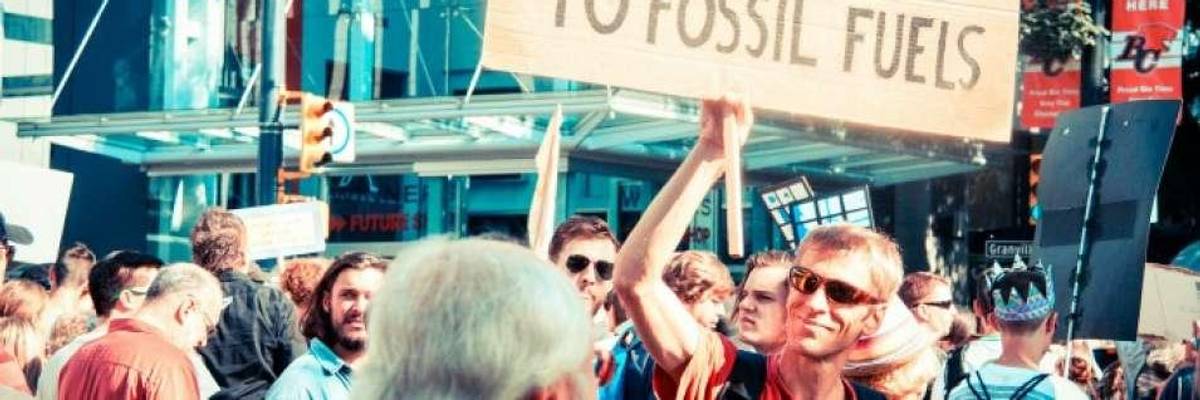
A demonstrator holds a sign in New York City during the 2014 People's Climate March. (Photo: Chris Yakimov/flickr/cc)
Taking a "tremendous step forward," the city of Fayetteville, Arkansas on Tuesday overwhelmingly voted to transition toward 100 percent clean energy.
"Going renewable is the right thing to do--and now is the right time to do it."The Sierra Club says it's the first city in the state to take such an action, and the 54th city to do so in the nation.
The commitment is laid out in the Fayetteville's Energy Action Plan, which the city council passed 7-1. That greenhouse gas-slashing plan aims to be "the groundwork for a thriving, beautiful community for generations to come."
To meet that task, the plan focuses on four sectors: reducing overall energy use, diverting waste from landfills, shifting toward clean energy production, and reducing transportation-related emissions.
Among the specific goals the city lays out are to achieve
It also seeks to "build local support for national carbon emission reduction and carbon capture strategies."
"The Sierra Club applauds Fayetteville ... for this tremendous step forward," said Glen Hooks, director of the Arkansas Sierra Club.
"Mayor Lioneld Jordan, the City Council, and the superb public servants in the city's Sustainability Department are to be commended for their vision and commitment to improving the quality of life for Fayetteville residents. We are proud to recognize Fayetteville as the first Arkansas city to commit to a 100 percent renewable energy future--the first of what we believe will be many," he added.
Mayor Jordan, it should be noted, is among hundreds of U.S. mayors who have vowed for their cities to meet the goals of the Paris climate accord in the face of President Donald Trump's backing out of the deal.
After Fayetteville, it appears that Ann Arbor, Michigan might be the next city to join the burgeoning list of U.S. municipalities committing to a clean energy future. Its city council just last month approved a resolution to "power 100 percent of the city's municipal government operations with clean and renewable energy sources such as wind and solar by 2035 or sooner," as MLive reported. The resolution directs "the city administrator to provide a multi-year action plan by September 2018 with five-year target objectives," the reporting continues.
According to Jodie Van Horn, director of Sierra Club's Ready for 100 campaign, cities are stepping away from dirty fuels "to 100 percent clean energy because it's better for them--clean energy creates local jobs, cuts pollution, and saves homes and businesses money."
While Van Horn acknowledges the switch won't happen overnight, "we know that clean, renewable energy resources are abundant and have the potential to meet all of our energy needs without the risks from fossil fuels. Wind and solar don't produce the pollutants that contribute to so many human diseases--from asthma to cancer--nor do they contribute to climate change." Add to that the fact that "renewable energy is now the least-expensive option, on average, for new electricity capacity around the world," she writes.
As she lays out in a recent report (pdf) spotlighting some of the cities that committed to 100 percent clean energy, "Going renewable is the right thing to do--and now is the right time to do it."
Dear Common Dreams reader, It’s been nearly 30 years since I co-founded Common Dreams with my late wife, Lina Newhouser. We had the radical notion that journalism should serve the public good, not corporate profits. It was clear to us from the outset what it would take to build such a project. No paid advertisements. No corporate sponsors. No millionaire publisher telling us what to think or do. Many people said we wouldn't last a year, but we proved those doubters wrong. Together with a tremendous team of journalists and dedicated staff, we built an independent media outlet free from the constraints of profits and corporate control. Our mission has always been simple: To inform. To inspire. To ignite change for the common good. Building Common Dreams was not easy. Our survival was never guaranteed. When you take on the most powerful forces—Wall Street greed, fossil fuel industry destruction, Big Tech lobbyists, and uber-rich oligarchs who have spent billions upon billions rigging the economy and democracy in their favor—the only bulwark you have is supporters who believe in your work. But here’s the urgent message from me today. It's never been this bad out there. And it's never been this hard to keep us going. At the very moment Common Dreams is most needed, the threats we face are intensifying. We need your support now more than ever. We don't accept corporate advertising and never will. We don't have a paywall because we don't think people should be blocked from critical news based on their ability to pay. Everything we do is funded by the donations of readers like you. When everyone does the little they can afford, we are strong. But if that support retreats or dries up, so do we. Will you donate now to make sure Common Dreams not only survives but thrives? —Craig Brown, Co-founder |
Taking a "tremendous step forward," the city of Fayetteville, Arkansas on Tuesday overwhelmingly voted to transition toward 100 percent clean energy.
"Going renewable is the right thing to do--and now is the right time to do it."The Sierra Club says it's the first city in the state to take such an action, and the 54th city to do so in the nation.
The commitment is laid out in the Fayetteville's Energy Action Plan, which the city council passed 7-1. That greenhouse gas-slashing plan aims to be "the groundwork for a thriving, beautiful community for generations to come."
To meet that task, the plan focuses on four sectors: reducing overall energy use, diverting waste from landfills, shifting toward clean energy production, and reducing transportation-related emissions.
Among the specific goals the city lays out are to achieve
It also seeks to "build local support for national carbon emission reduction and carbon capture strategies."
"The Sierra Club applauds Fayetteville ... for this tremendous step forward," said Glen Hooks, director of the Arkansas Sierra Club.
"Mayor Lioneld Jordan, the City Council, and the superb public servants in the city's Sustainability Department are to be commended for their vision and commitment to improving the quality of life for Fayetteville residents. We are proud to recognize Fayetteville as the first Arkansas city to commit to a 100 percent renewable energy future--the first of what we believe will be many," he added.
Mayor Jordan, it should be noted, is among hundreds of U.S. mayors who have vowed for their cities to meet the goals of the Paris climate accord in the face of President Donald Trump's backing out of the deal.
After Fayetteville, it appears that Ann Arbor, Michigan might be the next city to join the burgeoning list of U.S. municipalities committing to a clean energy future. Its city council just last month approved a resolution to "power 100 percent of the city's municipal government operations with clean and renewable energy sources such as wind and solar by 2035 or sooner," as MLive reported. The resolution directs "the city administrator to provide a multi-year action plan by September 2018 with five-year target objectives," the reporting continues.
According to Jodie Van Horn, director of Sierra Club's Ready for 100 campaign, cities are stepping away from dirty fuels "to 100 percent clean energy because it's better for them--clean energy creates local jobs, cuts pollution, and saves homes and businesses money."
While Van Horn acknowledges the switch won't happen overnight, "we know that clean, renewable energy resources are abundant and have the potential to meet all of our energy needs without the risks from fossil fuels. Wind and solar don't produce the pollutants that contribute to so many human diseases--from asthma to cancer--nor do they contribute to climate change." Add to that the fact that "renewable energy is now the least-expensive option, on average, for new electricity capacity around the world," she writes.
As she lays out in a recent report (pdf) spotlighting some of the cities that committed to 100 percent clean energy, "Going renewable is the right thing to do--and now is the right time to do it."
Taking a "tremendous step forward," the city of Fayetteville, Arkansas on Tuesday overwhelmingly voted to transition toward 100 percent clean energy.
"Going renewable is the right thing to do--and now is the right time to do it."The Sierra Club says it's the first city in the state to take such an action, and the 54th city to do so in the nation.
The commitment is laid out in the Fayetteville's Energy Action Plan, which the city council passed 7-1. That greenhouse gas-slashing plan aims to be "the groundwork for a thriving, beautiful community for generations to come."
To meet that task, the plan focuses on four sectors: reducing overall energy use, diverting waste from landfills, shifting toward clean energy production, and reducing transportation-related emissions.
Among the specific goals the city lays out are to achieve
It also seeks to "build local support for national carbon emission reduction and carbon capture strategies."
"The Sierra Club applauds Fayetteville ... for this tremendous step forward," said Glen Hooks, director of the Arkansas Sierra Club.
"Mayor Lioneld Jordan, the City Council, and the superb public servants in the city's Sustainability Department are to be commended for their vision and commitment to improving the quality of life for Fayetteville residents. We are proud to recognize Fayetteville as the first Arkansas city to commit to a 100 percent renewable energy future--the first of what we believe will be many," he added.
Mayor Jordan, it should be noted, is among hundreds of U.S. mayors who have vowed for their cities to meet the goals of the Paris climate accord in the face of President Donald Trump's backing out of the deal.
After Fayetteville, it appears that Ann Arbor, Michigan might be the next city to join the burgeoning list of U.S. municipalities committing to a clean energy future. Its city council just last month approved a resolution to "power 100 percent of the city's municipal government operations with clean and renewable energy sources such as wind and solar by 2035 or sooner," as MLive reported. The resolution directs "the city administrator to provide a multi-year action plan by September 2018 with five-year target objectives," the reporting continues.
According to Jodie Van Horn, director of Sierra Club's Ready for 100 campaign, cities are stepping away from dirty fuels "to 100 percent clean energy because it's better for them--clean energy creates local jobs, cuts pollution, and saves homes and businesses money."
While Van Horn acknowledges the switch won't happen overnight, "we know that clean, renewable energy resources are abundant and have the potential to meet all of our energy needs without the risks from fossil fuels. Wind and solar don't produce the pollutants that contribute to so many human diseases--from asthma to cancer--nor do they contribute to climate change." Add to that the fact that "renewable energy is now the least-expensive option, on average, for new electricity capacity around the world," she writes.
As she lays out in a recent report (pdf) spotlighting some of the cities that committed to 100 percent clean energy, "Going renewable is the right thing to do--and now is the right time to do it."