SUBSCRIBE TO OUR FREE NEWSLETTER
Daily news & progressive opinion—funded by the people, not the corporations—delivered straight to your inbox.
5
#000000
#FFFFFF
To donate by check, phone, or other method, see our More Ways to Give page.
Daily news & progressive opinion—funded by the people, not the corporations—delivered straight to your inbox.
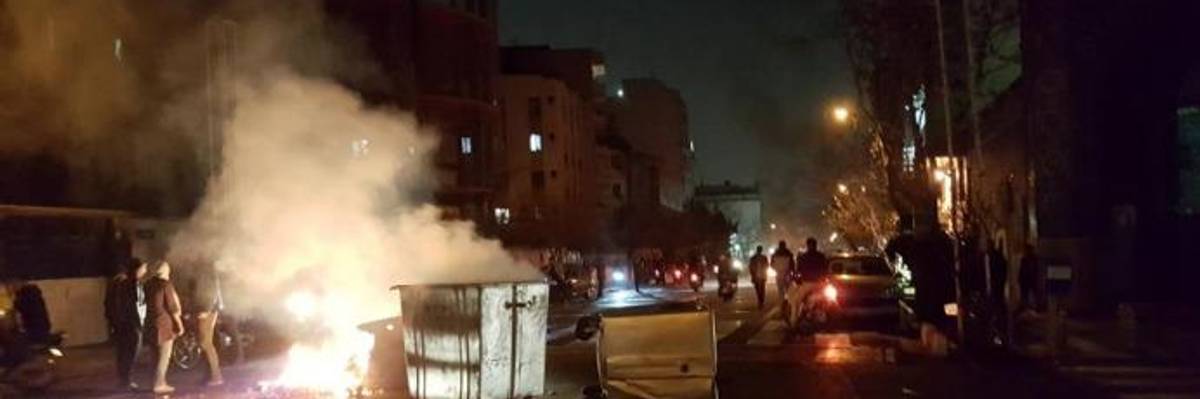
People protest Iran's economic hardships and other frustrations with the government in the nation's capitol, Tehran, on December 30, 2017. (Photo: obtained from social media by Reuters)
As a wave of demonstrations to protest the economic conditions in Iran sweeps the country, the global community is urging the Iranian government to respect human rights after two protesters were killed and authorities temporarily cut off access to two social media applications, while also demanding that world leaders not "exploit the current protests for their own benefit."
"The vast majority of us yearn for an Iranian government that respects the human rights and dignity of Iranians everywhere, and democratically represents its people. Ultimately, like any other country, it is up to Iranians living in Iran to decide their country's destiny."
--Trita Parsi, National Iranian American Council
The Iranian government has blocked access to the Facebook-owned photo and video app Instagram as well as Telegram, "a popular messaging app used by activists to organize and publicize the protests now roiling the Islamic Republic," the Associated Press reports.
Government officials are saying about 200 people have been arrested since the protests began Thursday, and confirmed to the AP that two demonstrators died at a Saturday night rally in Doroud, a city about 200 miles southwest of Tehran in Iran's western Lorestan province.
While police crack down on demonstrations nationwide, Reuters reports that the motivation for protests has expanded beyond frustration over economic hardships. Protesters reportedly have also "chanted slogans in support of political prisoners," alleged and condemned government corruption, "expressed anger over costly interventions in Syria and Iraq," and "begun to call on Supreme Leader Ayatollah Ali Khamenei to step down."
Responding to the protests, National Iranian American Council president Trita Parsi said, "We reiterate our call to the Iranian government to uphold its international human rights obligations, including to allow the right to free expression, to respect the dignity and safety of every Iranian, and to refrain from violence."
"The vast majority of us yearn for an Iranian government that respects the human rights and dignity of Iranians everywhere, and democratically represents its people," Parsi added, while noting that "ultimately, like any other country, it is up to Iranians living in Iran to decide their country's destiny."
Parsi also vowed to hold accountable other governments and politcians who may attempt to use the protests for their own gain. "As Iranian Americans we will also work to ensure that neither our government in the U.S., nor others in the region or beyond, undermine the safety of the Iranian people or exploit the current protests for their own benefit," he said.
Middle Eastern expert Juan Cole called out U.S. President Donald Trump for his comments on the protests, which include a tweet Sunday morning warning that the "USA is watching very closely for human rights violations!" In a piece published Sunday, Cole outlined how Trump's actions and policies indicate that he "doesn't actually care about Iranian protesters."
"The protesters are protesting economic hardship. But Trump and the Washington Establishment were all for imposing economic hardship on the Iranian public to pressure the government to give up its nuclear fuel enrichment program," Cole writes. "Some of today's economic problems are rooted in the American deep sanctions and in the GOP Congress's refusal to lift sanctions on Iranians after the government signed the nuclear deal."
Pointing to recently passed legislation that gives tax breaks to corporations and wealthy Americans--including Trump--at the expense of working families, Cole notes that the president and his party have "just plunged millions of Americans living in straitened circumstances into even more dire poverty," and that a provision in new law amounts to "trying to take health care insurance away" from millions of people.
He also points to the Trump administration's inadequate response to the humanitarian crisis in Puerto Rico, a U.S. terrority, following a devastating hurricane in September. "Trump hasn't even gotten the electricity back on for American citizens in Puerto Rico because of his racism," Cole writes, "so if Trump were in power in Iran, the people in the streets protesting would be treated much worse than they are now."
"Sympathizing with working people facing increased prices is not Trump's brand," Cole concludes, "and it is rich for him to pretend to care about them."
Golnar Motevalli, a journalist with Bloomberg, also criticized Trump's remarks on the protests considering his policies toward Iran, and reports that his tweets have "triggered a slew of angry comments packed, packed with ridicule."
Dear Common Dreams reader, It’s been nearly 30 years since I co-founded Common Dreams with my late wife, Lina Newhouser. We had the radical notion that journalism should serve the public good, not corporate profits. It was clear to us from the outset what it would take to build such a project. No paid advertisements. No corporate sponsors. No millionaire publisher telling us what to think or do. Many people said we wouldn't last a year, but we proved those doubters wrong. Together with a tremendous team of journalists and dedicated staff, we built an independent media outlet free from the constraints of profits and corporate control. Our mission has always been simple: To inform. To inspire. To ignite change for the common good. Building Common Dreams was not easy. Our survival was never guaranteed. When you take on the most powerful forces—Wall Street greed, fossil fuel industry destruction, Big Tech lobbyists, and uber-rich oligarchs who have spent billions upon billions rigging the economy and democracy in their favor—the only bulwark you have is supporters who believe in your work. But here’s the urgent message from me today. It's never been this bad out there. And it's never been this hard to keep us going. At the very moment Common Dreams is most needed, the threats we face are intensifying. We need your support now more than ever. We don't accept corporate advertising and never will. We don't have a paywall because we don't think people should be blocked from critical news based on their ability to pay. Everything we do is funded by the donations of readers like you. When everyone does the little they can afford, we are strong. But if that support retreats or dries up, so do we. Will you donate now to make sure Common Dreams not only survives but thrives? —Craig Brown, Co-founder |
As a wave of demonstrations to protest the economic conditions in Iran sweeps the country, the global community is urging the Iranian government to respect human rights after two protesters were killed and authorities temporarily cut off access to two social media applications, while also demanding that world leaders not "exploit the current protests for their own benefit."
"The vast majority of us yearn for an Iranian government that respects the human rights and dignity of Iranians everywhere, and democratically represents its people. Ultimately, like any other country, it is up to Iranians living in Iran to decide their country's destiny."
--Trita Parsi, National Iranian American Council
The Iranian government has blocked access to the Facebook-owned photo and video app Instagram as well as Telegram, "a popular messaging app used by activists to organize and publicize the protests now roiling the Islamic Republic," the Associated Press reports.
Government officials are saying about 200 people have been arrested since the protests began Thursday, and confirmed to the AP that two demonstrators died at a Saturday night rally in Doroud, a city about 200 miles southwest of Tehran in Iran's western Lorestan province.
While police crack down on demonstrations nationwide, Reuters reports that the motivation for protests has expanded beyond frustration over economic hardships. Protesters reportedly have also "chanted slogans in support of political prisoners," alleged and condemned government corruption, "expressed anger over costly interventions in Syria and Iraq," and "begun to call on Supreme Leader Ayatollah Ali Khamenei to step down."
Responding to the protests, National Iranian American Council president Trita Parsi said, "We reiterate our call to the Iranian government to uphold its international human rights obligations, including to allow the right to free expression, to respect the dignity and safety of every Iranian, and to refrain from violence."
"The vast majority of us yearn for an Iranian government that respects the human rights and dignity of Iranians everywhere, and democratically represents its people," Parsi added, while noting that "ultimately, like any other country, it is up to Iranians living in Iran to decide their country's destiny."
Parsi also vowed to hold accountable other governments and politcians who may attempt to use the protests for their own gain. "As Iranian Americans we will also work to ensure that neither our government in the U.S., nor others in the region or beyond, undermine the safety of the Iranian people or exploit the current protests for their own benefit," he said.
Middle Eastern expert Juan Cole called out U.S. President Donald Trump for his comments on the protests, which include a tweet Sunday morning warning that the "USA is watching very closely for human rights violations!" In a piece published Sunday, Cole outlined how Trump's actions and policies indicate that he "doesn't actually care about Iranian protesters."
"The protesters are protesting economic hardship. But Trump and the Washington Establishment were all for imposing economic hardship on the Iranian public to pressure the government to give up its nuclear fuel enrichment program," Cole writes. "Some of today's economic problems are rooted in the American deep sanctions and in the GOP Congress's refusal to lift sanctions on Iranians after the government signed the nuclear deal."
Pointing to recently passed legislation that gives tax breaks to corporations and wealthy Americans--including Trump--at the expense of working families, Cole notes that the president and his party have "just plunged millions of Americans living in straitened circumstances into even more dire poverty," and that a provision in new law amounts to "trying to take health care insurance away" from millions of people.
He also points to the Trump administration's inadequate response to the humanitarian crisis in Puerto Rico, a U.S. terrority, following a devastating hurricane in September. "Trump hasn't even gotten the electricity back on for American citizens in Puerto Rico because of his racism," Cole writes, "so if Trump were in power in Iran, the people in the streets protesting would be treated much worse than they are now."
"Sympathizing with working people facing increased prices is not Trump's brand," Cole concludes, "and it is rich for him to pretend to care about them."
Golnar Motevalli, a journalist with Bloomberg, also criticized Trump's remarks on the protests considering his policies toward Iran, and reports that his tweets have "triggered a slew of angry comments packed, packed with ridicule."
As a wave of demonstrations to protest the economic conditions in Iran sweeps the country, the global community is urging the Iranian government to respect human rights after two protesters were killed and authorities temporarily cut off access to two social media applications, while also demanding that world leaders not "exploit the current protests for their own benefit."
"The vast majority of us yearn for an Iranian government that respects the human rights and dignity of Iranians everywhere, and democratically represents its people. Ultimately, like any other country, it is up to Iranians living in Iran to decide their country's destiny."
--Trita Parsi, National Iranian American Council
The Iranian government has blocked access to the Facebook-owned photo and video app Instagram as well as Telegram, "a popular messaging app used by activists to organize and publicize the protests now roiling the Islamic Republic," the Associated Press reports.
Government officials are saying about 200 people have been arrested since the protests began Thursday, and confirmed to the AP that two demonstrators died at a Saturday night rally in Doroud, a city about 200 miles southwest of Tehran in Iran's western Lorestan province.
While police crack down on demonstrations nationwide, Reuters reports that the motivation for protests has expanded beyond frustration over economic hardships. Protesters reportedly have also "chanted slogans in support of political prisoners," alleged and condemned government corruption, "expressed anger over costly interventions in Syria and Iraq," and "begun to call on Supreme Leader Ayatollah Ali Khamenei to step down."
Responding to the protests, National Iranian American Council president Trita Parsi said, "We reiterate our call to the Iranian government to uphold its international human rights obligations, including to allow the right to free expression, to respect the dignity and safety of every Iranian, and to refrain from violence."
"The vast majority of us yearn for an Iranian government that respects the human rights and dignity of Iranians everywhere, and democratically represents its people," Parsi added, while noting that "ultimately, like any other country, it is up to Iranians living in Iran to decide their country's destiny."
Parsi also vowed to hold accountable other governments and politcians who may attempt to use the protests for their own gain. "As Iranian Americans we will also work to ensure that neither our government in the U.S., nor others in the region or beyond, undermine the safety of the Iranian people or exploit the current protests for their own benefit," he said.
Middle Eastern expert Juan Cole called out U.S. President Donald Trump for his comments on the protests, which include a tweet Sunday morning warning that the "USA is watching very closely for human rights violations!" In a piece published Sunday, Cole outlined how Trump's actions and policies indicate that he "doesn't actually care about Iranian protesters."
"The protesters are protesting economic hardship. But Trump and the Washington Establishment were all for imposing economic hardship on the Iranian public to pressure the government to give up its nuclear fuel enrichment program," Cole writes. "Some of today's economic problems are rooted in the American deep sanctions and in the GOP Congress's refusal to lift sanctions on Iranians after the government signed the nuclear deal."
Pointing to recently passed legislation that gives tax breaks to corporations and wealthy Americans--including Trump--at the expense of working families, Cole notes that the president and his party have "just plunged millions of Americans living in straitened circumstances into even more dire poverty," and that a provision in new law amounts to "trying to take health care insurance away" from millions of people.
He also points to the Trump administration's inadequate response to the humanitarian crisis in Puerto Rico, a U.S. terrority, following a devastating hurricane in September. "Trump hasn't even gotten the electricity back on for American citizens in Puerto Rico because of his racism," Cole writes, "so if Trump were in power in Iran, the people in the streets protesting would be treated much worse than they are now."
"Sympathizing with working people facing increased prices is not Trump's brand," Cole concludes, "and it is rich for him to pretend to care about them."
Golnar Motevalli, a journalist with Bloomberg, also criticized Trump's remarks on the protests considering his policies toward Iran, and reports that his tweets have "triggered a slew of angry comments packed, packed with ridicule."