

SUBSCRIBE TO OUR FREE NEWSLETTER
Daily news & progressive opinion—funded by the people, not the corporations—delivered straight to your inbox.
5
#000000
#FFFFFF
To donate by check, phone, or other method, see our More Ways to Give page.
Daily news & progressive opinion—funded by the people, not the corporations—delivered straight to your inbox.
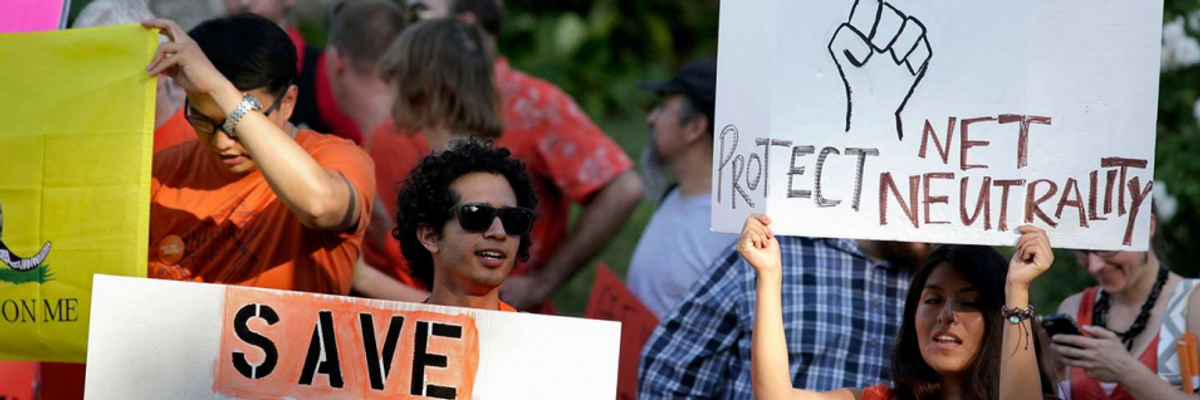
"If you share my concerns, I hope you will consider contacting your members of Congress to let them know that you support an internet that is free, fair, open, and accessible by everyone," Swanson wrote. (Photo: @LiberalResist/Twitter)
Joining the large coalition of states and advocacy groups preparing to take legal action against the Federal Communications Commission (FCC) over its newly passed net neutrality repeal plan, Minnesota Attorney General Lori Swanson announced in an email to supporters on Tuesday that she will take part in a multistate suit against the Republican-controlled agency in an effort to "overturn" its attack on the open internet.
"Without net neutrality, mega corporations can dominate the content people see online by paying money to obtain faster speeds."
--Lori Swanson, Minnesota Attorney General
"Net neutrality is essential for consumers and an informed electorate," Swanson wrote. "Without net neutrality, broadband companies are free to block content they don't want you to see, to slow it down and make it harder to access, or to prioritize content based on who pays them money. This will make it more difficult and more expensive for consumers to access the content they want."
Swanson went on to link corporate-backed efforts to roll back net neutrality protections to corporate mergers that are rapidly consolidating sources of news and information into the hands of a few large companies.
"This isn't just a consumer protection issue--it's a democracy protection issue too," Swanson wrote.
Eliminating net neutrality, Swanson observes, would tighten major corporations' stranglehold on information and allow them to "control what content to make prominent or to obscure, including by promoting sites they own or favor. This will influence the information to which voters and the public have access and will impact elections."
"Congress might try to pass a law next year to cement the FCC's repeal of net neutrality," Swanson's email concluded. "If you share my concerns, I hope you will consider contacting your members of Congress to let them know that you support an internet that is free, fair, open, and accessible by everyone."
According to numbers compiled by Battle for the Net, Americans are doing precisely that. Since FCC chair Ajit Pai's plan to kill net neutrality was unveiled just before Thanksgiving, more than 1.3 million calls have been placed to members of Congress, demanding that they voice support for net neutrality and overrule the FCC's decision using the Congressional Review Act. (Battle for the Net has also set up a "scoreboard" for Americans to track their representatives' position on neutrality.)
Public opposition to the FCC's vote has also been reflected in new polls and an upsurge in consumer complaints.
A Huffington Post/YouGov survey published over the weekend found that only 20 percent of Americans who are aware of the concept of net neutrality support Pai's plan, while 57 percent oppose it.
And as Axios reported on Tuesday, consumers filed more than 2,000 complaints through the FCC's Consumer Complaint Center in December, up from just 157 in October.
Dear Common Dreams reader, It’s been nearly 30 years since I co-founded Common Dreams with my late wife, Lina Newhouser. We had the radical notion that journalism should serve the public good, not corporate profits. It was clear to us from the outset what it would take to build such a project. No paid advertisements. No corporate sponsors. No millionaire publisher telling us what to think or do. Many people said we wouldn't last a year, but we proved those doubters wrong. Together with a tremendous team of journalists and dedicated staff, we built an independent media outlet free from the constraints of profits and corporate control. Our mission has always been simple: To inform. To inspire. To ignite change for the common good. Building Common Dreams was not easy. Our survival was never guaranteed. When you take on the most powerful forces—Wall Street greed, fossil fuel industry destruction, Big Tech lobbyists, and uber-rich oligarchs who have spent billions upon billions rigging the economy and democracy in their favor—the only bulwark you have is supporters who believe in your work. But here’s the urgent message from me today. It's never been this bad out there. And it's never been this hard to keep us going. At the very moment Common Dreams is most needed, the threats we face are intensifying. We need your support now more than ever. We don't accept corporate advertising and never will. We don't have a paywall because we don't think people should be blocked from critical news based on their ability to pay. Everything we do is funded by the donations of readers like you. When everyone does the little they can afford, we are strong. But if that support retreats or dries up, so do we. Will you donate now to make sure Common Dreams not only survives but thrives? —Craig Brown, Co-founder |
Joining the large coalition of states and advocacy groups preparing to take legal action against the Federal Communications Commission (FCC) over its newly passed net neutrality repeal plan, Minnesota Attorney General Lori Swanson announced in an email to supporters on Tuesday that she will take part in a multistate suit against the Republican-controlled agency in an effort to "overturn" its attack on the open internet.
"Without net neutrality, mega corporations can dominate the content people see online by paying money to obtain faster speeds."
--Lori Swanson, Minnesota Attorney General
"Net neutrality is essential for consumers and an informed electorate," Swanson wrote. "Without net neutrality, broadband companies are free to block content they don't want you to see, to slow it down and make it harder to access, or to prioritize content based on who pays them money. This will make it more difficult and more expensive for consumers to access the content they want."
Swanson went on to link corporate-backed efforts to roll back net neutrality protections to corporate mergers that are rapidly consolidating sources of news and information into the hands of a few large companies.
"This isn't just a consumer protection issue--it's a democracy protection issue too," Swanson wrote.
Eliminating net neutrality, Swanson observes, would tighten major corporations' stranglehold on information and allow them to "control what content to make prominent or to obscure, including by promoting sites they own or favor. This will influence the information to which voters and the public have access and will impact elections."
"Congress might try to pass a law next year to cement the FCC's repeal of net neutrality," Swanson's email concluded. "If you share my concerns, I hope you will consider contacting your members of Congress to let them know that you support an internet that is free, fair, open, and accessible by everyone."
According to numbers compiled by Battle for the Net, Americans are doing precisely that. Since FCC chair Ajit Pai's plan to kill net neutrality was unveiled just before Thanksgiving, more than 1.3 million calls have been placed to members of Congress, demanding that they voice support for net neutrality and overrule the FCC's decision using the Congressional Review Act. (Battle for the Net has also set up a "scoreboard" for Americans to track their representatives' position on neutrality.)
Public opposition to the FCC's vote has also been reflected in new polls and an upsurge in consumer complaints.
A Huffington Post/YouGov survey published over the weekend found that only 20 percent of Americans who are aware of the concept of net neutrality support Pai's plan, while 57 percent oppose it.
And as Axios reported on Tuesday, consumers filed more than 2,000 complaints through the FCC's Consumer Complaint Center in December, up from just 157 in October.
Joining the large coalition of states and advocacy groups preparing to take legal action against the Federal Communications Commission (FCC) over its newly passed net neutrality repeal plan, Minnesota Attorney General Lori Swanson announced in an email to supporters on Tuesday that she will take part in a multistate suit against the Republican-controlled agency in an effort to "overturn" its attack on the open internet.
"Without net neutrality, mega corporations can dominate the content people see online by paying money to obtain faster speeds."
--Lori Swanson, Minnesota Attorney General
"Net neutrality is essential for consumers and an informed electorate," Swanson wrote. "Without net neutrality, broadband companies are free to block content they don't want you to see, to slow it down and make it harder to access, or to prioritize content based on who pays them money. This will make it more difficult and more expensive for consumers to access the content they want."
Swanson went on to link corporate-backed efforts to roll back net neutrality protections to corporate mergers that are rapidly consolidating sources of news and information into the hands of a few large companies.
"This isn't just a consumer protection issue--it's a democracy protection issue too," Swanson wrote.
Eliminating net neutrality, Swanson observes, would tighten major corporations' stranglehold on information and allow them to "control what content to make prominent or to obscure, including by promoting sites they own or favor. This will influence the information to which voters and the public have access and will impact elections."
"Congress might try to pass a law next year to cement the FCC's repeal of net neutrality," Swanson's email concluded. "If you share my concerns, I hope you will consider contacting your members of Congress to let them know that you support an internet that is free, fair, open, and accessible by everyone."
According to numbers compiled by Battle for the Net, Americans are doing precisely that. Since FCC chair Ajit Pai's plan to kill net neutrality was unveiled just before Thanksgiving, more than 1.3 million calls have been placed to members of Congress, demanding that they voice support for net neutrality and overrule the FCC's decision using the Congressional Review Act. (Battle for the Net has also set up a "scoreboard" for Americans to track their representatives' position on neutrality.)
Public opposition to the FCC's vote has also been reflected in new polls and an upsurge in consumer complaints.
A Huffington Post/YouGov survey published over the weekend found that only 20 percent of Americans who are aware of the concept of net neutrality support Pai's plan, while 57 percent oppose it.
And as Axios reported on Tuesday, consumers filed more than 2,000 complaints through the FCC's Consumer Complaint Center in December, up from just 157 in October.

