

SUBSCRIBE TO OUR FREE NEWSLETTER
Daily news & progressive opinion—funded by the people, not the corporations—delivered straight to your inbox.
5
#000000
#FFFFFF
To donate by check, phone, or other method, see our More Ways to Give page.
Daily news & progressive opinion—funded by the people, not the corporations—delivered straight to your inbox.
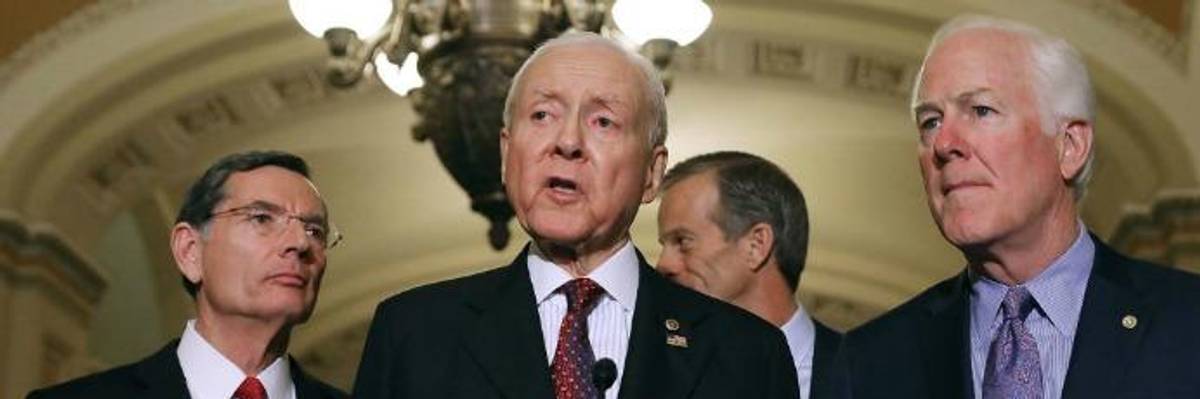
Sen. John Barrasso (R-Wy.), Senate Finance Committee Chairman Orrin Hatch (R-Utah), Sen. John Thune (R-S.D.) and Senate Majority Whip John Cornyn (R-Texas) talk with reporters following the weekly Senate Republican Policy Committee luncheon in the U.S. Capitol November 28, 2017 in Washington, D.C. (Photo: Chip Somodevilla/Getty Images)
Sen. Orrin Hatch (R-Utah) was one of the principal architects of the GOP's massive $1.5 trillion tax bill, and the editorial board of his home state's largest newspaper decided to recognize his efforts by naming him "Utahn of the Year."
But a look beyond the editorial's headline is enough to reveal that the honor is not all it appears to be. "The criteria are not set in stone," the Salt Lake Tribune notes in its opening paragraph. "The Tribune has assigned the label to the Utahn who, over the past 12 months, has done the most. Has made the most news. Has had the biggest impact. For good or for ill."
Several paragraphs in, it immediately becomes clear that the paper is spotlighting Hatch for doing ill, not good. Designating Hatch "Utahn of the Year," the Tribune notes, "has everything to do with recognizing":
"It would be good for Utah if Hatch, having finally caught the Great White Whale of tax reform, were to call it a career," the Tribune concludes. "If he doesn't, the voters should end it for him."
Judging by his first response, Hatch appeared not to have made it past the headline. In a tweet Monday afternoon, the Utah senator expressed gratitude "for this great Christmas honor from the Salt Lake Tribune."
Around 24 hours after the "grateful" tweet was sent, a Hatch spokesman took to Twitter to insist that the senator's comments were "tongue-in-cheek." (Some were unconvinced by the communication team's response.)
Hatch's initial expression of thanks sparked a flood of mockery on social media, with some suggesting that Hatch read the Tribune's editorial about as closely as he read the GOP's 500-page tax bill.
"This is spectacular," wrote Washington Post columnist Gene Weingarten. "Orrin Hatch retweeted this article naming him Utahn of the Year, thanking them for the honor. As with the tax bill, he obviously never read it."
Others piled on the ridicule:
As chairman of the Senate Finance Committee, Hatch played a substantial role in crafting the Republican tax bill that President Donald Trump signed into law last Friday.
Amid a flurry of backlash against a real-estate provision in the tax plan that could further enrich Trump and more than a dozen Senate Republicans, Hatch acknowledged that he personally authored what critics took to calling the "Corker Kickback," and denied that it was buried in the bill out of self-interest.
According to an analysis by the International Business Times, the provision could shave hundreds of thousands of dollars off of Hatch's taxes per year.
Dear Common Dreams reader, It’s been nearly 30 years since I co-founded Common Dreams with my late wife, Lina Newhouser. We had the radical notion that journalism should serve the public good, not corporate profits. It was clear to us from the outset what it would take to build such a project. No paid advertisements. No corporate sponsors. No millionaire publisher telling us what to think or do. Many people said we wouldn't last a year, but we proved those doubters wrong. Together with a tremendous team of journalists and dedicated staff, we built an independent media outlet free from the constraints of profits and corporate control. Our mission has always been simple: To inform. To inspire. To ignite change for the common good. Building Common Dreams was not easy. Our survival was never guaranteed. When you take on the most powerful forces—Wall Street greed, fossil fuel industry destruction, Big Tech lobbyists, and uber-rich oligarchs who have spent billions upon billions rigging the economy and democracy in their favor—the only bulwark you have is supporters who believe in your work. But here’s the urgent message from me today. It's never been this bad out there. And it's never been this hard to keep us going. At the very moment Common Dreams is most needed, the threats we face are intensifying. We need your support now more than ever. We don't accept corporate advertising and never will. We don't have a paywall because we don't think people should be blocked from critical news based on their ability to pay. Everything we do is funded by the donations of readers like you. When everyone does the little they can afford, we are strong. But if that support retreats or dries up, so do we. Will you donate now to make sure Common Dreams not only survives but thrives? —Craig Brown, Co-founder |
Sen. Orrin Hatch (R-Utah) was one of the principal architects of the GOP's massive $1.5 trillion tax bill, and the editorial board of his home state's largest newspaper decided to recognize his efforts by naming him "Utahn of the Year."
But a look beyond the editorial's headline is enough to reveal that the honor is not all it appears to be. "The criteria are not set in stone," the Salt Lake Tribune notes in its opening paragraph. "The Tribune has assigned the label to the Utahn who, over the past 12 months, has done the most. Has made the most news. Has had the biggest impact. For good or for ill."
Several paragraphs in, it immediately becomes clear that the paper is spotlighting Hatch for doing ill, not good. Designating Hatch "Utahn of the Year," the Tribune notes, "has everything to do with recognizing":
"It would be good for Utah if Hatch, having finally caught the Great White Whale of tax reform, were to call it a career," the Tribune concludes. "If he doesn't, the voters should end it for him."
Judging by his first response, Hatch appeared not to have made it past the headline. In a tweet Monday afternoon, the Utah senator expressed gratitude "for this great Christmas honor from the Salt Lake Tribune."
Around 24 hours after the "grateful" tweet was sent, a Hatch spokesman took to Twitter to insist that the senator's comments were "tongue-in-cheek." (Some were unconvinced by the communication team's response.)
Hatch's initial expression of thanks sparked a flood of mockery on social media, with some suggesting that Hatch read the Tribune's editorial about as closely as he read the GOP's 500-page tax bill.
"This is spectacular," wrote Washington Post columnist Gene Weingarten. "Orrin Hatch retweeted this article naming him Utahn of the Year, thanking them for the honor. As with the tax bill, he obviously never read it."
Others piled on the ridicule:
As chairman of the Senate Finance Committee, Hatch played a substantial role in crafting the Republican tax bill that President Donald Trump signed into law last Friday.
Amid a flurry of backlash against a real-estate provision in the tax plan that could further enrich Trump and more than a dozen Senate Republicans, Hatch acknowledged that he personally authored what critics took to calling the "Corker Kickback," and denied that it was buried in the bill out of self-interest.
According to an analysis by the International Business Times, the provision could shave hundreds of thousands of dollars off of Hatch's taxes per year.
Sen. Orrin Hatch (R-Utah) was one of the principal architects of the GOP's massive $1.5 trillion tax bill, and the editorial board of his home state's largest newspaper decided to recognize his efforts by naming him "Utahn of the Year."
But a look beyond the editorial's headline is enough to reveal that the honor is not all it appears to be. "The criteria are not set in stone," the Salt Lake Tribune notes in its opening paragraph. "The Tribune has assigned the label to the Utahn who, over the past 12 months, has done the most. Has made the most news. Has had the biggest impact. For good or for ill."
Several paragraphs in, it immediately becomes clear that the paper is spotlighting Hatch for doing ill, not good. Designating Hatch "Utahn of the Year," the Tribune notes, "has everything to do with recognizing":
"It would be good for Utah if Hatch, having finally caught the Great White Whale of tax reform, were to call it a career," the Tribune concludes. "If he doesn't, the voters should end it for him."
Judging by his first response, Hatch appeared not to have made it past the headline. In a tweet Monday afternoon, the Utah senator expressed gratitude "for this great Christmas honor from the Salt Lake Tribune."
Around 24 hours after the "grateful" tweet was sent, a Hatch spokesman took to Twitter to insist that the senator's comments were "tongue-in-cheek." (Some were unconvinced by the communication team's response.)
Hatch's initial expression of thanks sparked a flood of mockery on social media, with some suggesting that Hatch read the Tribune's editorial about as closely as he read the GOP's 500-page tax bill.
"This is spectacular," wrote Washington Post columnist Gene Weingarten. "Orrin Hatch retweeted this article naming him Utahn of the Year, thanking them for the honor. As with the tax bill, he obviously never read it."
Others piled on the ridicule:
As chairman of the Senate Finance Committee, Hatch played a substantial role in crafting the Republican tax bill that President Donald Trump signed into law last Friday.
Amid a flurry of backlash against a real-estate provision in the tax plan that could further enrich Trump and more than a dozen Senate Republicans, Hatch acknowledged that he personally authored what critics took to calling the "Corker Kickback," and denied that it was buried in the bill out of self-interest.
According to an analysis by the International Business Times, the provision could shave hundreds of thousands of dollars off of Hatch's taxes per year.

