

SUBSCRIBE TO OUR FREE NEWSLETTER
Daily news & progressive opinion—funded by the people, not the corporations—delivered straight to your inbox.
5
#000000
#FFFFFF
To donate by check, phone, or other method, see our More Ways to Give page.
Daily news & progressive opinion—funded by the people, not the corporations—delivered straight to your inbox.
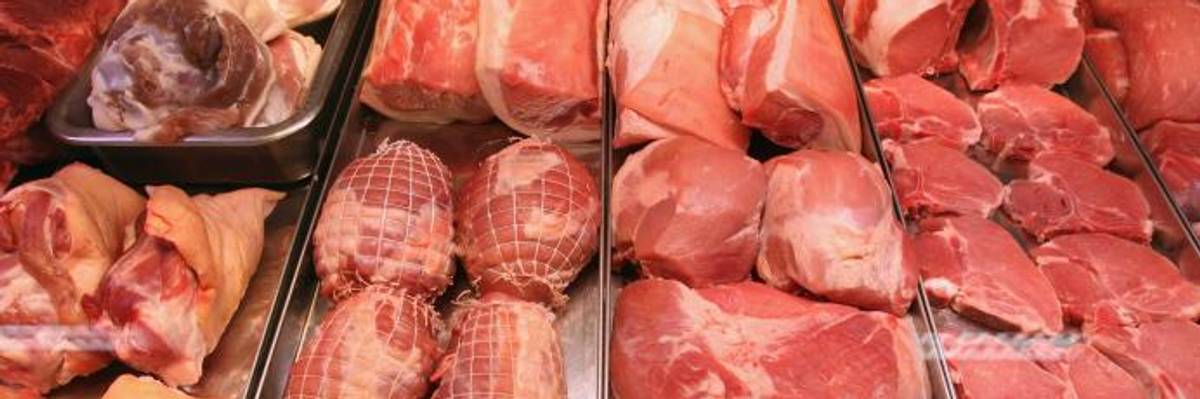
Cuts of beef and pork lie in a display counter at a supermarket in Berlin, Germany. (Photo: Sean Gallup/Getty Images)
"Driven by a global consensus around meat's negative contributions to climate change and global health epidemics such as obesity, cancer, and antibiotic resistance," a new report by a British investor network concludes that a meat tax should be considered "inevitable" for any government serious about addressing the climate crisis and other health concerns that stem from factory farms and livestock production.
"If policymakers are to cover the true cost of livestock epidemics like avian flu and human epidemics like obesity, diabetes, and cancer, while also tackling the twin challenges of climate change and antibiotic resistance, then a shift from subsidization to taxation of the meat industry looks inevitable."
--Jeremy Coller, FAIRR
For more than a decade, the United Nations and environmentalists have warned that "livestock is a major threat" to the environment, due to land and water degradation as well as the substantial amount of greenhouse gas emissions that farm animals generate.
As of 2013, the U.N. Food and Agriculture Organization found (pdf) that agriculture, including livestock, accounted for nearly 15 percent of anthropogenic emissions. The majority of emissions came from cattle raised for beef and milk.
A report from Farm Animal Investment Risk and Return (FAIRR)--which will be released in full next month--advises that meat is "on the same pathway to taxation as goods such as sugar, carbon, and tobacco," which has led more than 180 countries to tax tobacco, 60 jurisdictions to tax carbon, and at least 25 to tax sugar.
FAIRR researchers point to a 2015 move by the World Health Organization (WHO) to classify processed meat as carcinogenic and red meat as a probable carcinogen, reflecting "similar reports on the harmful effects of tobacco and sugar." They also acknowlege that since the early 1990s, global meat consumption has grown by more than 500 percent.
In response to skyrocketing rates of meat consumption, last year a team at Oxford University conducted the first-ever global analysis of meat taxes, which concluded--as the lead researcher put it--"It is clear that if we don't do something about the emissions from our food system, we have no chance of limiting climate change."
In light of the worldwide surge in consumption and the research illustrating its consequences, as governments look for ways to reduce emissions to meet goals established by the Paris Climate Accord,"it is increasingly probable we'll see meat taxes become a reality," said FAIRR founder Jeremy Coller.
"Countries such as Sweden and Denmark have already looked at meat tax proposals," Coller noted. "If policymakers are to cover the true cost of livestock epidemics like avian flu and human epidemics like obesity, diabetes, and cancer, while also tackling the twin challenges of climate change and antibiotic resistance, then a shift from subsidization to taxation of the meat industry looks inevitable."
"Current levels of meat consumption are not healthy or sustainable," said Marco Springmann, a senior researcher on environmental sustainability and public health at Oxford University. "They lead to high emissions of greenhouse gases that threaten to jeopardize existing climate commitments, as well as to large numbers of avoidable deaths from chronic diseases."
"Taxing meat for environmental or health purposes could be a first and important step in addressing these twin challenges," Springmann added, "and it would send a strong signal that dietary change toward more healthy and sustainable plant-based diets is urgently needed to preserve both our health and the environment."
Dear Common Dreams reader, It’s been nearly 30 years since I co-founded Common Dreams with my late wife, Lina Newhouser. We had the radical notion that journalism should serve the public good, not corporate profits. It was clear to us from the outset what it would take to build such a project. No paid advertisements. No corporate sponsors. No millionaire publisher telling us what to think or do. Many people said we wouldn't last a year, but we proved those doubters wrong. Together with a tremendous team of journalists and dedicated staff, we built an independent media outlet free from the constraints of profits and corporate control. Our mission has always been simple: To inform. To inspire. To ignite change for the common good. Building Common Dreams was not easy. Our survival was never guaranteed. When you take on the most powerful forces—Wall Street greed, fossil fuel industry destruction, Big Tech lobbyists, and uber-rich oligarchs who have spent billions upon billions rigging the economy and democracy in their favor—the only bulwark you have is supporters who believe in your work. But here’s the urgent message from me today. It's never been this bad out there. And it's never been this hard to keep us going. At the very moment Common Dreams is most needed, the threats we face are intensifying. We need your support now more than ever. We don't accept corporate advertising and never will. We don't have a paywall because we don't think people should be blocked from critical news based on their ability to pay. Everything we do is funded by the donations of readers like you. When everyone does the little they can afford, we are strong. But if that support retreats or dries up, so do we. Will you donate now to make sure Common Dreams not only survives but thrives? —Craig Brown, Co-founder |
"Driven by a global consensus around meat's negative contributions to climate change and global health epidemics such as obesity, cancer, and antibiotic resistance," a new report by a British investor network concludes that a meat tax should be considered "inevitable" for any government serious about addressing the climate crisis and other health concerns that stem from factory farms and livestock production.
"If policymakers are to cover the true cost of livestock epidemics like avian flu and human epidemics like obesity, diabetes, and cancer, while also tackling the twin challenges of climate change and antibiotic resistance, then a shift from subsidization to taxation of the meat industry looks inevitable."
--Jeremy Coller, FAIRR
For more than a decade, the United Nations and environmentalists have warned that "livestock is a major threat" to the environment, due to land and water degradation as well as the substantial amount of greenhouse gas emissions that farm animals generate.
As of 2013, the U.N. Food and Agriculture Organization found (pdf) that agriculture, including livestock, accounted for nearly 15 percent of anthropogenic emissions. The majority of emissions came from cattle raised for beef and milk.
A report from Farm Animal Investment Risk and Return (FAIRR)--which will be released in full next month--advises that meat is "on the same pathway to taxation as goods such as sugar, carbon, and tobacco," which has led more than 180 countries to tax tobacco, 60 jurisdictions to tax carbon, and at least 25 to tax sugar.
FAIRR researchers point to a 2015 move by the World Health Organization (WHO) to classify processed meat as carcinogenic and red meat as a probable carcinogen, reflecting "similar reports on the harmful effects of tobacco and sugar." They also acknowlege that since the early 1990s, global meat consumption has grown by more than 500 percent.
In response to skyrocketing rates of meat consumption, last year a team at Oxford University conducted the first-ever global analysis of meat taxes, which concluded--as the lead researcher put it--"It is clear that if we don't do something about the emissions from our food system, we have no chance of limiting climate change."
In light of the worldwide surge in consumption and the research illustrating its consequences, as governments look for ways to reduce emissions to meet goals established by the Paris Climate Accord,"it is increasingly probable we'll see meat taxes become a reality," said FAIRR founder Jeremy Coller.
"Countries such as Sweden and Denmark have already looked at meat tax proposals," Coller noted. "If policymakers are to cover the true cost of livestock epidemics like avian flu and human epidemics like obesity, diabetes, and cancer, while also tackling the twin challenges of climate change and antibiotic resistance, then a shift from subsidization to taxation of the meat industry looks inevitable."
"Current levels of meat consumption are not healthy or sustainable," said Marco Springmann, a senior researcher on environmental sustainability and public health at Oxford University. "They lead to high emissions of greenhouse gases that threaten to jeopardize existing climate commitments, as well as to large numbers of avoidable deaths from chronic diseases."
"Taxing meat for environmental or health purposes could be a first and important step in addressing these twin challenges," Springmann added, "and it would send a strong signal that dietary change toward more healthy and sustainable plant-based diets is urgently needed to preserve both our health and the environment."
"Driven by a global consensus around meat's negative contributions to climate change and global health epidemics such as obesity, cancer, and antibiotic resistance," a new report by a British investor network concludes that a meat tax should be considered "inevitable" for any government serious about addressing the climate crisis and other health concerns that stem from factory farms and livestock production.
"If policymakers are to cover the true cost of livestock epidemics like avian flu and human epidemics like obesity, diabetes, and cancer, while also tackling the twin challenges of climate change and antibiotic resistance, then a shift from subsidization to taxation of the meat industry looks inevitable."
--Jeremy Coller, FAIRR
For more than a decade, the United Nations and environmentalists have warned that "livestock is a major threat" to the environment, due to land and water degradation as well as the substantial amount of greenhouse gas emissions that farm animals generate.
As of 2013, the U.N. Food and Agriculture Organization found (pdf) that agriculture, including livestock, accounted for nearly 15 percent of anthropogenic emissions. The majority of emissions came from cattle raised for beef and milk.
A report from Farm Animal Investment Risk and Return (FAIRR)--which will be released in full next month--advises that meat is "on the same pathway to taxation as goods such as sugar, carbon, and tobacco," which has led more than 180 countries to tax tobacco, 60 jurisdictions to tax carbon, and at least 25 to tax sugar.
FAIRR researchers point to a 2015 move by the World Health Organization (WHO) to classify processed meat as carcinogenic and red meat as a probable carcinogen, reflecting "similar reports on the harmful effects of tobacco and sugar." They also acknowlege that since the early 1990s, global meat consumption has grown by more than 500 percent.
In response to skyrocketing rates of meat consumption, last year a team at Oxford University conducted the first-ever global analysis of meat taxes, which concluded--as the lead researcher put it--"It is clear that if we don't do something about the emissions from our food system, we have no chance of limiting climate change."
In light of the worldwide surge in consumption and the research illustrating its consequences, as governments look for ways to reduce emissions to meet goals established by the Paris Climate Accord,"it is increasingly probable we'll see meat taxes become a reality," said FAIRR founder Jeremy Coller.
"Countries such as Sweden and Denmark have already looked at meat tax proposals," Coller noted. "If policymakers are to cover the true cost of livestock epidemics like avian flu and human epidemics like obesity, diabetes, and cancer, while also tackling the twin challenges of climate change and antibiotic resistance, then a shift from subsidization to taxation of the meat industry looks inevitable."
"Current levels of meat consumption are not healthy or sustainable," said Marco Springmann, a senior researcher on environmental sustainability and public health at Oxford University. "They lead to high emissions of greenhouse gases that threaten to jeopardize existing climate commitments, as well as to large numbers of avoidable deaths from chronic diseases."
"Taxing meat for environmental or health purposes could be a first and important step in addressing these twin challenges," Springmann added, "and it would send a strong signal that dietary change toward more healthy and sustainable plant-based diets is urgently needed to preserve both our health and the environment."

