SUBSCRIBE TO OUR FREE NEWSLETTER
Daily news & progressive opinion—funded by the people, not the corporations—delivered straight to your inbox.
5
#000000
#FFFFFF
To donate by check, phone, or other method, see our More Ways to Give page.
Daily news & progressive opinion—funded by the people, not the corporations—delivered straight to your inbox.
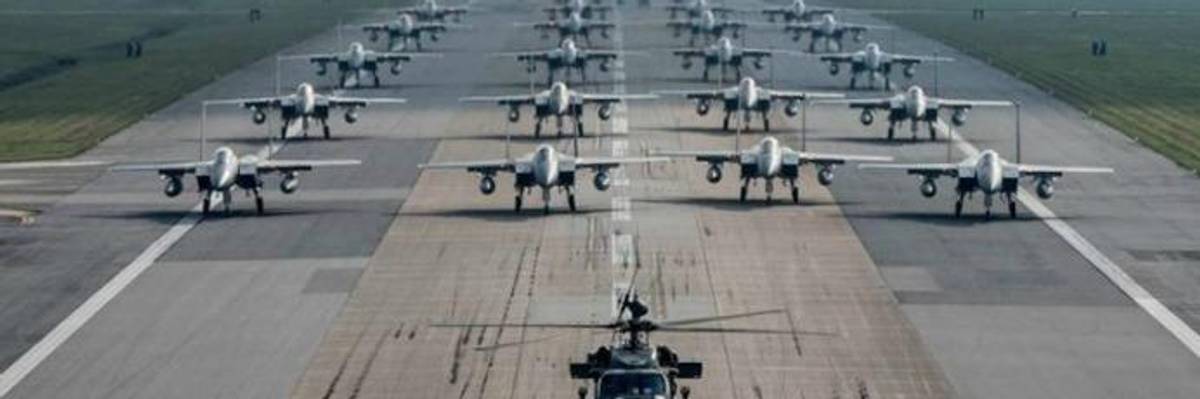
U.S. Pacific Command posted this photo to Facebook earlier this year alongside this cryptic caption: "The United States Air Force can generate substantial combat power in an instant if need be, even with no notice at all. 18th Wing, U.S. Pacific Air Forces demonstrated that capability this week during a zero-notice exercise at Kadena Air Base, Japan." (Photo: DoD)
With many headlines overnight warning that Pyongyang now has the ability "to hit Washington, D.C." with an intercontinental ballistic missile, the latest test by North Korea on Tuesday offers a new opportunity to remind people about the list of global cities the U.S. military could strike with its massive arsenal of ICBMs, Naval-based cruise missiles, and fleet of nuclear submarines: All of them. Every single one. Probably within the hour.
While the United Nations and others expressed serious concern about the lastest test--and the Trump administration announced a fresh round of sanctions on Wednesday morning--there was little (if any) open acknowledgement that while the North Koreans make steady progress on their ICBM and nuclear weapons programs, the U.S. maintains the world's largest and most sophisticated atomic weapons program in the form of the Nuclear Triad while also commanding an arsenal of hundreds of ICBMs with ranges long enough to hit any major city in the world.
Capable of flying over 6,000 miles towards a precision target, the Minuteman-III missile--of which it has more than 400--remains the U.S. military's premiere ICBM. In addition to U.S. Navy ships position in key locations around the world armed with countless cruise missiles, the American arsenal also includes an unparalled nuclear strike capability which--despite the inherent threat of any and all atomic weapons--far surpasses anything the North Koreas could develop within the coming years, if ever. As Newsweek documented earlier this year, while North Korea maintains a large and powerful military relative to its size and economic position,
the U.S.'s overall military capabilities are unparalleled. The U.S. has one of the world's largest military budgets accounting for gross domestic product, spending roughly $618 billion a year on arms and other military capabilities. It has nearly 8,000 nuclear warheads in reserve, 13,900 aircraft, 920 attack helicopters and 72 submarines, along with 800 overseas military bases in 70 countries scattered across strategic areas throughout the world, and roughly 150,090 soldiers stationed across 150 countries. The U.S. employs about 1,066,600 soldiers.
Beyond that, as journalist Noah Schachtman reported for Wired in 2007, the U.S. military "has been searching for ways to, in the words of U.S. Strategic Command's Lt. Gen. C. Robert Kehler, 'strike virtually anywhere on the face of the Earth within 60 minutes.' The boys at Stratco call the concept 'Prompt Global Strike,' or PGS."
But, he added, "The Pentagon doesn't just want to blast any target on Earth, in an hour. The military wants to strike everywhere and anywhere, just about instantly, with 'cans of whup-ass.'"
Just a friendly reminder.
Dear Common Dreams reader, It’s been nearly 30 years since I co-founded Common Dreams with my late wife, Lina Newhouser. We had the radical notion that journalism should serve the public good, not corporate profits. It was clear to us from the outset what it would take to build such a project. No paid advertisements. No corporate sponsors. No millionaire publisher telling us what to think or do. Many people said we wouldn't last a year, but we proved those doubters wrong. Together with a tremendous team of journalists and dedicated staff, we built an independent media outlet free from the constraints of profits and corporate control. Our mission has always been simple: To inform. To inspire. To ignite change for the common good. Building Common Dreams was not easy. Our survival was never guaranteed. When you take on the most powerful forces—Wall Street greed, fossil fuel industry destruction, Big Tech lobbyists, and uber-rich oligarchs who have spent billions upon billions rigging the economy and democracy in their favor—the only bulwark you have is supporters who believe in your work. But here’s the urgent message from me today. It's never been this bad out there. And it's never been this hard to keep us going. At the very moment Common Dreams is most needed, the threats we face are intensifying. We need your support now more than ever. We don't accept corporate advertising and never will. We don't have a paywall because we don't think people should be blocked from critical news based on their ability to pay. Everything we do is funded by the donations of readers like you. When everyone does the little they can afford, we are strong. But if that support retreats or dries up, so do we. Will you donate now to make sure Common Dreams not only survives but thrives? —Craig Brown, Co-founder |
With many headlines overnight warning that Pyongyang now has the ability "to hit Washington, D.C." with an intercontinental ballistic missile, the latest test by North Korea on Tuesday offers a new opportunity to remind people about the list of global cities the U.S. military could strike with its massive arsenal of ICBMs, Naval-based cruise missiles, and fleet of nuclear submarines: All of them. Every single one. Probably within the hour.
While the United Nations and others expressed serious concern about the lastest test--and the Trump administration announced a fresh round of sanctions on Wednesday morning--there was little (if any) open acknowledgement that while the North Koreans make steady progress on their ICBM and nuclear weapons programs, the U.S. maintains the world's largest and most sophisticated atomic weapons program in the form of the Nuclear Triad while also commanding an arsenal of hundreds of ICBMs with ranges long enough to hit any major city in the world.
Capable of flying over 6,000 miles towards a precision target, the Minuteman-III missile--of which it has more than 400--remains the U.S. military's premiere ICBM. In addition to U.S. Navy ships position in key locations around the world armed with countless cruise missiles, the American arsenal also includes an unparalled nuclear strike capability which--despite the inherent threat of any and all atomic weapons--far surpasses anything the North Koreas could develop within the coming years, if ever. As Newsweek documented earlier this year, while North Korea maintains a large and powerful military relative to its size and economic position,
the U.S.'s overall military capabilities are unparalleled. The U.S. has one of the world's largest military budgets accounting for gross domestic product, spending roughly $618 billion a year on arms and other military capabilities. It has nearly 8,000 nuclear warheads in reserve, 13,900 aircraft, 920 attack helicopters and 72 submarines, along with 800 overseas military bases in 70 countries scattered across strategic areas throughout the world, and roughly 150,090 soldiers stationed across 150 countries. The U.S. employs about 1,066,600 soldiers.
Beyond that, as journalist Noah Schachtman reported for Wired in 2007, the U.S. military "has been searching for ways to, in the words of U.S. Strategic Command's Lt. Gen. C. Robert Kehler, 'strike virtually anywhere on the face of the Earth within 60 minutes.' The boys at Stratco call the concept 'Prompt Global Strike,' or PGS."
But, he added, "The Pentagon doesn't just want to blast any target on Earth, in an hour. The military wants to strike everywhere and anywhere, just about instantly, with 'cans of whup-ass.'"
Just a friendly reminder.
With many headlines overnight warning that Pyongyang now has the ability "to hit Washington, D.C." with an intercontinental ballistic missile, the latest test by North Korea on Tuesday offers a new opportunity to remind people about the list of global cities the U.S. military could strike with its massive arsenal of ICBMs, Naval-based cruise missiles, and fleet of nuclear submarines: All of them. Every single one. Probably within the hour.
While the United Nations and others expressed serious concern about the lastest test--and the Trump administration announced a fresh round of sanctions on Wednesday morning--there was little (if any) open acknowledgement that while the North Koreans make steady progress on their ICBM and nuclear weapons programs, the U.S. maintains the world's largest and most sophisticated atomic weapons program in the form of the Nuclear Triad while also commanding an arsenal of hundreds of ICBMs with ranges long enough to hit any major city in the world.
Capable of flying over 6,000 miles towards a precision target, the Minuteman-III missile--of which it has more than 400--remains the U.S. military's premiere ICBM. In addition to U.S. Navy ships position in key locations around the world armed with countless cruise missiles, the American arsenal also includes an unparalled nuclear strike capability which--despite the inherent threat of any and all atomic weapons--far surpasses anything the North Koreas could develop within the coming years, if ever. As Newsweek documented earlier this year, while North Korea maintains a large and powerful military relative to its size and economic position,
the U.S.'s overall military capabilities are unparalleled. The U.S. has one of the world's largest military budgets accounting for gross domestic product, spending roughly $618 billion a year on arms and other military capabilities. It has nearly 8,000 nuclear warheads in reserve, 13,900 aircraft, 920 attack helicopters and 72 submarines, along with 800 overseas military bases in 70 countries scattered across strategic areas throughout the world, and roughly 150,090 soldiers stationed across 150 countries. The U.S. employs about 1,066,600 soldiers.
Beyond that, as journalist Noah Schachtman reported for Wired in 2007, the U.S. military "has been searching for ways to, in the words of U.S. Strategic Command's Lt. Gen. C. Robert Kehler, 'strike virtually anywhere on the face of the Earth within 60 minutes.' The boys at Stratco call the concept 'Prompt Global Strike,' or PGS."
But, he added, "The Pentagon doesn't just want to blast any target on Earth, in an hour. The military wants to strike everywhere and anywhere, just about instantly, with 'cans of whup-ass.'"
Just a friendly reminder.