
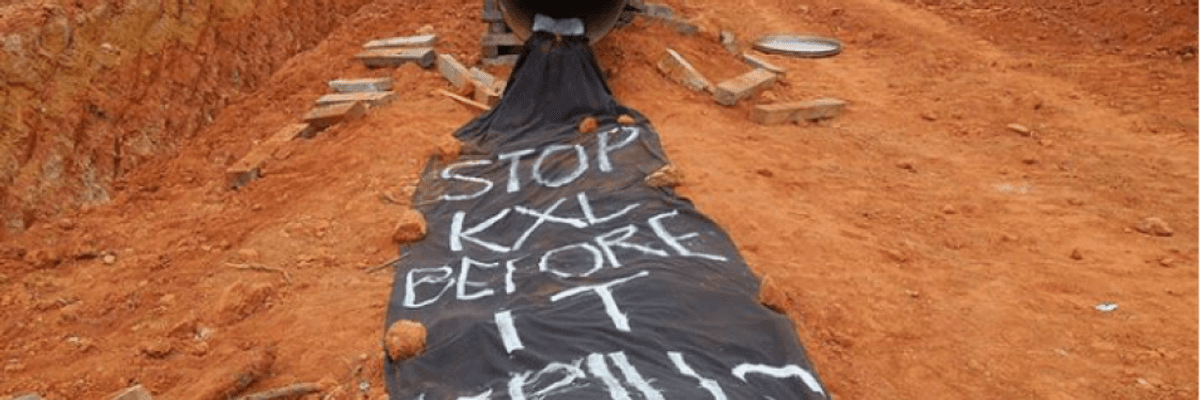
Those who had warned against the pipeline's approval for precisely these reasons and continue to worked tirelessly to prevent the construction of the Keystone XL (KXL) project, were among the first to respond to Thursday's spill. (Photo: Tar Sands Blockade)
As Predicted--Because 'Pipelines Are Bound to Spill'--Existing Keystone Gushes 200K Gallons of Oil
'With their horrible safety record, today's spill is just the latest tragedy caused by the irresponsible oil company TransCanada.'
Some of the worst fears and dire predictions of opponents of the Keystone XL pipeline came true on Thursday when pipeline owner TransCanada announced that more than 200,000 gallons of oil had spilled from the existing portion of the Keystone system in Marshall County, South Dakota.
"These pipelines are bound to spill, and they put communities, precious drinking water, and our climate at risk." --Rachel Rye Butler, Greenpeace
While the company reported the spill in a public statement, Buzzfeed notes there was an approximately four-and-a-half hour gap between when the company said the breach was discovered at 6:00 am and when local officials say they were notified at 10:30 am. As a South Dakota Department of Environment and Natural Resources told the news outlet, "We're not quite sure why there was a time gap in there."
Outside of the company's statement, there has been no outside or independent verification of the size of the spill or details about the scale of the possible damage.
Those who had warned against the pipeline's approval for precisely these reasons and continue to work tirelessly to prevent the construction of the Keystone XL (KXL) project, were among the first to respond to Thursday's spill.
"With their horrible safety record, today's spill is just the latest tragedy caused by the irresponsible oil company TransCanada," said Ben Schreiber, senior political strategist at Friends of the Earth. "We cannot let the world's fossil fuel empires continue to drive government policy toward climate catastrophe. The only safe solution for oil and fossil fuels is to keep them in the ground."
Rachel Rye Butler, an anti-tarsands campaigner with Greenpeace, noted that Thursday's spill comes just days before the Nebraska Public Service Commission is set to decide on state approval for Keystone XL, which was ultimately rejected under President Obama but given a greenlight earlier this year by the Trump administration. "The writing on the wall to reject this pipeline could not be more clear," Butler said in a statement. "These pipelines are bound to spill, and they put communities, precious drinking water, and our climate at risk."
"This is exactly the kind of disaster we can expect more of if Keystone XL is approved. No matter what TransCanada says, there's no such thing as a safe fossil fuel pipeline." --May Boeve, 350.orgShe added, "The existing Keystone pipeline just saw an enormous spill of oil yet there is an attempt by the same company to build a brand new pipeline, Keystone XL, that would pump over 800,000 barrels of tar sands oil per day if built."
350.org's executive director May Boeve said, "This is exactly the kind of disaster we can expect more of if Keystone XL is approved. No matter what TransCanada says, there's no such thing as a safe fossil fuel pipeline. Indigenous peoples, farmers, and ranchers along Keystone XL's proposed route have been holding the line against this project for years. Whatever Nebraska commissioners decide on Monday, we'll be ready for the work ahead to stop this and all new fossil fuel projects that threaten our communities and climate."
Scott Parkin, organizing director for the Rainforest Action Network, also expressed frustration. "Enough is enough," he said. "Pipelines leak--it's not a question of 'if,' but 'when.' The pending permit for TransCanada's Keystone XL pipeline should be flatly rejected by Nebraska's Public Service Commission. We need to stop all expansion of extreme fossil fuels such as tar sands oil--and we need the finance community to stop funding these preventable climate disasters--disasters for the climate, the environment and Indigenous rights."
According to Buzzfeed:
David Flute, chairman of the Sisseton-Wahpeton Oyate tribe, [said] the leak was on a section of pipeline adjacent to his reservation. He said the area has "the cleanest lakes in South Dakota," as well as a large subterranean aquifer, and that he was "concerned" about the possibility of contamination.
"I'm thinking there is going to be an impact, some type of environmental impact," Flute said. "As the oil seeps, if they can't contain the spill, which I'm hoping they do, if they're unable to contain it from seeping into the water systems, it can be hurtful and harmful to everybody."
Walsh said the spill had not impacted any bodies of water on the surface, meaning oil "won't be traveling along a river or a creek." He also said the oil was unlikely to reach the aquifer in the area, which sit between 800 and 900 feet underground.
Butler from Greenpeace, however, said the spill is just the latest evidence showing how fossil fuels represent an antiquated and dangerous mode of energy production.
"It is time to say no to outdated fossil fuel infrastructure and invest in clean energy instead," she said. "At the end of the day, you can't drink oil."
We are at a crossroads
This country and this world are at a monumental crossroads. In a few short weeks, US voters will have an opportunity to beat back the forces of fascism and confront the billionaires who are rigging the economy, our media system, and our democracy, making it increasingly impossible for ordinary people to get by. We’re not just talking about the election. We’re talking about what must be done once these fascist elements are vanquished from power. We need a bolder set of solutions than what either major party has so far been willing to offer and a working-class movement ready to fight like hell for it. Trump didn't emerge from nowhere. The conditions that fueled MAGA authoritarianism were created by decades of radical neoliberal economic policies and a corrupt political system dominated by corporate interests. They slashed taxes on the super-rich, promising that the benefits would trickle down. They said giveaways to the corporate titans would make life more affordable for the rest of us. It was all bullshit. And when a bitter, betrayed populace searches for someone to blame, right-wing demagogues have little trouble finding scapegoats. People know when they're being lied to, but you won't hear any of this from the corporate media. Only independent journalism—powered and funded by people who believe in building a better world—can deliver truly trustworthy daily news. Our Fall Campaign is underway, and we need your help. To power our newsroom through the rest of the year, we need to raise $125,000 by midnight on October 31. So if you share our vision, please contribute whatever you can to sustain our work. |
Some of the worst fears and dire predictions of opponents of the Keystone XL pipeline came true on Thursday when pipeline owner TransCanada announced that more than 200,000 gallons of oil had spilled from the existing portion of the Keystone system in Marshall County, South Dakota.
"These pipelines are bound to spill, and they put communities, precious drinking water, and our climate at risk." --Rachel Rye Butler, Greenpeace
While the company reported the spill in a public statement, Buzzfeed notes there was an approximately four-and-a-half hour gap between when the company said the breach was discovered at 6:00 am and when local officials say they were notified at 10:30 am. As a South Dakota Department of Environment and Natural Resources told the news outlet, "We're not quite sure why there was a time gap in there."
Outside of the company's statement, there has been no outside or independent verification of the size of the spill or details about the scale of the possible damage.
Those who had warned against the pipeline's approval for precisely these reasons and continue to work tirelessly to prevent the construction of the Keystone XL (KXL) project, were among the first to respond to Thursday's spill.
"With their horrible safety record, today's spill is just the latest tragedy caused by the irresponsible oil company TransCanada," said Ben Schreiber, senior political strategist at Friends of the Earth. "We cannot let the world's fossil fuel empires continue to drive government policy toward climate catastrophe. The only safe solution for oil and fossil fuels is to keep them in the ground."
Rachel Rye Butler, an anti-tarsands campaigner with Greenpeace, noted that Thursday's spill comes just days before the Nebraska Public Service Commission is set to decide on state approval for Keystone XL, which was ultimately rejected under President Obama but given a greenlight earlier this year by the Trump administration. "The writing on the wall to reject this pipeline could not be more clear," Butler said in a statement. "These pipelines are bound to spill, and they put communities, precious drinking water, and our climate at risk."
"This is exactly the kind of disaster we can expect more of if Keystone XL is approved. No matter what TransCanada says, there's no such thing as a safe fossil fuel pipeline." --May Boeve, 350.orgShe added, "The existing Keystone pipeline just saw an enormous spill of oil yet there is an attempt by the same company to build a brand new pipeline, Keystone XL, that would pump over 800,000 barrels of tar sands oil per day if built."
350.org's executive director May Boeve said, "This is exactly the kind of disaster we can expect more of if Keystone XL is approved. No matter what TransCanada says, there's no such thing as a safe fossil fuel pipeline. Indigenous peoples, farmers, and ranchers along Keystone XL's proposed route have been holding the line against this project for years. Whatever Nebraska commissioners decide on Monday, we'll be ready for the work ahead to stop this and all new fossil fuel projects that threaten our communities and climate."
Scott Parkin, organizing director for the Rainforest Action Network, also expressed frustration. "Enough is enough," he said. "Pipelines leak--it's not a question of 'if,' but 'when.' The pending permit for TransCanada's Keystone XL pipeline should be flatly rejected by Nebraska's Public Service Commission. We need to stop all expansion of extreme fossil fuels such as tar sands oil--and we need the finance community to stop funding these preventable climate disasters--disasters for the climate, the environment and Indigenous rights."
According to Buzzfeed:
David Flute, chairman of the Sisseton-Wahpeton Oyate tribe, [said] the leak was on a section of pipeline adjacent to his reservation. He said the area has "the cleanest lakes in South Dakota," as well as a large subterranean aquifer, and that he was "concerned" about the possibility of contamination.
"I'm thinking there is going to be an impact, some type of environmental impact," Flute said. "As the oil seeps, if they can't contain the spill, which I'm hoping they do, if they're unable to contain it from seeping into the water systems, it can be hurtful and harmful to everybody."
Walsh said the spill had not impacted any bodies of water on the surface, meaning oil "won't be traveling along a river or a creek." He also said the oil was unlikely to reach the aquifer in the area, which sit between 800 and 900 feet underground.
Butler from Greenpeace, however, said the spill is just the latest evidence showing how fossil fuels represent an antiquated and dangerous mode of energy production.
"It is time to say no to outdated fossil fuel infrastructure and invest in clean energy instead," she said. "At the end of the day, you can't drink oil."
Some of the worst fears and dire predictions of opponents of the Keystone XL pipeline came true on Thursday when pipeline owner TransCanada announced that more than 200,000 gallons of oil had spilled from the existing portion of the Keystone system in Marshall County, South Dakota.
"These pipelines are bound to spill, and they put communities, precious drinking water, and our climate at risk." --Rachel Rye Butler, Greenpeace
While the company reported the spill in a public statement, Buzzfeed notes there was an approximately four-and-a-half hour gap between when the company said the breach was discovered at 6:00 am and when local officials say they were notified at 10:30 am. As a South Dakota Department of Environment and Natural Resources told the news outlet, "We're not quite sure why there was a time gap in there."
Outside of the company's statement, there has been no outside or independent verification of the size of the spill or details about the scale of the possible damage.
Those who had warned against the pipeline's approval for precisely these reasons and continue to work tirelessly to prevent the construction of the Keystone XL (KXL) project, were among the first to respond to Thursday's spill.
"With their horrible safety record, today's spill is just the latest tragedy caused by the irresponsible oil company TransCanada," said Ben Schreiber, senior political strategist at Friends of the Earth. "We cannot let the world's fossil fuel empires continue to drive government policy toward climate catastrophe. The only safe solution for oil and fossil fuels is to keep them in the ground."
Rachel Rye Butler, an anti-tarsands campaigner with Greenpeace, noted that Thursday's spill comes just days before the Nebraska Public Service Commission is set to decide on state approval for Keystone XL, which was ultimately rejected under President Obama but given a greenlight earlier this year by the Trump administration. "The writing on the wall to reject this pipeline could not be more clear," Butler said in a statement. "These pipelines are bound to spill, and they put communities, precious drinking water, and our climate at risk."
"This is exactly the kind of disaster we can expect more of if Keystone XL is approved. No matter what TransCanada says, there's no such thing as a safe fossil fuel pipeline." --May Boeve, 350.orgShe added, "The existing Keystone pipeline just saw an enormous spill of oil yet there is an attempt by the same company to build a brand new pipeline, Keystone XL, that would pump over 800,000 barrels of tar sands oil per day if built."
350.org's executive director May Boeve said, "This is exactly the kind of disaster we can expect more of if Keystone XL is approved. No matter what TransCanada says, there's no such thing as a safe fossil fuel pipeline. Indigenous peoples, farmers, and ranchers along Keystone XL's proposed route have been holding the line against this project for years. Whatever Nebraska commissioners decide on Monday, we'll be ready for the work ahead to stop this and all new fossil fuel projects that threaten our communities and climate."
Scott Parkin, organizing director for the Rainforest Action Network, also expressed frustration. "Enough is enough," he said. "Pipelines leak--it's not a question of 'if,' but 'when.' The pending permit for TransCanada's Keystone XL pipeline should be flatly rejected by Nebraska's Public Service Commission. We need to stop all expansion of extreme fossil fuels such as tar sands oil--and we need the finance community to stop funding these preventable climate disasters--disasters for the climate, the environment and Indigenous rights."
According to Buzzfeed:
David Flute, chairman of the Sisseton-Wahpeton Oyate tribe, [said] the leak was on a section of pipeline adjacent to his reservation. He said the area has "the cleanest lakes in South Dakota," as well as a large subterranean aquifer, and that he was "concerned" about the possibility of contamination.
"I'm thinking there is going to be an impact, some type of environmental impact," Flute said. "As the oil seeps, if they can't contain the spill, which I'm hoping they do, if they're unable to contain it from seeping into the water systems, it can be hurtful and harmful to everybody."
Walsh said the spill had not impacted any bodies of water on the surface, meaning oil "won't be traveling along a river or a creek." He also said the oil was unlikely to reach the aquifer in the area, which sit between 800 and 900 feet underground.
Butler from Greenpeace, however, said the spill is just the latest evidence showing how fossil fuels represent an antiquated and dangerous mode of energy production.
"It is time to say no to outdated fossil fuel infrastructure and invest in clean energy instead," she said. "At the end of the day, you can't drink oil."