SUBSCRIBE TO OUR FREE NEWSLETTER
Daily news & progressive opinion—funded by the people, not the corporations—delivered straight to your inbox.
5
#000000
#FFFFFF
To donate by check, phone, or other method, see our More Ways to Give page.
Daily news & progressive opinion—funded by the people, not the corporations—delivered straight to your inbox.
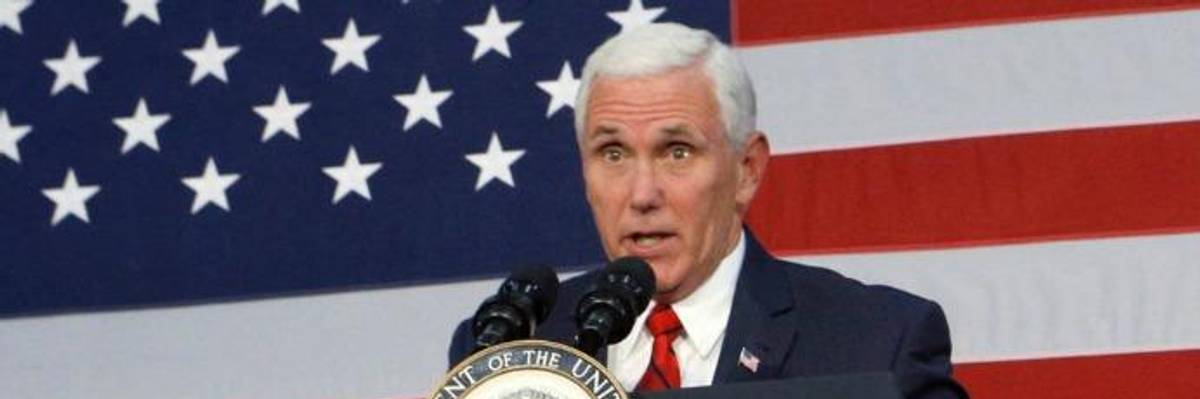
Vice President Mike Pence speaks at a campaign rally for Sen. Luther Strange (R-Ala.) at HealthSouth Aviation on September 25, 2017 in Birmingham, Alabama. (Photo: Hal Yeager/Getty Images)
"Nothing could be further from the truth" was how Mike Pence, then Donald Trump's running mate, responded in October of 2016 to claims that members of Trump's presidential campaign were in contact with WikiLeaks in the run-up to the November election.
"Boy, Pence sure does get caught saying demonstrably false things in public a lot, doesn't he?"
-- Chris Hayes, MSNBC
Late Monday, after The Atlantic reported that a member of Trump's presidential campaign--the president's eldest son Donald Trump Jr.--had, in fact, been in contact with WikiLeaks beginning in September of 2016, Pence was quick to deny that he had any knowledge of the communications.
"The Vice President was never aware of anyone associated with the campaign being in contact with WikiLeaks," Pence's office said in a statement. "He first learned of this news from a published report earlier tonight."
As many were quick to point out, Pence's denial of knowledge fits with a longstanding pattern that the vice president followed throughout the presidential campaign and during his short tenure in office.
Politico's Matthew Nusbaum summarizes:
Most famously, Pence said during the transition that Michael Flynn had not discussed sanctions with the Russian ambassador during the transition. Flynn had, in fact discussed those sanctions, as the Washington Post reported in February. The White House had previously been alerted that those conversations had been picked up by intelligence officials, though Pence said he learned about them from media reports. Flynn was fired as a result of misleading the vice president, Trump would later say.
Pence had also claimed the transition was not seeking a security clearance for Flynn's son, Michael Flynn Jr., which also proved false.
While Pence's office has maintained that the vice president had merely been speaking based on the information at his disposal, commentators were quick to express skepticism of his repeated denial of knowledge of campaign-related matters, given his close proximity to the president.
"Boy, Pence sure does get caught saying demonstrably false things in public a lot, doesn't he?" wrote MSNBC's Chris Hayes following Pence's statement.
Others were similarly incredulous that the vice president could be so thoroughly out of the loop, with some arguing that Pence's efforts to distance himself from campaign-related matters is part of an effort to keep his presidential prospects alive.
"Practically since his appointment as vice president, speculation has run rampant about the White House #2 one day becoming #1," writes The Week's Jeva Lange. "Of course, those ambitions would require some careful distancing from thorny situations like those involving Trump Jr."
Dear Common Dreams reader, It’s been nearly 30 years since I co-founded Common Dreams with my late wife, Lina Newhouser. We had the radical notion that journalism should serve the public good, not corporate profits. It was clear to us from the outset what it would take to build such a project. No paid advertisements. No corporate sponsors. No millionaire publisher telling us what to think or do. Many people said we wouldn't last a year, but we proved those doubters wrong. Together with a tremendous team of journalists and dedicated staff, we built an independent media outlet free from the constraints of profits and corporate control. Our mission has always been simple: To inform. To inspire. To ignite change for the common good. Building Common Dreams was not easy. Our survival was never guaranteed. When you take on the most powerful forces—Wall Street greed, fossil fuel industry destruction, Big Tech lobbyists, and uber-rich oligarchs who have spent billions upon billions rigging the economy and democracy in their favor—the only bulwark you have is supporters who believe in your work. But here’s the urgent message from me today. It's never been this bad out there. And it's never been this hard to keep us going. At the very moment Common Dreams is most needed, the threats we face are intensifying. We need your support now more than ever. We don't accept corporate advertising and never will. We don't have a paywall because we don't think people should be blocked from critical news based on their ability to pay. Everything we do is funded by the donations of readers like you. When everyone does the little they can afford, we are strong. But if that support retreats or dries up, so do we. Will you donate now to make sure Common Dreams not only survives but thrives? —Craig Brown, Co-founder |
"Nothing could be further from the truth" was how Mike Pence, then Donald Trump's running mate, responded in October of 2016 to claims that members of Trump's presidential campaign were in contact with WikiLeaks in the run-up to the November election.
"Boy, Pence sure does get caught saying demonstrably false things in public a lot, doesn't he?"
-- Chris Hayes, MSNBC
Late Monday, after The Atlantic reported that a member of Trump's presidential campaign--the president's eldest son Donald Trump Jr.--had, in fact, been in contact with WikiLeaks beginning in September of 2016, Pence was quick to deny that he had any knowledge of the communications.
"The Vice President was never aware of anyone associated with the campaign being in contact with WikiLeaks," Pence's office said in a statement. "He first learned of this news from a published report earlier tonight."
As many were quick to point out, Pence's denial of knowledge fits with a longstanding pattern that the vice president followed throughout the presidential campaign and during his short tenure in office.
Politico's Matthew Nusbaum summarizes:
Most famously, Pence said during the transition that Michael Flynn had not discussed sanctions with the Russian ambassador during the transition. Flynn had, in fact discussed those sanctions, as the Washington Post reported in February. The White House had previously been alerted that those conversations had been picked up by intelligence officials, though Pence said he learned about them from media reports. Flynn was fired as a result of misleading the vice president, Trump would later say.
Pence had also claimed the transition was not seeking a security clearance for Flynn's son, Michael Flynn Jr., which also proved false.
While Pence's office has maintained that the vice president had merely been speaking based on the information at his disposal, commentators were quick to express skepticism of his repeated denial of knowledge of campaign-related matters, given his close proximity to the president.
"Boy, Pence sure does get caught saying demonstrably false things in public a lot, doesn't he?" wrote MSNBC's Chris Hayes following Pence's statement.
Others were similarly incredulous that the vice president could be so thoroughly out of the loop, with some arguing that Pence's efforts to distance himself from campaign-related matters is part of an effort to keep his presidential prospects alive.
"Practically since his appointment as vice president, speculation has run rampant about the White House #2 one day becoming #1," writes The Week's Jeva Lange. "Of course, those ambitions would require some careful distancing from thorny situations like those involving Trump Jr."
"Nothing could be further from the truth" was how Mike Pence, then Donald Trump's running mate, responded in October of 2016 to claims that members of Trump's presidential campaign were in contact with WikiLeaks in the run-up to the November election.
"Boy, Pence sure does get caught saying demonstrably false things in public a lot, doesn't he?"
-- Chris Hayes, MSNBC
Late Monday, after The Atlantic reported that a member of Trump's presidential campaign--the president's eldest son Donald Trump Jr.--had, in fact, been in contact with WikiLeaks beginning in September of 2016, Pence was quick to deny that he had any knowledge of the communications.
"The Vice President was never aware of anyone associated with the campaign being in contact with WikiLeaks," Pence's office said in a statement. "He first learned of this news from a published report earlier tonight."
As many were quick to point out, Pence's denial of knowledge fits with a longstanding pattern that the vice president followed throughout the presidential campaign and during his short tenure in office.
Politico's Matthew Nusbaum summarizes:
Most famously, Pence said during the transition that Michael Flynn had not discussed sanctions with the Russian ambassador during the transition. Flynn had, in fact discussed those sanctions, as the Washington Post reported in February. The White House had previously been alerted that those conversations had been picked up by intelligence officials, though Pence said he learned about them from media reports. Flynn was fired as a result of misleading the vice president, Trump would later say.
Pence had also claimed the transition was not seeking a security clearance for Flynn's son, Michael Flynn Jr., which also proved false.
While Pence's office has maintained that the vice president had merely been speaking based on the information at his disposal, commentators were quick to express skepticism of his repeated denial of knowledge of campaign-related matters, given his close proximity to the president.
"Boy, Pence sure does get caught saying demonstrably false things in public a lot, doesn't he?" wrote MSNBC's Chris Hayes following Pence's statement.
Others were similarly incredulous that the vice president could be so thoroughly out of the loop, with some arguing that Pence's efforts to distance himself from campaign-related matters is part of an effort to keep his presidential prospects alive.
"Practically since his appointment as vice president, speculation has run rampant about the White House #2 one day becoming #1," writes The Week's Jeva Lange. "Of course, those ambitions would require some careful distancing from thorny situations like those involving Trump Jr."