SUBSCRIBE TO OUR FREE NEWSLETTER
Daily news & progressive opinion—funded by the people, not the corporations—delivered straight to your inbox.
5
#000000
#FFFFFF
To donate by check, phone, or other method, see our More Ways to Give page.
Daily news & progressive opinion—funded by the people, not the corporations—delivered straight to your inbox.
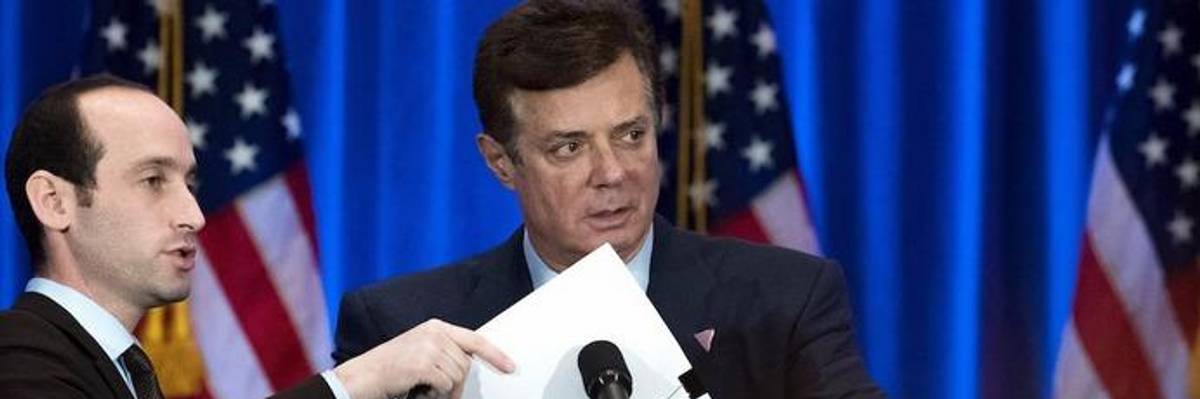
Paul Manafort (r), at a campaign event with Trump senior adviser Stephen Miller, during the 2016 presidential campaign. (Photo: Drew Angerer/Getty Images)
After a weekend of speculation about the possibility of indictments, the New York Times was the first to report that former chairman of President Donald Trump's 2016 presidential campaign Paul Manafort, along with his former business associate and top deputy Rick Gates, were ordered to surrender themselves to federal authorities on Monday.
The specific charges against Manafort and Gates contained in the indictment include conspiracy to launder money, failing to register as a foreign agent, false statements, and multiple counts of failing to file reports for foreign bank accounts.
And while nothing in the indictment appears to be directly related to collusion with Russia or activities with the Trump campaign, the Times reports that these are the first charges under the direction of Robert Mueller III and "represent a significant escalation in [his] special counsel investigation that has cast a shadow over the president's first year in office."
According to Times journalist Matt Apuzzo, speaking with MSNBC this morning after the frontpage broke, Manafort agreed to turn himself in. In its reporting, the Associated Press has confirmed that Gates will also submit to authorities.
Subsequently, Manafort and his attorney were seen entering the FBI field office in Washington, DC:
The AP reports:
Manafort has been one of Mueller's prime targets. Earlier this year, FBI agents raided Manafort's home, searching for tax and international banking records. Manafort has been a subject of a longstanding FBI investigation into his dealings in Ukraine and work for the country's former president, Viktor Yanukovych. That investigation was incorporated into Mueller's broader probe.
In Gates, Mueller brings in not just Manafort's chief deputy, but a key player from Trump's campaign who survived past Manafort's ouster last summer. As of two weeks ago, Gates was still working for Tom Barrack, a Trump confidant, helping with the closeout of the inauguration committee's campaign account.
Offering his perspective, MSNBC's legal analyst Ari Melber posted this analysis on Facebook, which included:
Indictments can mark the end or the beginning of an investigation. These look like a beginning.
That is because we know Mueller is not done with his interviews, and has apparently not finished interviewing the highest level people in the White House, or all the people who attended the Trump Tower meeting.
Indictments in the middle of an investigation can also put other targets on notice, if they have reason to believe the investigation will focus on them next.
On social media, the reaction was swift, with many noting that Manafort, despite the White House's attempt to downplay it, played a central role in the Trump campaign and that Gates, though he lacks the same kind of name recognition, was also a key player in GOP politics in 2016.
Others pointed out that this should be considered a pivotal moment in Mueller's Trump-Russia probe, but certainly not the end of the story:
Dear Common Dreams reader, It’s been nearly 30 years since I co-founded Common Dreams with my late wife, Lina Newhouser. We had the radical notion that journalism should serve the public good, not corporate profits. It was clear to us from the outset what it would take to build such a project. No paid advertisements. No corporate sponsors. No millionaire publisher telling us what to think or do. Many people said we wouldn't last a year, but we proved those doubters wrong. Together with a tremendous team of journalists and dedicated staff, we built an independent media outlet free from the constraints of profits and corporate control. Our mission has always been simple: To inform. To inspire. To ignite change for the common good. Building Common Dreams was not easy. Our survival was never guaranteed. When you take on the most powerful forces—Wall Street greed, fossil fuel industry destruction, Big Tech lobbyists, and uber-rich oligarchs who have spent billions upon billions rigging the economy and democracy in their favor—the only bulwark you have is supporters who believe in your work. But here’s the urgent message from me today. It's never been this bad out there. And it's never been this hard to keep us going. At the very moment Common Dreams is most needed, the threats we face are intensifying. We need your support now more than ever. We don't accept corporate advertising and never will. We don't have a paywall because we don't think people should be blocked from critical news based on their ability to pay. Everything we do is funded by the donations of readers like you. When everyone does the little they can afford, we are strong. But if that support retreats or dries up, so do we. Will you donate now to make sure Common Dreams not only survives but thrives? —Craig Brown, Co-founder |
After a weekend of speculation about the possibility of indictments, the New York Times was the first to report that former chairman of President Donald Trump's 2016 presidential campaign Paul Manafort, along with his former business associate and top deputy Rick Gates, were ordered to surrender themselves to federal authorities on Monday.
The specific charges against Manafort and Gates contained in the indictment include conspiracy to launder money, failing to register as a foreign agent, false statements, and multiple counts of failing to file reports for foreign bank accounts.
And while nothing in the indictment appears to be directly related to collusion with Russia or activities with the Trump campaign, the Times reports that these are the first charges under the direction of Robert Mueller III and "represent a significant escalation in [his] special counsel investigation that has cast a shadow over the president's first year in office."
According to Times journalist Matt Apuzzo, speaking with MSNBC this morning after the frontpage broke, Manafort agreed to turn himself in. In its reporting, the Associated Press has confirmed that Gates will also submit to authorities.
Subsequently, Manafort and his attorney were seen entering the FBI field office in Washington, DC:
The AP reports:
Manafort has been one of Mueller's prime targets. Earlier this year, FBI agents raided Manafort's home, searching for tax and international banking records. Manafort has been a subject of a longstanding FBI investigation into his dealings in Ukraine and work for the country's former president, Viktor Yanukovych. That investigation was incorporated into Mueller's broader probe.
In Gates, Mueller brings in not just Manafort's chief deputy, but a key player from Trump's campaign who survived past Manafort's ouster last summer. As of two weeks ago, Gates was still working for Tom Barrack, a Trump confidant, helping with the closeout of the inauguration committee's campaign account.
Offering his perspective, MSNBC's legal analyst Ari Melber posted this analysis on Facebook, which included:
Indictments can mark the end or the beginning of an investigation. These look like a beginning.
That is because we know Mueller is not done with his interviews, and has apparently not finished interviewing the highest level people in the White House, or all the people who attended the Trump Tower meeting.
Indictments in the middle of an investigation can also put other targets on notice, if they have reason to believe the investigation will focus on them next.
On social media, the reaction was swift, with many noting that Manafort, despite the White House's attempt to downplay it, played a central role in the Trump campaign and that Gates, though he lacks the same kind of name recognition, was also a key player in GOP politics in 2016.
Others pointed out that this should be considered a pivotal moment in Mueller's Trump-Russia probe, but certainly not the end of the story:
After a weekend of speculation about the possibility of indictments, the New York Times was the first to report that former chairman of President Donald Trump's 2016 presidential campaign Paul Manafort, along with his former business associate and top deputy Rick Gates, were ordered to surrender themselves to federal authorities on Monday.
The specific charges against Manafort and Gates contained in the indictment include conspiracy to launder money, failing to register as a foreign agent, false statements, and multiple counts of failing to file reports for foreign bank accounts.
And while nothing in the indictment appears to be directly related to collusion with Russia or activities with the Trump campaign, the Times reports that these are the first charges under the direction of Robert Mueller III and "represent a significant escalation in [his] special counsel investigation that has cast a shadow over the president's first year in office."
According to Times journalist Matt Apuzzo, speaking with MSNBC this morning after the frontpage broke, Manafort agreed to turn himself in. In its reporting, the Associated Press has confirmed that Gates will also submit to authorities.
Subsequently, Manafort and his attorney were seen entering the FBI field office in Washington, DC:
The AP reports:
Manafort has been one of Mueller's prime targets. Earlier this year, FBI agents raided Manafort's home, searching for tax and international banking records. Manafort has been a subject of a longstanding FBI investigation into his dealings in Ukraine and work for the country's former president, Viktor Yanukovych. That investigation was incorporated into Mueller's broader probe.
In Gates, Mueller brings in not just Manafort's chief deputy, but a key player from Trump's campaign who survived past Manafort's ouster last summer. As of two weeks ago, Gates was still working for Tom Barrack, a Trump confidant, helping with the closeout of the inauguration committee's campaign account.
Offering his perspective, MSNBC's legal analyst Ari Melber posted this analysis on Facebook, which included:
Indictments can mark the end or the beginning of an investigation. These look like a beginning.
That is because we know Mueller is not done with his interviews, and has apparently not finished interviewing the highest level people in the White House, or all the people who attended the Trump Tower meeting.
Indictments in the middle of an investigation can also put other targets on notice, if they have reason to believe the investigation will focus on them next.
On social media, the reaction was swift, with many noting that Manafort, despite the White House's attempt to downplay it, played a central role in the Trump campaign and that Gates, though he lacks the same kind of name recognition, was also a key player in GOP politics in 2016.
Others pointed out that this should be considered a pivotal moment in Mueller's Trump-Russia probe, but certainly not the end of the story: