"This groundbreaking accomplishment, brought about by the persistence of civic groups, election officials, and legislators, means a quarter of Americans now live in a state where AVR has been approved. We hope other states will follow suit," said Jonathan Brater with the Brennan Center's Democracy program.
In 'Huge Leap Forward,' Illinois Becomes 10th State With Automatic Voter Registration
"This is what democracy looks like!"
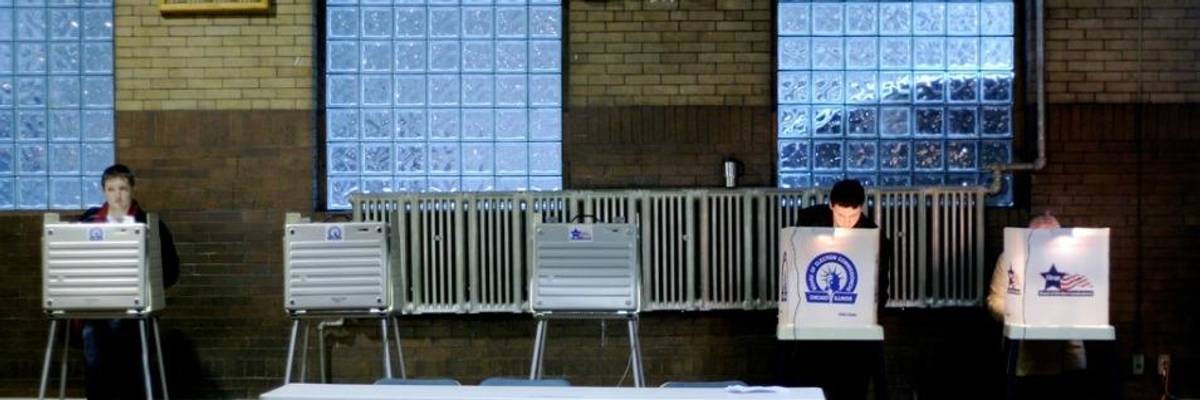
In a time of increased efforts to restrict access to the polls, Illinois took a step in the opposite direction, becoming on Monday the 10th state to enact automatic voter registration (AVR).
This "is a huge leap forward," said Jonathan Brater, counsel with the Brennan Center's Democracy program. "This groundbreaking accomplishment, brought about by the persistence of civic groups, election officials, and legislators, means a quarter of Americans now live in a state where AVR has been approved. We hope other states will follow suit."
Republican Gov. Bruce Rauner signed the bill after state legislators unanimously passed the measure in late May. Prospective voters will be automatically registered at the Secretary of State's office when obtaining a driver's license or state ID, unless they choose to opt out. The bill's proponents call it a "win-win-win," as it strengthens democracy by adding voters to the rolls, cuts down on errors, and decreases paperwork.
According to the Associated Press,
Most of the changes will take place ahead of the November 2018 election when Rauner is seeking a second term, including a major update of voter files and registrations through the Secretary of State's offices, which in Illinois provides motor services for drivers. Other agencies will be on board by July 2019.
"We are proud of our work to bring over 1 million eligible voters into the electoral process in Illinois," said Brian Gladstein, executive director of Common Cause Illinois, one of the groups behind the
Individuals and advocacy groups who'd supported the bill celebrated the news on Twitter:
We are at a crossroads
This country and this world are at a monumental crossroads. In a few short weeks, US voters will have an opportunity to beat back the forces of fascism and confront the billionaires who are rigging the economy, our media system, and our democracy, making it increasingly impossible for ordinary people to get by. We’re not just talking about the election. We’re talking about what must be done once these fascist elements are vanquished from power. We need a bolder set of solutions than what either major party has so far been willing to offer and a working-class movement ready to fight like hell for it. Trump didn't emerge from nowhere. The conditions that fueled MAGA authoritarianism were created by decades of radical neoliberal economic policies and a corrupt political system dominated by corporate interests. They slashed taxes on the super-rich, promising that the benefits would trickle down. They said giveaways to the corporate titans would make life more affordable for the rest of us. It was all bullshit. And when a bitter, betrayed populace searches for someone to blame, right-wing demagogues have little trouble finding scapegoats. People know when they're being lied to, but you won't hear any of this from the corporate media. Only independent journalism—powered and funded by people who believe in building a better world—can deliver truly trustworthy daily news. Our Fall Campaign is underway, and we need your help. To power our newsroom through the rest of the year, we need to raise $125,000 by midnight on October 31. So if you share our vision, please contribute whatever you can to sustain our work. |
In a time of increased efforts to restrict access to the polls, Illinois took a step in the opposite direction, becoming on Monday the 10th state to enact automatic voter registration (AVR).
This "is a huge leap forward," said Jonathan Brater, counsel with the Brennan Center's Democracy program. "This groundbreaking accomplishment, brought about by the persistence of civic groups, election officials, and legislators, means a quarter of Americans now live in a state where AVR has been approved. We hope other states will follow suit."
Republican Gov. Bruce Rauner signed the bill after state legislators unanimously passed the measure in late May. Prospective voters will be automatically registered at the Secretary of State's office when obtaining a driver's license or state ID, unless they choose to opt out. The bill's proponents call it a "win-win-win," as it strengthens democracy by adding voters to the rolls, cuts down on errors, and decreases paperwork.
According to the Associated Press,
Most of the changes will take place ahead of the November 2018 election when Rauner is seeking a second term, including a major update of voter files and registrations through the Secretary of State's offices, which in Illinois provides motor services for drivers. Other agencies will be on board by July 2019.
"We are proud of our work to bring over 1 million eligible voters into the electoral process in Illinois," said Brian Gladstein, executive director of Common Cause Illinois, one of the groups behind the
Individuals and advocacy groups who'd supported the bill celebrated the news on Twitter:
In a time of increased efforts to restrict access to the polls, Illinois took a step in the opposite direction, becoming on Monday the 10th state to enact automatic voter registration (AVR).
This "is a huge leap forward," said Jonathan Brater, counsel with the Brennan Center's Democracy program. "This groundbreaking accomplishment, brought about by the persistence of civic groups, election officials, and legislators, means a quarter of Americans now live in a state where AVR has been approved. We hope other states will follow suit."
Republican Gov. Bruce Rauner signed the bill after state legislators unanimously passed the measure in late May. Prospective voters will be automatically registered at the Secretary of State's office when obtaining a driver's license or state ID, unless they choose to opt out. The bill's proponents call it a "win-win-win," as it strengthens democracy by adding voters to the rolls, cuts down on errors, and decreases paperwork.
According to the Associated Press,
Most of the changes will take place ahead of the November 2018 election when Rauner is seeking a second term, including a major update of voter files and registrations through the Secretary of State's offices, which in Illinois provides motor services for drivers. Other agencies will be on board by July 2019.
"We are proud of our work to bring over 1 million eligible voters into the electoral process in Illinois," said Brian Gladstein, executive director of Common Cause Illinois, one of the groups behind the
Individuals and advocacy groups who'd supported the bill celebrated the news on Twitter: