SUBSCRIBE TO OUR FREE NEWSLETTER
Daily news & progressive opinion—funded by the people, not the corporations—delivered straight to your inbox.
5
#000000
#FFFFFF
To donate by check, phone, or other method, see our More Ways to Give page.
Daily news & progressive opinion—funded by the people, not the corporations—delivered straight to your inbox.
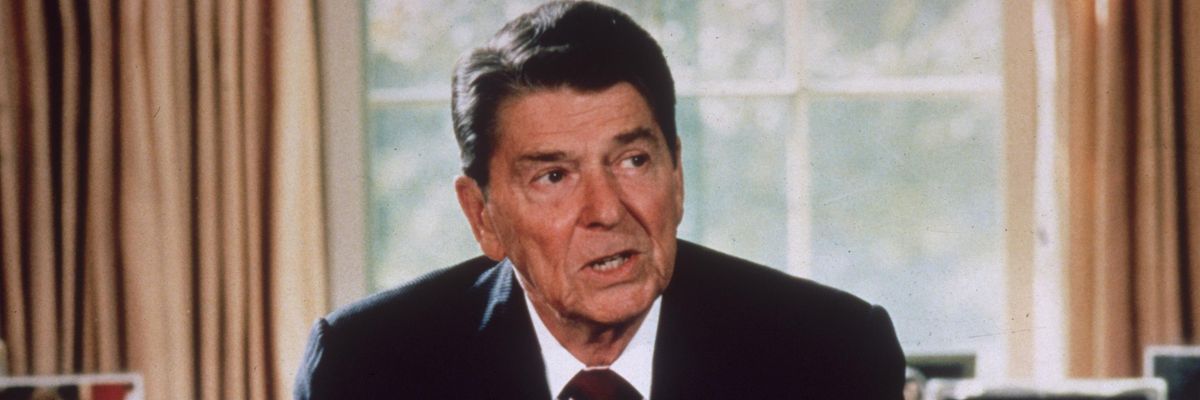
President Ronald Reagan, whose administration saw a five percent drop in American workers' union membership, is being inducted into the Department of Labor's Hall of Honor. (Photo: Hulton Archive/Getty Images)
A month after beginning to roll back the Obama administration's rules making more Americans eligible for overtime pay, Donald Trump's Department of Labor again displayed a lack of concern for workers when it announced its very first inductee to its Hall of Honor would be President Ronald Reagan, "who openly and actively diminished the power of American labor unions."
The Hall of Honor is meant "to honor Americans whose distinctive contributions have elevated working conditions, wages, and overall quality of life for American families." While Reagan had been the president of the Screen Actors Guild during his acting career, his most significant labor-related action during his two terms in the White House was his firing of 11,000 striking air traffic controllers in 1981
The workers had walked out of their jobs when negotiations with the Federal Aviation Administration stalled. The air traffic controllers' union, whose members perform a job that's been recognized as one of the most high-stress occupations, had been seeking annual wage increases of $10,000 and a reduction of their weekly hours from 40 to 32.
Reagan's abrupt dismissal of the workers represented a change in politicians' relationship with American workers. Union membership declined by about five percent during Reagan's term, and labor historian Joseph A. McCartin has noted that the event put in motion a shift in how Republican leaders interact with the labor movement.
"Gov. Scott Walker of Wisconsin invoked Reagan's handling of [the strike] as he prepared to 'change history' by stripping public employees of collective bargaining rights in a party-line vote," he wrote in a New York Times editorial in 2011.
Critics, including union organizers, spoke out against Reagan's induction on social media, noting the irony of the choice.
The department's announcement coincided with a new report by the Economic Policy Institute, released Thursday, showing the decline in union membership over the last four decades and its impact on workers. "Since the 1970s, declining unionization has fueled rising inequality and stalled economic progress for the broad American middle class," says the report. "When unions are weak, the highest incomes go up even more, but when unions are strong, middle incomes go up."
The Labor Department's decision to honor Reagan suggests that the Trump administration is equating his contributions to the labor movement with those of past inductees including social justice organizers Eugene Debs and Bayard Rustin, the Chinese workers who fought for safer working conditions while completing the transcontinental railroad in the 19th century, and the Memphis sanitation workers who unionized after staging huge peaceful protest marches.
Dear Common Dreams reader, It’s been nearly 30 years since I co-founded Common Dreams with my late wife, Lina Newhouser. We had the radical notion that journalism should serve the public good, not corporate profits. It was clear to us from the outset what it would take to build such a project. No paid advertisements. No corporate sponsors. No millionaire publisher telling us what to think or do. Many people said we wouldn't last a year, but we proved those doubters wrong. Together with a tremendous team of journalists and dedicated staff, we built an independent media outlet free from the constraints of profits and corporate control. Our mission has always been simple: To inform. To inspire. To ignite change for the common good. Building Common Dreams was not easy. Our survival was never guaranteed. When you take on the most powerful forces—Wall Street greed, fossil fuel industry destruction, Big Tech lobbyists, and uber-rich oligarchs who have spent billions upon billions rigging the economy and democracy in their favor—the only bulwark you have is supporters who believe in your work. But here’s the urgent message from me today. It's never been this bad out there. And it's never been this hard to keep us going. At the very moment Common Dreams is most needed, the threats we face are intensifying. We need your support now more than ever. We don't accept corporate advertising and never will. We don't have a paywall because we don't think people should be blocked from critical news based on their ability to pay. Everything we do is funded by the donations of readers like you. When everyone does the little they can afford, we are strong. But if that support retreats or dries up, so do we. Will you donate now to make sure Common Dreams not only survives but thrives? —Craig Brown, Co-founder |
A month after beginning to roll back the Obama administration's rules making more Americans eligible for overtime pay, Donald Trump's Department of Labor again displayed a lack of concern for workers when it announced its very first inductee to its Hall of Honor would be President Ronald Reagan, "who openly and actively diminished the power of American labor unions."
The Hall of Honor is meant "to honor Americans whose distinctive contributions have elevated working conditions, wages, and overall quality of life for American families." While Reagan had been the president of the Screen Actors Guild during his acting career, his most significant labor-related action during his two terms in the White House was his firing of 11,000 striking air traffic controllers in 1981
The workers had walked out of their jobs when negotiations with the Federal Aviation Administration stalled. The air traffic controllers' union, whose members perform a job that's been recognized as one of the most high-stress occupations, had been seeking annual wage increases of $10,000 and a reduction of their weekly hours from 40 to 32.
Reagan's abrupt dismissal of the workers represented a change in politicians' relationship with American workers. Union membership declined by about five percent during Reagan's term, and labor historian Joseph A. McCartin has noted that the event put in motion a shift in how Republican leaders interact with the labor movement.
"Gov. Scott Walker of Wisconsin invoked Reagan's handling of [the strike] as he prepared to 'change history' by stripping public employees of collective bargaining rights in a party-line vote," he wrote in a New York Times editorial in 2011.
Critics, including union organizers, spoke out against Reagan's induction on social media, noting the irony of the choice.
The department's announcement coincided with a new report by the Economic Policy Institute, released Thursday, showing the decline in union membership over the last four decades and its impact on workers. "Since the 1970s, declining unionization has fueled rising inequality and stalled economic progress for the broad American middle class," says the report. "When unions are weak, the highest incomes go up even more, but when unions are strong, middle incomes go up."
The Labor Department's decision to honor Reagan suggests that the Trump administration is equating his contributions to the labor movement with those of past inductees including social justice organizers Eugene Debs and Bayard Rustin, the Chinese workers who fought for safer working conditions while completing the transcontinental railroad in the 19th century, and the Memphis sanitation workers who unionized after staging huge peaceful protest marches.
A month after beginning to roll back the Obama administration's rules making more Americans eligible for overtime pay, Donald Trump's Department of Labor again displayed a lack of concern for workers when it announced its very first inductee to its Hall of Honor would be President Ronald Reagan, "who openly and actively diminished the power of American labor unions."
The Hall of Honor is meant "to honor Americans whose distinctive contributions have elevated working conditions, wages, and overall quality of life for American families." While Reagan had been the president of the Screen Actors Guild during his acting career, his most significant labor-related action during his two terms in the White House was his firing of 11,000 striking air traffic controllers in 1981
The workers had walked out of their jobs when negotiations with the Federal Aviation Administration stalled. The air traffic controllers' union, whose members perform a job that's been recognized as one of the most high-stress occupations, had been seeking annual wage increases of $10,000 and a reduction of their weekly hours from 40 to 32.
Reagan's abrupt dismissal of the workers represented a change in politicians' relationship with American workers. Union membership declined by about five percent during Reagan's term, and labor historian Joseph A. McCartin has noted that the event put in motion a shift in how Republican leaders interact with the labor movement.
"Gov. Scott Walker of Wisconsin invoked Reagan's handling of [the strike] as he prepared to 'change history' by stripping public employees of collective bargaining rights in a party-line vote," he wrote in a New York Times editorial in 2011.
Critics, including union organizers, spoke out against Reagan's induction on social media, noting the irony of the choice.
The department's announcement coincided with a new report by the Economic Policy Institute, released Thursday, showing the decline in union membership over the last four decades and its impact on workers. "Since the 1970s, declining unionization has fueled rising inequality and stalled economic progress for the broad American middle class," says the report. "When unions are weak, the highest incomes go up even more, but when unions are strong, middle incomes go up."
The Labor Department's decision to honor Reagan suggests that the Trump administration is equating his contributions to the labor movement with those of past inductees including social justice organizers Eugene Debs and Bayard Rustin, the Chinese workers who fought for safer working conditions while completing the transcontinental railroad in the 19th century, and the Memphis sanitation workers who unionized after staging huge peaceful protest marches.