SUBSCRIBE TO OUR FREE NEWSLETTER
Daily news & progressive opinion—funded by the people, not the corporations—delivered straight to your inbox.
5
#000000
#FFFFFF
To donate by check, phone, or other method, see our More Ways to Give page.
Daily news & progressive opinion—funded by the people, not the corporations—delivered straight to your inbox.
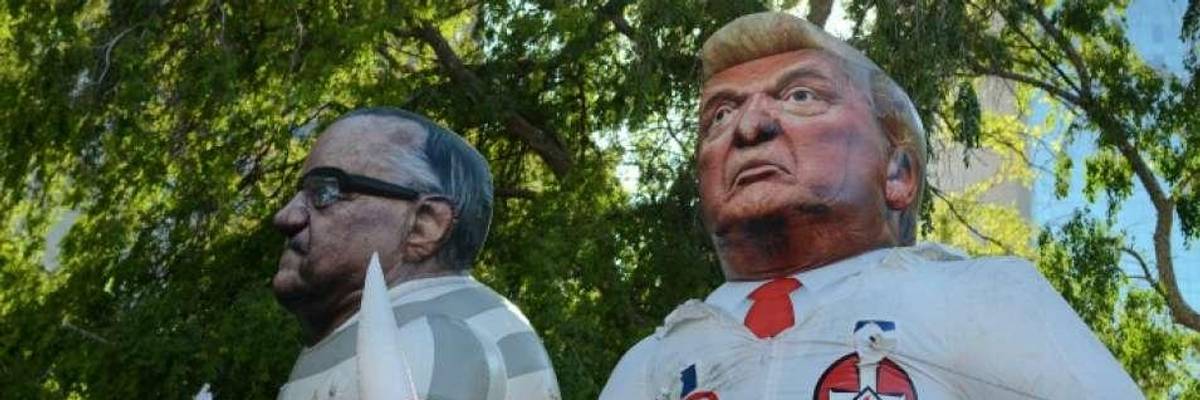
Inflatable figures of President Donald Trump in KKK garb and former Sheriff Joe Arpaio in prisoner uniform outide a rally in Phoenix, Arizona on Tuesday, August 22. (Photo: Monica D. Spencer/flickr/cc)
Human rights groups and advocates were outraged when President Donald Trump, from his controversial rally in Arizona Tuesday night, strongly implied he would pardon Joe Arpaio, the notorious former sheriff of Maricopa County who has been convicted of violating a federal court order to stop discriminating against Latinos in his county.
"So was sheriff Joe convicted for doing his job?" Trump asked a roaring crowd. "I'll make a prediction: I think he's going to be just fine, OK?" Trump said of Arpaio, who is scheduled to be sentenced in October. "But I won't do it tonight because I don't want to cause any controversy."
Watch:
The condemnation was swift:
The president's remarks Tuesday followed his admission to Fox News last week that he was "seriously considering" a pardon for the former sheriff. Trump's relationship with Arpaio pre-dates his presidency, and as Vox notes, "Arpaio played a key role in validating Donald Trump, whose candidacy was initially seen as a joke, as the champion of hardline immigration policies and the cultural anxieties that came alongside them." Arpaio participated in Trump's first major campaign rally in Phoenix in August 2015, and that following January the former sheriff formally endorsed Trump for president.
As Trump continued his long-winded and bizarre speech from Arizona on Tuesday night, rights advocates began raising alarms over renewed concerns that 85-year-old Arpaio won't be held accountable for demonstrating, as the judge put it, a "flagrant disregard" for the court mandate to stop systemically racially profiling and detaining county residents based on suspicions about their immigration status.
The American Civil Liberties Union (ACLU) began circulating a petition, and offered five reasons Arpaio wasn't just "doing his job." In addition to highlighting his racial profiling of Latinos, the ACLU acknowledges denouncements of the former sheriff's actions from the Justice Department and federal courts, outlines the conditions of his infamous Tent City, and details accusations that Arpaio "ignored hundreds of sex crime cases," all while using his powerful position to intimidate his critics.
Calling the potential pardon a "direct attack on the rule of law, as well as the U.S. Constitution," ACLU deputy legal director Cecillia Wang explained the history and established precedents for the presidential pardon in a series of tweets:
Many other rights advocates, legal experts, and journalists condemned Arpaio's pending pardon on Twitter:
Dear Common Dreams reader, It’s been nearly 30 years since I co-founded Common Dreams with my late wife, Lina Newhouser. We had the radical notion that journalism should serve the public good, not corporate profits. It was clear to us from the outset what it would take to build such a project. No paid advertisements. No corporate sponsors. No millionaire publisher telling us what to think or do. Many people said we wouldn't last a year, but we proved those doubters wrong. Together with a tremendous team of journalists and dedicated staff, we built an independent media outlet free from the constraints of profits and corporate control. Our mission has always been simple: To inform. To inspire. To ignite change for the common good. Building Common Dreams was not easy. Our survival was never guaranteed. When you take on the most powerful forces—Wall Street greed, fossil fuel industry destruction, Big Tech lobbyists, and uber-rich oligarchs who have spent billions upon billions rigging the economy and democracy in their favor—the only bulwark you have is supporters who believe in your work. But here’s the urgent message from me today. It's never been this bad out there. And it's never been this hard to keep us going. At the very moment Common Dreams is most needed, the threats we face are intensifying. We need your support now more than ever. We don't accept corporate advertising and never will. We don't have a paywall because we don't think people should be blocked from critical news based on their ability to pay. Everything we do is funded by the donations of readers like you. When everyone does the little they can afford, we are strong. But if that support retreats or dries up, so do we. Will you donate now to make sure Common Dreams not only survives but thrives? —Craig Brown, Co-founder |
Human rights groups and advocates were outraged when President Donald Trump, from his controversial rally in Arizona Tuesday night, strongly implied he would pardon Joe Arpaio, the notorious former sheriff of Maricopa County who has been convicted of violating a federal court order to stop discriminating against Latinos in his county.
"So was sheriff Joe convicted for doing his job?" Trump asked a roaring crowd. "I'll make a prediction: I think he's going to be just fine, OK?" Trump said of Arpaio, who is scheduled to be sentenced in October. "But I won't do it tonight because I don't want to cause any controversy."
Watch:
The condemnation was swift:
The president's remarks Tuesday followed his admission to Fox News last week that he was "seriously considering" a pardon for the former sheriff. Trump's relationship with Arpaio pre-dates his presidency, and as Vox notes, "Arpaio played a key role in validating Donald Trump, whose candidacy was initially seen as a joke, as the champion of hardline immigration policies and the cultural anxieties that came alongside them." Arpaio participated in Trump's first major campaign rally in Phoenix in August 2015, and that following January the former sheriff formally endorsed Trump for president.
As Trump continued his long-winded and bizarre speech from Arizona on Tuesday night, rights advocates began raising alarms over renewed concerns that 85-year-old Arpaio won't be held accountable for demonstrating, as the judge put it, a "flagrant disregard" for the court mandate to stop systemically racially profiling and detaining county residents based on suspicions about their immigration status.
The American Civil Liberties Union (ACLU) began circulating a petition, and offered five reasons Arpaio wasn't just "doing his job." In addition to highlighting his racial profiling of Latinos, the ACLU acknowledges denouncements of the former sheriff's actions from the Justice Department and federal courts, outlines the conditions of his infamous Tent City, and details accusations that Arpaio "ignored hundreds of sex crime cases," all while using his powerful position to intimidate his critics.
Calling the potential pardon a "direct attack on the rule of law, as well as the U.S. Constitution," ACLU deputy legal director Cecillia Wang explained the history and established precedents for the presidential pardon in a series of tweets:
Many other rights advocates, legal experts, and journalists condemned Arpaio's pending pardon on Twitter:
Human rights groups and advocates were outraged when President Donald Trump, from his controversial rally in Arizona Tuesday night, strongly implied he would pardon Joe Arpaio, the notorious former sheriff of Maricopa County who has been convicted of violating a federal court order to stop discriminating against Latinos in his county.
"So was sheriff Joe convicted for doing his job?" Trump asked a roaring crowd. "I'll make a prediction: I think he's going to be just fine, OK?" Trump said of Arpaio, who is scheduled to be sentenced in October. "But I won't do it tonight because I don't want to cause any controversy."
Watch:
The condemnation was swift:
The president's remarks Tuesday followed his admission to Fox News last week that he was "seriously considering" a pardon for the former sheriff. Trump's relationship with Arpaio pre-dates his presidency, and as Vox notes, "Arpaio played a key role in validating Donald Trump, whose candidacy was initially seen as a joke, as the champion of hardline immigration policies and the cultural anxieties that came alongside them." Arpaio participated in Trump's first major campaign rally in Phoenix in August 2015, and that following January the former sheriff formally endorsed Trump for president.
As Trump continued his long-winded and bizarre speech from Arizona on Tuesday night, rights advocates began raising alarms over renewed concerns that 85-year-old Arpaio won't be held accountable for demonstrating, as the judge put it, a "flagrant disregard" for the court mandate to stop systemically racially profiling and detaining county residents based on suspicions about their immigration status.
The American Civil Liberties Union (ACLU) began circulating a petition, and offered five reasons Arpaio wasn't just "doing his job." In addition to highlighting his racial profiling of Latinos, the ACLU acknowledges denouncements of the former sheriff's actions from the Justice Department and federal courts, outlines the conditions of his infamous Tent City, and details accusations that Arpaio "ignored hundreds of sex crime cases," all while using his powerful position to intimidate his critics.
Calling the potential pardon a "direct attack on the rule of law, as well as the U.S. Constitution," ACLU deputy legal director Cecillia Wang explained the history and established precedents for the presidential pardon in a series of tweets:
Many other rights advocates, legal experts, and journalists condemned Arpaio's pending pardon on Twitter: