SUBSCRIBE TO OUR FREE NEWSLETTER
Daily news & progressive opinion—funded by the people, not the corporations—delivered straight to your inbox.
5
#000000
#FFFFFF
To donate by check, phone, or other method, see our More Ways to Give page.
With a climate denier in the Oval Office, a "fossil fuel puppet" heading the Environmental Protection Agency, and Big Oil lobbyists filling the ranks of secretive deregulatory teams, a new report by National Oceanic and Atmospheric Administration (NOAA) confirmed that 2016 was the hottest--and in some ways most alarming--year on record.
"Today's remarkably hot temperatures, caused by human carbon pollution, are a sign of what's to come. If we don't get global warming under control, the consequences will indeed be bad."
--Dana Nuccitelli, the GuardianThe report--based on contributions from over 450 scientists from nearly 60 countries--is the most detailed climate assessment that has emerged from a government agency since Donald Trump became president, a fact that raised questions about how it will be received by the White House.
Released annually, the NOAA's State of the Climate report (pdf) has contained consistently "frightening" results over the last several years.
But as The Atlantic's Robinson Meyer notes, 2016 appears to have been "altogether exceptional," and not in a good way.
The agency's executive summary alone--which contains seven bullet points detailing how 2016 was a particularly bad year for the climate--was sufficient to deeply concern many activists, scientists, and lawmakers.
In 2016, the report found:
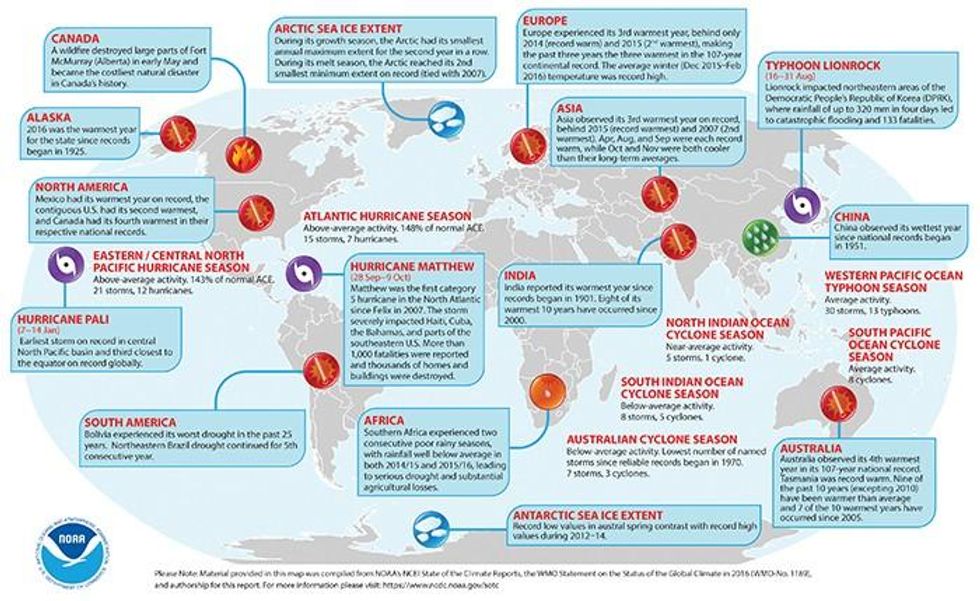
The report also included a graphic (click image for version) that highlighted the impact such metrics had throughout the globe, from severe wildfires in Canada to sweltering heat in India.
Upon the report's release, commentators were quick to ask pointed questions about whether Trump--who has called climate change a "hoax"--or members of his administration would even so much as acknowledge the results, let alone do anything about them.
Trump's budget proposals from earlier this year provide some indication of how he feels about the agency that produced the analysis.
In March, the Washington Post obtained a budget memo showing that the Trump administration intended to slash NOAA funding by 17 percent, a cut that former NOAA chief scientist Rick Spinrad said would "jeopardiz[e] the safety of the American public."
This, along with the fact that the EPA is reportedly taking deregulatory directions from the fossil fuel industry, has many analysts seriously alarmed about the near future.
"Today's remarkably hot temperatures, caused by human carbon pollution, are a sign of what's to come," writes the Guardian's Dana Nuccitelli. "If we don't get global warming under control, the consequences will indeed be bad.
With a climate denier in the Oval Office, a "fossil fuel puppet" heading the Environmental Protection Agency, and Big Oil lobbyists filling the ranks of secretive deregulatory teams, a new report by National Oceanic and Atmospheric Administration (NOAA) confirmed that 2016 was the hottest--and in some ways most alarming--year on record.
"Today's remarkably hot temperatures, caused by human carbon pollution, are a sign of what's to come. If we don't get global warming under control, the consequences will indeed be bad."
--Dana Nuccitelli, the GuardianThe report--based on contributions from over 450 scientists from nearly 60 countries--is the most detailed climate assessment that has emerged from a government agency since Donald Trump became president, a fact that raised questions about how it will be received by the White House.
Released annually, the NOAA's State of the Climate report (pdf) has contained consistently "frightening" results over the last several years.
But as The Atlantic's Robinson Meyer notes, 2016 appears to have been "altogether exceptional," and not in a good way.
The agency's executive summary alone--which contains seven bullet points detailing how 2016 was a particularly bad year for the climate--was sufficient to deeply concern many activists, scientists, and lawmakers.
In 2016, the report found:
The report also included a graphic (click image for version) that highlighted the impact such metrics had throughout the globe, from severe wildfires in Canada to sweltering heat in India.
Upon the report's release, commentators were quick to ask pointed questions about whether Trump--who has called climate change a "hoax"--or members of his administration would even so much as acknowledge the results, let alone do anything about them.
Trump's budget proposals from earlier this year provide some indication of how he feels about the agency that produced the analysis.
In March, the Washington Post obtained a budget memo showing that the Trump administration intended to slash NOAA funding by 17 percent, a cut that former NOAA chief scientist Rick Spinrad said would "jeopardiz[e] the safety of the American public."
This, along with the fact that the EPA is reportedly taking deregulatory directions from the fossil fuel industry, has many analysts seriously alarmed about the near future.
"Today's remarkably hot temperatures, caused by human carbon pollution, are a sign of what's to come," writes the Guardian's Dana Nuccitelli. "If we don't get global warming under control, the consequences will indeed be bad.
With a climate denier in the Oval Office, a "fossil fuel puppet" heading the Environmental Protection Agency, and Big Oil lobbyists filling the ranks of secretive deregulatory teams, a new report by National Oceanic and Atmospheric Administration (NOAA) confirmed that 2016 was the hottest--and in some ways most alarming--year on record.
"Today's remarkably hot temperatures, caused by human carbon pollution, are a sign of what's to come. If we don't get global warming under control, the consequences will indeed be bad."
--Dana Nuccitelli, the GuardianThe report--based on contributions from over 450 scientists from nearly 60 countries--is the most detailed climate assessment that has emerged from a government agency since Donald Trump became president, a fact that raised questions about how it will be received by the White House.
Released annually, the NOAA's State of the Climate report (pdf) has contained consistently "frightening" results over the last several years.
But as The Atlantic's Robinson Meyer notes, 2016 appears to have been "altogether exceptional," and not in a good way.
The agency's executive summary alone--which contains seven bullet points detailing how 2016 was a particularly bad year for the climate--was sufficient to deeply concern many activists, scientists, and lawmakers.
In 2016, the report found:
The report also included a graphic (click image for version) that highlighted the impact such metrics had throughout the globe, from severe wildfires in Canada to sweltering heat in India.
Upon the report's release, commentators were quick to ask pointed questions about whether Trump--who has called climate change a "hoax"--or members of his administration would even so much as acknowledge the results, let alone do anything about them.
Trump's budget proposals from earlier this year provide some indication of how he feels about the agency that produced the analysis.
In March, the Washington Post obtained a budget memo showing that the Trump administration intended to slash NOAA funding by 17 percent, a cut that former NOAA chief scientist Rick Spinrad said would "jeopardiz[e] the safety of the American public."
This, along with the fact that the EPA is reportedly taking deregulatory directions from the fossil fuel industry, has many analysts seriously alarmed about the near future.
"Today's remarkably hot temperatures, caused by human carbon pollution, are a sign of what's to come," writes the Guardian's Dana Nuccitelli. "If we don't get global warming under control, the consequences will indeed be bad.