SUBSCRIBE TO OUR FREE NEWSLETTER
Daily news & progressive opinion—funded by the people, not the corporations—delivered straight to your inbox.
5
#000000
#FFFFFF
To donate by check, phone, or other method, see our More Ways to Give page.
Daily news & progressive opinion—funded by the people, not the corporations—delivered straight to your inbox.
A group of five Democratic U.S. senators has demanded to know whether Wells Fargo--recently slapped by regulators with a $185 million fine for creating millions of unauthorized bank and credit card accounts, racking up fees for consumers and bonuses for employees--intends on rescinding compensation to executives behind the "staggering fraud."
In their letter (pdf) sent Thursday to Wells Fargo chairman and CEO John G. Stumpf, Elizabeth Warren (Mass.), Sherrod Brown (Ohio), Jack Reed (R.I.), Robert Menendez (N.J.), and Jeff Merkley (Ore.), all members of the Republican-led Senate Banking Committee, ask whether the bank will invoke its clawback provision, "designed to prevent exactly what happened with Ms. Toldstedt: shareholders and consumers bearing the burden of bank misconduct while senior executives walk away with multi-million dollar awards based on what the company later finds out are fraudulent practices."
That's Carrie Tolstedt, the former senior executive vice president of community banking, the division that led the fraudulent incentive-compensation program.
The senators write that Tolstedt
was also rewarded with more than $20 million in annual bonuses between 2010 and 2015, which Wells Fargo publicly justified in certain instances by noting the "strong cross-sell ratios" her division had achieved. That is a direct reference to the extraordinary number of accounts created by her division, many of which were never authorized by customers.
Ms. Tolstedt announced her retirement from the bank on July 12th of this year. Ms. Tolstedt retired at age 56, just two months before Wells Fargo entered into the settlement with the CFPB [Consumer Financial Protection Bureau] and other entities. Her retirement triggered an even more lucrative reward: as much as $125 million in stock options and restricted stock shares.
Following her retirement announcement, Stumpf praised Tolstedt as "a standard-bearer of our culture" and "a champion for our customers." CFPB head Richard Cordray, meanwhile, denounced the unit she led, saying it committed "unfair and abusive practices under federal law."
The senators demand an answer about the clawback by Sept. 19, the day before Stumpf is scheduled to testify before the committee.
As the Huffington Post's Zach Carter writes Friday of the letter to Stumpf: "When Warren asks him to re-evaluate prior executive payouts, she's asking him to consider ponying up part of his own fortune."
Carter notes:
Stumpf received $19.3 million from Wells Fargo in both 2014 and 2013. He was the highest-paid big bank CEO in 2012, pocketing $22.9 million, as reported by The Wall Street Journal. He has served as the company's CEO since the summer of 2007.
The senators "weren't shy about its implications for his own bank account," Carter writes.
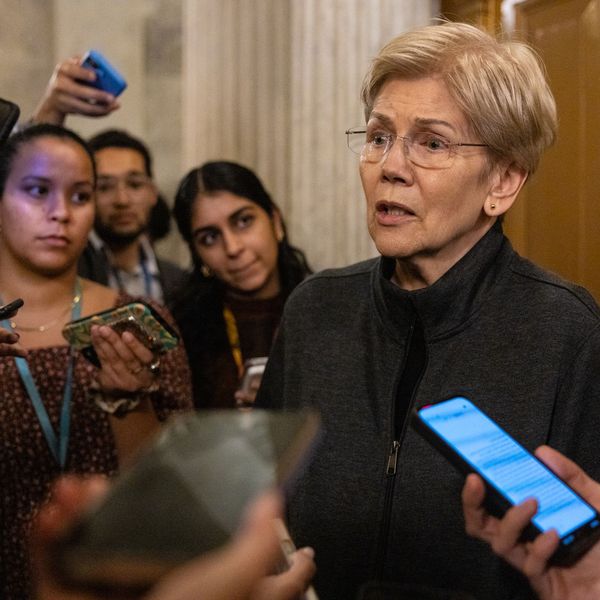
Speaking last week about Wells Fargo to CNN, Sen. Warren said its behavior was "flatly wrong," and said either the bank knew what was going on or it didn't.
"It's a bank, right? They're supposed to keep track of people's money, safety, security, and not know what more than 5,000 of your employees are doing? If they really didn't know, then that tells me that this is a bank that is simply too big to manage."
The senators' letter comes as the House this week passed legislation described as "a gift to the Big Banks, that would extend their 'license to steal' and tear down hard-fought banking regulations, some of which have not yet been implemented."
In his column Thursday entitled "Thanks, Wells Fargo, for Being Such a Bunch of Weasels," the Los Angeles Times' David Lazarus wrote that the bank "has made a powerful case for why regulatory oversight is crucial and why the banking industry remains unworthy of the public's trust."
Dear Common Dreams reader, It’s been nearly 30 years since I co-founded Common Dreams with my late wife, Lina Newhouser. We had the radical notion that journalism should serve the public good, not corporate profits. It was clear to us from the outset what it would take to build such a project. No paid advertisements. No corporate sponsors. No millionaire publisher telling us what to think or do. Many people said we wouldn't last a year, but we proved those doubters wrong. Together with a tremendous team of journalists and dedicated staff, we built an independent media outlet free from the constraints of profits and corporate control. Our mission has always been simple: To inform. To inspire. To ignite change for the common good. Building Common Dreams was not easy. Our survival was never guaranteed. When you take on the most powerful forces—Wall Street greed, fossil fuel industry destruction, Big Tech lobbyists, and uber-rich oligarchs who have spent billions upon billions rigging the economy and democracy in their favor—the only bulwark you have is supporters who believe in your work. But here’s the urgent message from me today. It's never been this bad out there. And it's never been this hard to keep us going. At the very moment Common Dreams is most needed, the threats we face are intensifying. We need your support now more than ever. We don't accept corporate advertising and never will. We don't have a paywall because we don't think people should be blocked from critical news based on their ability to pay. Everything we do is funded by the donations of readers like you. When everyone does the little they can afford, we are strong. But if that support retreats or dries up, so do we. Will you donate now to make sure Common Dreams not only survives but thrives? —Craig Brown, Co-founder |
A group of five Democratic U.S. senators has demanded to know whether Wells Fargo--recently slapped by regulators with a $185 million fine for creating millions of unauthorized bank and credit card accounts, racking up fees for consumers and bonuses for employees--intends on rescinding compensation to executives behind the "staggering fraud."
In their letter (pdf) sent Thursday to Wells Fargo chairman and CEO John G. Stumpf, Elizabeth Warren (Mass.), Sherrod Brown (Ohio), Jack Reed (R.I.), Robert Menendez (N.J.), and Jeff Merkley (Ore.), all members of the Republican-led Senate Banking Committee, ask whether the bank will invoke its clawback provision, "designed to prevent exactly what happened with Ms. Toldstedt: shareholders and consumers bearing the burden of bank misconduct while senior executives walk away with multi-million dollar awards based on what the company later finds out are fraudulent practices."
That's Carrie Tolstedt, the former senior executive vice president of community banking, the division that led the fraudulent incentive-compensation program.
The senators write that Tolstedt
was also rewarded with more than $20 million in annual bonuses between 2010 and 2015, which Wells Fargo publicly justified in certain instances by noting the "strong cross-sell ratios" her division had achieved. That is a direct reference to the extraordinary number of accounts created by her division, many of which were never authorized by customers.
Ms. Tolstedt announced her retirement from the bank on July 12th of this year. Ms. Tolstedt retired at age 56, just two months before Wells Fargo entered into the settlement with the CFPB [Consumer Financial Protection Bureau] and other entities. Her retirement triggered an even more lucrative reward: as much as $125 million in stock options and restricted stock shares.
Following her retirement announcement, Stumpf praised Tolstedt as "a standard-bearer of our culture" and "a champion for our customers." CFPB head Richard Cordray, meanwhile, denounced the unit she led, saying it committed "unfair and abusive practices under federal law."
The senators demand an answer about the clawback by Sept. 19, the day before Stumpf is scheduled to testify before the committee.
As the Huffington Post's Zach Carter writes Friday of the letter to Stumpf: "When Warren asks him to re-evaluate prior executive payouts, she's asking him to consider ponying up part of his own fortune."
Carter notes:
Stumpf received $19.3 million from Wells Fargo in both 2014 and 2013. He was the highest-paid big bank CEO in 2012, pocketing $22.9 million, as reported by The Wall Street Journal. He has served as the company's CEO since the summer of 2007.
The senators "weren't shy about its implications for his own bank account," Carter writes.
Speaking last week about Wells Fargo to CNN, Sen. Warren said its behavior was "flatly wrong," and said either the bank knew what was going on or it didn't.
"It's a bank, right? They're supposed to keep track of people's money, safety, security, and not know what more than 5,000 of your employees are doing? If they really didn't know, then that tells me that this is a bank that is simply too big to manage."
The senators' letter comes as the House this week passed legislation described as "a gift to the Big Banks, that would extend their 'license to steal' and tear down hard-fought banking regulations, some of which have not yet been implemented."
In his column Thursday entitled "Thanks, Wells Fargo, for Being Such a Bunch of Weasels," the Los Angeles Times' David Lazarus wrote that the bank "has made a powerful case for why regulatory oversight is crucial and why the banking industry remains unworthy of the public's trust."
A group of five Democratic U.S. senators has demanded to know whether Wells Fargo--recently slapped by regulators with a $185 million fine for creating millions of unauthorized bank and credit card accounts, racking up fees for consumers and bonuses for employees--intends on rescinding compensation to executives behind the "staggering fraud."
In their letter (pdf) sent Thursday to Wells Fargo chairman and CEO John G. Stumpf, Elizabeth Warren (Mass.), Sherrod Brown (Ohio), Jack Reed (R.I.), Robert Menendez (N.J.), and Jeff Merkley (Ore.), all members of the Republican-led Senate Banking Committee, ask whether the bank will invoke its clawback provision, "designed to prevent exactly what happened with Ms. Toldstedt: shareholders and consumers bearing the burden of bank misconduct while senior executives walk away with multi-million dollar awards based on what the company later finds out are fraudulent practices."
That's Carrie Tolstedt, the former senior executive vice president of community banking, the division that led the fraudulent incentive-compensation program.
The senators write that Tolstedt
was also rewarded with more than $20 million in annual bonuses between 2010 and 2015, which Wells Fargo publicly justified in certain instances by noting the "strong cross-sell ratios" her division had achieved. That is a direct reference to the extraordinary number of accounts created by her division, many of which were never authorized by customers.
Ms. Tolstedt announced her retirement from the bank on July 12th of this year. Ms. Tolstedt retired at age 56, just two months before Wells Fargo entered into the settlement with the CFPB [Consumer Financial Protection Bureau] and other entities. Her retirement triggered an even more lucrative reward: as much as $125 million in stock options and restricted stock shares.
Following her retirement announcement, Stumpf praised Tolstedt as "a standard-bearer of our culture" and "a champion for our customers." CFPB head Richard Cordray, meanwhile, denounced the unit she led, saying it committed "unfair and abusive practices under federal law."
The senators demand an answer about the clawback by Sept. 19, the day before Stumpf is scheduled to testify before the committee.
As the Huffington Post's Zach Carter writes Friday of the letter to Stumpf: "When Warren asks him to re-evaluate prior executive payouts, she's asking him to consider ponying up part of his own fortune."
Carter notes:
Stumpf received $19.3 million from Wells Fargo in both 2014 and 2013. He was the highest-paid big bank CEO in 2012, pocketing $22.9 million, as reported by The Wall Street Journal. He has served as the company's CEO since the summer of 2007.
The senators "weren't shy about its implications for his own bank account," Carter writes.
Speaking last week about Wells Fargo to CNN, Sen. Warren said its behavior was "flatly wrong," and said either the bank knew what was going on or it didn't.
"It's a bank, right? They're supposed to keep track of people's money, safety, security, and not know what more than 5,000 of your employees are doing? If they really didn't know, then that tells me that this is a bank that is simply too big to manage."
The senators' letter comes as the House this week passed legislation described as "a gift to the Big Banks, that would extend their 'license to steal' and tear down hard-fought banking regulations, some of which have not yet been implemented."
In his column Thursday entitled "Thanks, Wells Fargo, for Being Such a Bunch of Weasels," the Los Angeles Times' David Lazarus wrote that the bank "has made a powerful case for why regulatory oversight is crucial and why the banking industry remains unworthy of the public's trust."