
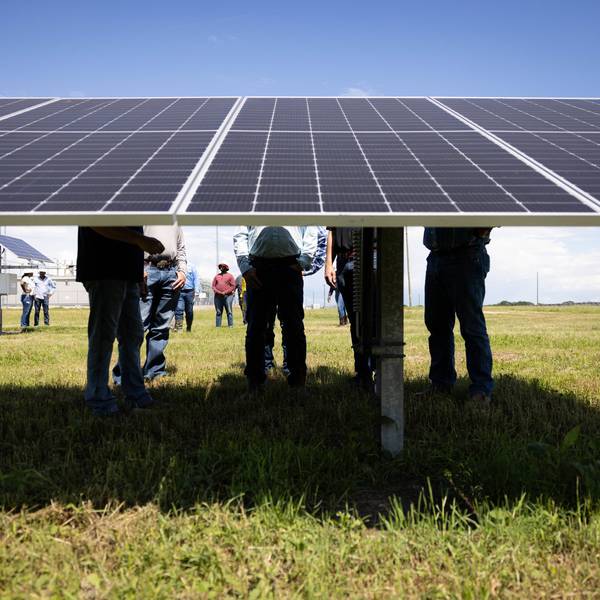
Outlook is Sunny: Solar Energy On Track for Its Best Year Ever
"Year after year, we’re seeing the demand for solar energy in America skyrocket."
The U.S. solar market is poised to have its best year in history, according to new statistics released Wednesday by GTM Research and the Solar Energy Industries Association (SEIA).
The record-breaking numbers show that 30 percent of all new electric generating capacity "brought on-line" in the first three quarters of the year was from solar energy, and more than half of U.S. states have installed more than 50 megawatts (MW) of solar photovoltaic (PV) cells.
With that in mind, the upcoming fourth quarter is likely to hit the ground running, with the U.S. expected to install more than three gigawatts (GW) of solar energy.
"This past quarter marked the calm before the storm," said GTM Research senior solar analyst Cory Honeyman.
"Year after year, we're seeing the demand for solar energy in America skyrocket, and the benefits that brings to both our nation's economy and environment are staggering," said SEIA president Rhone Resch on Wednesday.
The statistics come just as a coalition of international renewable energy organizations gathered at the United Nations climate summit this week to demonstrate that the solar revolution is already possible.
The International Renewable Energy (REN) Alliance gathered at COP21 on Wednesday to highlight case studies of communities throughout the world that have put "high-penetration combinations of renewable energy technologies" in place.
In fact, the industry is expanding even as international financial institutions continue prioritizing other energy sources, such as the fossil fuel industry. The Institute for Policy Studies reported in October that the World Bank "is still providing more than 1.5 times the funding for fossil fuel projects as for renewable energy projects...support for coal and gas projects has been especially strong."
Yet Peter Bosshard, interim executive director for the environmental nonprofit International Rivers, wrote in an op-ed for Common Dreams in June, "The future belongs to wind and solar power."
Also in June, Quartz reported that the industry's unprecedented growth had already led to "an increasing number of people [being] employed by the renewable industry in 2014."
"[T]he industry may be hitting the critical mass it needs to become unassailable," Quartz's Cassie Werber wrote.
On Wednesday, GTM Research predicted that 2016 will be an even bigger year for solar, with cumulative PV installations expected to double between now and the end of next year, and the U.S. projected to "finish 2016 with a total cumulative capacity of 41 GW of solar PV."
As Common Dreams reported in May, when statistics indicated that consumer support of solar power was starting to change the energy game, "the solar revolution is coming."
We are at a crossroads
This country and this world are at a monumental crossroads. In a few short weeks, US voters will have an opportunity to beat back the forces of fascism and confront the billionaires who are rigging the economy, our media system, and our democracy, making it increasingly impossible for ordinary people to get by. We’re not just talking about the election. We’re talking about what must be done once these fascist elements are vanquished from power. We need a bolder set of solutions than what either major party has so far been willing to offer and a working-class movement ready to fight like hell for it. Trump didn't emerge from nowhere. The conditions that fueled MAGA authoritarianism were created by decades of radical neoliberal economic policies and a corrupt political system dominated by corporate interests. They slashed taxes on the super-rich, promising that the benefits would trickle down. They said giveaways to the corporate titans would make life more affordable for the rest of us. It was all bullshit. And when a bitter, betrayed populace searches for someone to blame, right-wing demagogues have little trouble finding scapegoats. People know when they're being lied to, but you won't hear any of this from the corporate media. Only independent journalism—powered and funded by people who believe in building a better world—can deliver truly trustworthy daily news. Our Fall Campaign is underway, and we need your help. To power our newsroom through the rest of the year, we need to raise $125,000 by midnight on October 31. So if you share our vision, please contribute whatever you can to sustain our work. |
The U.S. solar market is poised to have its best year in history, according to new statistics released Wednesday by GTM Research and the Solar Energy Industries Association (SEIA).
The record-breaking numbers show that 30 percent of all new electric generating capacity "brought on-line" in the first three quarters of the year was from solar energy, and more than half of U.S. states have installed more than 50 megawatts (MW) of solar photovoltaic (PV) cells.
With that in mind, the upcoming fourth quarter is likely to hit the ground running, with the U.S. expected to install more than three gigawatts (GW) of solar energy.
"This past quarter marked the calm before the storm," said GTM Research senior solar analyst Cory Honeyman.
"Year after year, we're seeing the demand for solar energy in America skyrocket, and the benefits that brings to both our nation's economy and environment are staggering," said SEIA president Rhone Resch on Wednesday.
The statistics come just as a coalition of international renewable energy organizations gathered at the United Nations climate summit this week to demonstrate that the solar revolution is already possible.
The International Renewable Energy (REN) Alliance gathered at COP21 on Wednesday to highlight case studies of communities throughout the world that have put "high-penetration combinations of renewable energy technologies" in place.
In fact, the industry is expanding even as international financial institutions continue prioritizing other energy sources, such as the fossil fuel industry. The Institute for Policy Studies reported in October that the World Bank "is still providing more than 1.5 times the funding for fossil fuel projects as for renewable energy projects...support for coal and gas projects has been especially strong."
Yet Peter Bosshard, interim executive director for the environmental nonprofit International Rivers, wrote in an op-ed for Common Dreams in June, "The future belongs to wind and solar power."
Also in June, Quartz reported that the industry's unprecedented growth had already led to "an increasing number of people [being] employed by the renewable industry in 2014."
"[T]he industry may be hitting the critical mass it needs to become unassailable," Quartz's Cassie Werber wrote.
On Wednesday, GTM Research predicted that 2016 will be an even bigger year for solar, with cumulative PV installations expected to double between now and the end of next year, and the U.S. projected to "finish 2016 with a total cumulative capacity of 41 GW of solar PV."
As Common Dreams reported in May, when statistics indicated that consumer support of solar power was starting to change the energy game, "the solar revolution is coming."
The U.S. solar market is poised to have its best year in history, according to new statistics released Wednesday by GTM Research and the Solar Energy Industries Association (SEIA).
The record-breaking numbers show that 30 percent of all new electric generating capacity "brought on-line" in the first three quarters of the year was from solar energy, and more than half of U.S. states have installed more than 50 megawatts (MW) of solar photovoltaic (PV) cells.
With that in mind, the upcoming fourth quarter is likely to hit the ground running, with the U.S. expected to install more than three gigawatts (GW) of solar energy.
"This past quarter marked the calm before the storm," said GTM Research senior solar analyst Cory Honeyman.
"Year after year, we're seeing the demand for solar energy in America skyrocket, and the benefits that brings to both our nation's economy and environment are staggering," said SEIA president Rhone Resch on Wednesday.
The statistics come just as a coalition of international renewable energy organizations gathered at the United Nations climate summit this week to demonstrate that the solar revolution is already possible.
The International Renewable Energy (REN) Alliance gathered at COP21 on Wednesday to highlight case studies of communities throughout the world that have put "high-penetration combinations of renewable energy technologies" in place.
In fact, the industry is expanding even as international financial institutions continue prioritizing other energy sources, such as the fossil fuel industry. The Institute for Policy Studies reported in October that the World Bank "is still providing more than 1.5 times the funding for fossil fuel projects as for renewable energy projects...support for coal and gas projects has been especially strong."
Yet Peter Bosshard, interim executive director for the environmental nonprofit International Rivers, wrote in an op-ed for Common Dreams in June, "The future belongs to wind and solar power."
Also in June, Quartz reported that the industry's unprecedented growth had already led to "an increasing number of people [being] employed by the renewable industry in 2014."
"[T]he industry may be hitting the critical mass it needs to become unassailable," Quartz's Cassie Werber wrote.
On Wednesday, GTM Research predicted that 2016 will be an even bigger year for solar, with cumulative PV installations expected to double between now and the end of next year, and the U.S. projected to "finish 2016 with a total cumulative capacity of 41 GW of solar PV."
As Common Dreams reported in May, when statistics indicated that consumer support of solar power was starting to change the energy game, "the solar revolution is coming."