

SUBSCRIBE TO OUR FREE NEWSLETTER
Daily news & progressive opinion—funded by the people, not the corporations—delivered straight to your inbox.
5
#000000
#FFFFFF
To donate by check, phone, or other method, see our More Ways to Give page.
Police in Taiwan shot water cannons on anti-nuclear protesters Monday following a weekend in which the power of throngs of demonstrators brought the construction of a controversial plant to a halt.
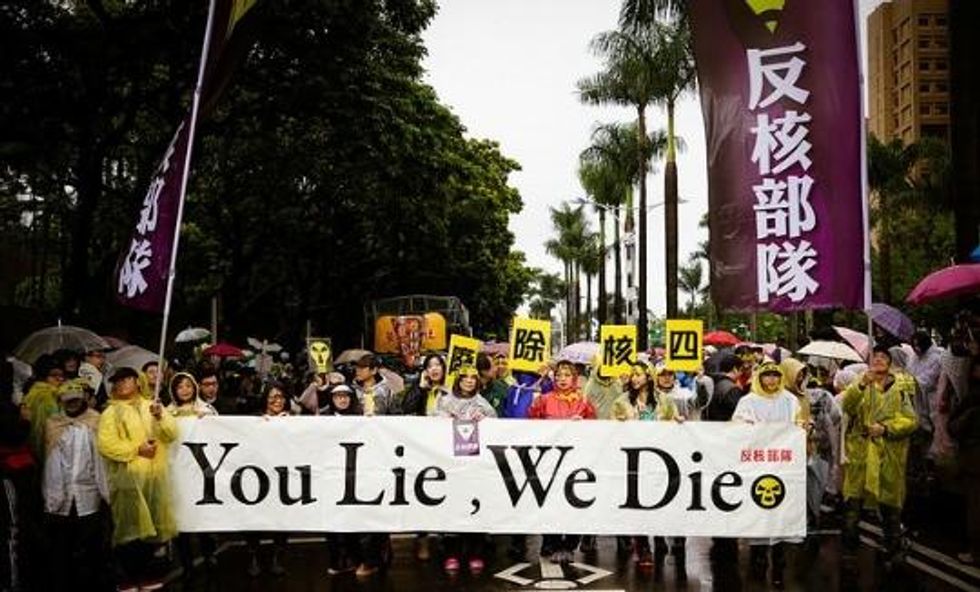
On Sunday as many as 50,000 protesters poured into Taipei's streets, blockading thoroughfares and calling for Taiwan's fourth nuclear power plant to be scrapped. Its slated home is New Taipei City, the most populous city in the seismically active state.
Public pressure against the plant was aided by a hunger strike undertaken by former opposition leader and anti-nuclear activist Lin Yi-xiong, who said he was forced to take the measure because authorities had refused to heed overwhelming public opposition to the plant.
The ruling Kuomintang party announced later Sunday that it was suspending the $9.4 billion Nuke 4, located in the northeast corner of the Taiwan.
The New York Times reports:
The Kuomintang announcement said that the first reactor on the Lungmen plant, which is near completion, would undergo safety testing and then be mothballed. Work will stop on the second reactor, and a referendum will then be held to determine whether the plant, also commonly known as No. 4, will be completed and go online, the announcement said.
Channel News Asia reports that the halt "is a concession to protesters, but is a far cry from giving in to their demands of abolishing it altogether."
Some protesters remained after the announcement, and a massive police force was seen unleashing water cannons at the protesters.
Nuclear power, which has faced mounting public opposition since the Fukushima disaster, currently provides about 18 percent of Taiwan's energy.
A similar anti-nuclear protest held last month urged the government to "to face anti-nuclear demands from the people."
__________________
Police in Taiwan shot water cannons on anti-nuclear protesters Monday following a weekend in which the power of throngs of demonstrators brought the construction of a controversial plant to a halt.
On Sunday as many as 50,000 protesters poured into Taipei's streets, blockading thoroughfares and calling for Taiwan's fourth nuclear power plant to be scrapped. Its slated home is New Taipei City, the most populous city in the seismically active state.
Public pressure against the plant was aided by a hunger strike undertaken by former opposition leader and anti-nuclear activist Lin Yi-xiong, who said he was forced to take the measure because authorities had refused to heed overwhelming public opposition to the plant.
The ruling Kuomintang party announced later Sunday that it was suspending the $9.4 billion Nuke 4, located in the northeast corner of the Taiwan.
The New York Times reports:
The Kuomintang announcement said that the first reactor on the Lungmen plant, which is near completion, would undergo safety testing and then be mothballed. Work will stop on the second reactor, and a referendum will then be held to determine whether the plant, also commonly known as No. 4, will be completed and go online, the announcement said.
Channel News Asia reports that the halt "is a concession to protesters, but is a far cry from giving in to their demands of abolishing it altogether."
Some protesters remained after the announcement, and a massive police force was seen unleashing water cannons at the protesters.
Nuclear power, which has faced mounting public opposition since the Fukushima disaster, currently provides about 18 percent of Taiwan's energy.
A similar anti-nuclear protest held last month urged the government to "to face anti-nuclear demands from the people."
__________________
Police in Taiwan shot water cannons on anti-nuclear protesters Monday following a weekend in which the power of throngs of demonstrators brought the construction of a controversial plant to a halt.
On Sunday as many as 50,000 protesters poured into Taipei's streets, blockading thoroughfares and calling for Taiwan's fourth nuclear power plant to be scrapped. Its slated home is New Taipei City, the most populous city in the seismically active state.
Public pressure against the plant was aided by a hunger strike undertaken by former opposition leader and anti-nuclear activist Lin Yi-xiong, who said he was forced to take the measure because authorities had refused to heed overwhelming public opposition to the plant.
The ruling Kuomintang party announced later Sunday that it was suspending the $9.4 billion Nuke 4, located in the northeast corner of the Taiwan.
The New York Times reports:
The Kuomintang announcement said that the first reactor on the Lungmen plant, which is near completion, would undergo safety testing and then be mothballed. Work will stop on the second reactor, and a referendum will then be held to determine whether the plant, also commonly known as No. 4, will be completed and go online, the announcement said.
Channel News Asia reports that the halt "is a concession to protesters, but is a far cry from giving in to their demands of abolishing it altogether."
Some protesters remained after the announcement, and a massive police force was seen unleashing water cannons at the protesters.
Nuclear power, which has faced mounting public opposition since the Fukushima disaster, currently provides about 18 percent of Taiwan's energy.
A similar anti-nuclear protest held last month urged the government to "to face anti-nuclear demands from the people."
__________________

